The grotesque brilliance of Dead Souls begins with a loophole that should sound merely technical. Pavel Chichikov wants to buy deceased serfs who still exist in the revision lists, the census records by which landowners remained fiscally responsible until the next official count. A dead person, if the paperwork has not caught up, remains taxable. If that same paper identity can be acquired cheaply, it might also be mortgaged as if it were a live asset. Gogol's plot is a fraud, but its horror is more basic: the world has already agreed to treat persons as entries before Chichikov arrives to exploit the delay.[1]
That is why the novel is more than a satire of one confidence man. Chichikov does not invent dehumanization. He notices a system in which human beings are called souls, counted as property, taxed through lists, moved through offices, and discussed at dinner as units of estate management. The absurdity of buying dead souls is possible because living souls have already been made administratively transferable. Gogol's philosophical sting lies there. The dead are not the first people to be reduced. They are the exposed remainder of a reduction that polite society has normalized.[1][4]
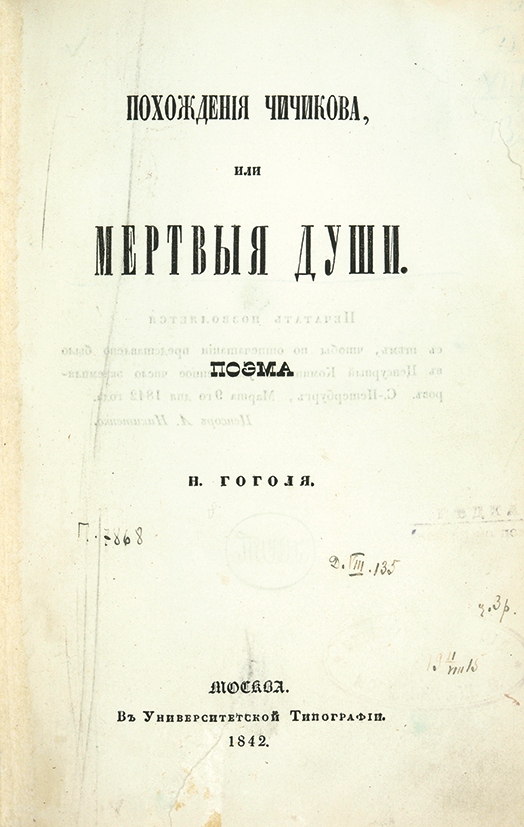
Image context: the cover image is a scan of the 1842 Moscow title page, where the book presents itself as the wanderings of Chichikov, or Dead Souls, and pointedly calls itself a poem. The page matters here because the novel's whole joke is also a document joke: a title page, a revision list, a deed, a mortgage, and a rumor all become ways of making absence circulate as value.[5]
A census mistake becomes a moral instrument
Gogol could have built the plot around stolen money, forged jewels, or a hidden inheritance. Instead he chooses a paper lag. The Project Gutenberg edition's introduction explains the machinery plainly: serf censuses were periodic, and landowners could still be taxed on registered serfs who had died in the interval. Chichikov's proposed bargain relieves owners of a burden while giving him fictive collateral.[1] The scheme is ridiculous only if one still assumes that the record should answer to the body. In Gogol's Russia, the record is already powerful enough to make the absent body economically active.
That delay between life and documentation gives the book its governing metaphor. A dead serf remains alive in fiscal language. A living landowner may be spiritually dead while appearing socially correct. Chichikov himself is almost all surface: agreeable manners, adjustable opinions, a competence for entering rooms, flattering officials, and discovering what each person wants to hear. The title's double pressure depends on that crossing. "Dead souls" names the purchased names, but it also names a world whose moral faculties have learned to function after conscience has gone missing.
This is why the famous premise should not be read as a gimmick. It is a test. Put the idea of buying dead peasants in front of each landowner, and Gogol can measure the hidden shape of that person's mind. Manilov dissolves into sentimental vagueness. Korobochka worries about being cheated. Nozdryov turns everything into swagger and improvisation. Sobakevich prices the dead as if their old physical strengths still added value. Plyushkin's decay turns accumulation itself into a sickness. Each transaction asks the same question: when a human remainder becomes negotiable, what does your reflex reveal?
Chichikov wins by sounding normal
The disturbing part is not that Chichikov sounds monstrous. He often sounds practical. When Korobochka hesitates, his impatience cuts through the scene: the "dead souls are good for NOTHING AT ALL," he argues, except as a burden he is willing to take off her hands.[1] The sentence is funny because it is economically plausible and morally obscene at once. He is correct within the rules of the transaction. That correctness is the indictment.
Gogol's comedy keeps returning to this doubled effect. The reader laughs because the negotiations are absurdly literal: how much should a dead peasant cost, whether the buyer is trustworthy, whether another buyer might offer a better price, whether the list should include names, whether paperwork can be completed in proper order. Yet the laughter keeps catching on the word "soul." A culture that uses a spiritual noun for a property unit has already made language do corrupting work before any individual fraud begins.
Oxford's current edition page frames Dead Souls through Chichikov as a dismissed civil servant turned confidence man, and Yale's edition page similarly places the novel among Gogol's central works beside The Inspector-General, "The Nose," and "The Overcoat."[2][4] That company matters. Gogol's signature territory is not evil in grand tragic costume. It is bureaucracy, appetite, official language, bodily detail, social performance, and the surreal moment when ordinary procedure reveals itself as spiritually deranged.
Chichikov belongs exactly there. He is not a Mephistopheles descending from outside the province. He is a skilled reader of available incentives. He understands that some people want status, some want safety, some want entertainment, some want to out-negotiate, and almost everyone wants their own self-image reflected back attractively. His charm is therefore not decoration around the plot. It is the plot's social technology. He can buy the dead because he knows how to flatter the living.
The disorder is the design
A tidy reform novel would make Chichikov the villain and the exposed system the lesson. Gogol does something harder. He makes the book itself unstable: part picaresque journey, part social anatomy, part grotesque catalogue, part lyrical outburst, part sermon that cannot fully trust its own sermonizing. The Google Books bibliographic page for Susanne Fusso's Designing Dead Souls: An Anatomy of Disorder in Gogol is useful here because its very title names a central reading problem: disorder is not a flaw to be cleaned away from the novel. It is one of its methods.[3]
The famous anecdote preserved in the Gutenberg introduction, that Pushkin heard Gogol read and exclaimed, "God! What a sad country Russia is!", catches the same tonal difficulty.[1] The book is hilariously full of foolishness, but its laughter does not release the reader from sadness. If anything, comedy sharpens the sadness because the characters are not spectacular enough to be safely dismissed. They are petty, vain, fearful, hungry, bored, ceremonious, proud, sentimental, and acquisitive. They are recognizably human in lowered form.
That lowering is Gogol's philosophical pressure. The novel asks what happens when moral life is not dramatically rejected but thinned by habit. No one has to make a manifesto against human dignity. A census does part of the work. A tax system does part of the work. A mortgage fantasy does part of the work. Polite conversation does part of the work. Chichikov merely connects the pieces into a deal.
The result is a satire without a clean outside. The officials who gather rumors about Chichikov are ridiculous too. Their desire to classify him becomes another version of the same paper hunger: is he a spy, a counterfeiter, a runaway captain, Napoleon in disguise? Once the dead souls scheme disturbs the town, imagination does not become moral clarity. It becomes bureaucratic panic with better costumes.
Why the title page calls it a poem
The 1842 title page is useful because it reminds us that Gogol did not simply offer a "novel" in the later realist sense. He called Dead Souls a poem.[5] That word can sound odd if one expects poetry to mean lyric compression or elevated feeling. But in this book the claim makes sense. Gogol wants amplitude: roads, estates, dinners, clerks, rumors, lists, faces, horses, furniture, weather, moral aside, national lament. He wants prose with the sweep of a wandering form, not a plot that behaves like a closed machine.
The unfinished state of the larger project intensifies that effect. The Gutenberg introduction describes Gogol's struggle with completion and the destruction of manuscripts for the later parts.[1] Yale's edition page, meanwhile, stresses the problem of translating Gogol's style, with its exuberant, erratic, bizarre energies.[4] Those details matter because Dead Souls is not powerful despite its incompletion and tonal unevenness. It is powerful because its form keeps exposing a world that cannot be made morally symmetrical.
Chichikov's journey therefore feels less like progress than circulation. He moves from person to person, estate to estate, appetite to appetite. The scheme gains paper mass, but the moral world does not clarify. Each stop adds another proof that value has become detached from life. Money can be imagined from names. Status can be imagined from ownership. Respectability can be performed before anyone knows what it rests on. Society itself becomes a coach road along which dead signs keep traveling.
That is why Dead Souls still feels fresh rather than merely antique. Its specific institution is Russian serfdom before emancipation; its deeper mechanism is more portable. A person can become an entry. An entry can become collateral. Collateral can become ambition. Ambition can become manners. Manners can become social proof. At every stage, language makes the conversion feel less violent than it is.
Gogol's final cruelty is that the title never stops working. The dead souls on Chichikov's lists are victims of a system that counted them before it lost them. The living souls around him are not free from that system; they keep reproducing it in speech, hospitality, bargaining, suspicion, and self-display. Even Gogol's laughter turns against itself. As the introduction puts it in one of the sharpest formulations attached to him, "Everything that I laughed at became sad."[1]
The sadness is earned. Dead Souls shows a society in which paperwork does not merely record moral failure after the fact. It helps create the conditions under which failure becomes ordinary. That is the book's philosophical force: Chichikov can only buy dead people because the living have already agreed to live by documents that do not know the difference.
Sources
- Nikolai Gogol, Dead Souls, Project Gutenberg HTML text, including the C. J. Hogarth translation and introductory context on the dead-souls scheme.
- Oxford University Press, Dead Souls (Oxford World's Classics edition page, Christopher English translation and Robert Maguire introduction).
- Google Books, Susanne Fusso, Designing Dead Souls: An Anatomy of Disorder in Gogol (Stanford University Press, 1993 bibliographic page).
- Yale University Press, Dead Souls, edited by Susanne Fusso and translated by Bernard Guilbert Guerney, edition and author context.
- Wikimedia Commons, "File:Dead Souls (novel) Nikolai Gogol 1842 title page.jpg," source page for the 1842 first-edition title-page image used as the cover.