
Audre Lorde's 1974 Poetry Center reading looks, at first, like a plain archival fragment: a poet at a microphone, a small room, a manuscript, a few minutes from a longer evening. The recording is more than that. It catches Lorde at the point where book, classroom, city, and public wound are all entering the same voice. She is not yet the simplified late-century icon of classroom quotations and anthology introductions. She is a working poet, reading from a manuscript that would become New York Head Shop and Museum, and using the room to test how poem, diagnosis, and witness can occupy one pressure system.[1][2][3]
The date matters. On September 26, 1974, The Poetry Center at San Francisco State University presented Lorde with Etheridge Knight, both reading work tied to Dudley Randall's Detroit-based Broadside Press.[2] The archive record notes that Lorde reads from the manuscript of New York Head Shop and Museum, which she says is forthcoming later that year, and also reads a recent poem responding to the police killing of a young Black child in New York City.[2] That pairing gives the footage its force. Lorde is not moving from "literary" poems to "political" poems as if those were separate rooms. The reading insists that urban life, institutional speech, racial violence, teaching, and lyric compression are already one field of poetic labor.
By 1974, Lorde had already moved through several crucial thresholds. The Academy of American Poets places The First Cities in 1968, Cables to Rage in 1970, and From a Land Where Other People Live in 1973, the last of which was nominated for a National Book Award.[4] The same biographical account identifies New York Head Shop and Museum as the point at which her poetry became her most political work to date.[4] That phrase can sound like a simple escalation, but the archival reading shows something subtler. Lorde's politics do not arrive as slogans pasted onto poems. They arrive as address, arrangement, and cadence: what the voice chooses to hold together without smoothing.
Broadside Press is part of that story. The Smithsonian's National Museum of African American History and Culture preserves a 1974 copy of New York Head Shop and Museum, identifying it as a Broadside Press book and placing it under the Black Arts Movement, Black Press, feminism, literature, race discrimination, urban life, and women.[3] CLMP's independent-publishing profile adds the publishing sequence: Lorde's From a Land Where Other People Live and The New York Head Shop and Museum both came through Broadside after earlier small-press books.[5] In other words, the poem in the clip belongs to a material literary network. It is not only a performance; it is a small-press artifact becoming audible before publication settles it into a book.
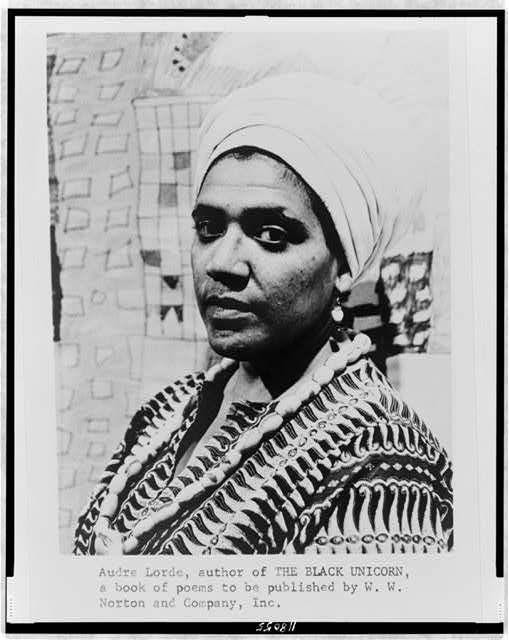
Image context: the cover uses a real Library of Congress photographic print of Lorde dated between 1970 and 1978. It is not a poster, illustration, or generated substitute. The direct gaze and head-and-shoulders framing fit this archival spotlight because the video depends on concentrated presence: Lorde's face, voice, and timing make the literary argument inseparable from the public act of speaking it.[6]
The Archival Reading
The embedded video is The Poetry Center's YouTube upload of Lorde reading "Black Studies" from New York Head Shop and Museum.[1] The fuller San Francisco State archive record gives the event's institutional frame: location at The Poetry Center, date of 1974-09-26, publisher listed as American Poetry Archives, and a longer program runtime of 55:40 for the Lorde and Knight event.[2] It also notes small but revealing preservation details: a substituted introduction, brief early audio issues, and retained distortion during Knight's opening because the historical record matters even when the sound is imperfect.[2]
The first thing to notice is that the clip's apparent plainness is part of its value. There is no documentary framing telling the viewer what to think, no later scholar preparing the categories, no memorial montage. Lorde stands inside the working conditions of a poetry reading. That means the listener has to hear the poem as made speech, not as a finished monument. The performance asks for attention to pacing: where the voice hardens, where it lets irony enter, where a phrase lands like institutional language being turned back on itself.
"Black Studies" is a useful title because it names a field and immediately makes that field unstable. In academic language, Black Studies can sound like a program, a department, a syllabus, or a curricular correction. Lorde's reading pushes the term toward lived knowledge. The poem's force comes from refusing to let study remain safely administrative. To study Black life, in the poem's world, is to confront bodies, city systems, memory, danger, work, and the daily pressure of being interpreted by hostile institutions. The classroom cannot pretend innocence if the street is already inside its vocabulary.[1][2]
That is why the video belongs in a literature post, not only in a civil-rights archive. Lorde's craft is doing the work. She does not abandon the poem in order to make a point. She makes the point by controlling the poem's movement. The title's institutional surface meets a voice trained in lyric compression and public accusation. The result is not a lecture against schools. It is a poem about what study must become when ordinary public language has failed to protect the people it names.
The broader event sharpens the stakes. The archive page says Lorde also read a recent poem on the police killing of a young Black child in New York City.[2] That detail is essential context even though the embedded clip centers "Black Studies." It reminds us that Lorde's 1974 reading did not separate intellectual formation from immediate public grief. A book manuscript, a curricular phrase, and a fresh act of state violence all appear in one evening. The archive preserves the order of urgency: poetry is not a retreat from the news; it is one of the forms by which news becomes survivable without becoming normalized.
Hearing Lorde in this early video also corrects a common flattening of her afterlife. Later readers often meet her through prose declarations from Sister Outsider, especially lines about silence, difference, care, and survival. Those lines matter, but the 1974 footage shows how much of that authority was already being made in poetry before the essays became classroom fixtures.[4] The voice is not motivational. It is diagnostic. It does not ask the audience to feel vaguely empowered. It asks the audience to recognize how language, power, and danger have already been arranged.
The small-press context matters for the same reason. Broadside Press gave the poems a publishing route inside Black literary infrastructure rather than waiting for mainstream permission.[3][5] That does not make the work provincial. It makes the work historically situated. The poem speaks from New York, travels through Detroit publication, is recorded in San Francisco, and now circulates through a university archive and YouTube. Each stage changes the audience, but the poem's pressure remains: what does it mean to study a life while systems are still endangering that life?
The clip's legacy lies in that unresolved demand. In 2026, "Black Studies" can be invoked as heritage, discipline, target, slogan, department, or culture-war shorthand. Lorde's reading makes it harder to use the phrase lazily. It returns the term to voice and risk. Study is not just information about Black life. It is an ethical practice of attention, memory, naming, and refusal. The footage survives because it lets us hear that practice before it has been softened into reverence: Lorde at the microphone, making a poem carry the work of survival without letting survival become a sentimental word.[1][2][4]
Sources
- The Poetry Center Archive Goes Live!, "Audre Lorde reads 'Black Studies' (complete) from New York Head Shop and Museum," YouTube video.
- The Poetry Center Digital Archive / San Francisco State University, "Audre Lorde and Etheridge Knight: September 26, 1974" (event description, metadata, provenance, and archive notes).
- National Museum of African American History and Culture, "New York Head Shop and Museum" (1974 Broadside Press object record).
- Academy of American Poets, "About Audre Lorde" (biography, publication sequence, poems, and bibliography).
- Community of Literary Magazines and Presses, "Audre Lorde: Voices from Independent Literary Publishing" (small-press and Broadside Press context).
- Library of Congress Prints & Photographs Online Catalog, "[Audre Lorde, head-and-shoulders portrait, facing front]" (source page for the archival portrait).