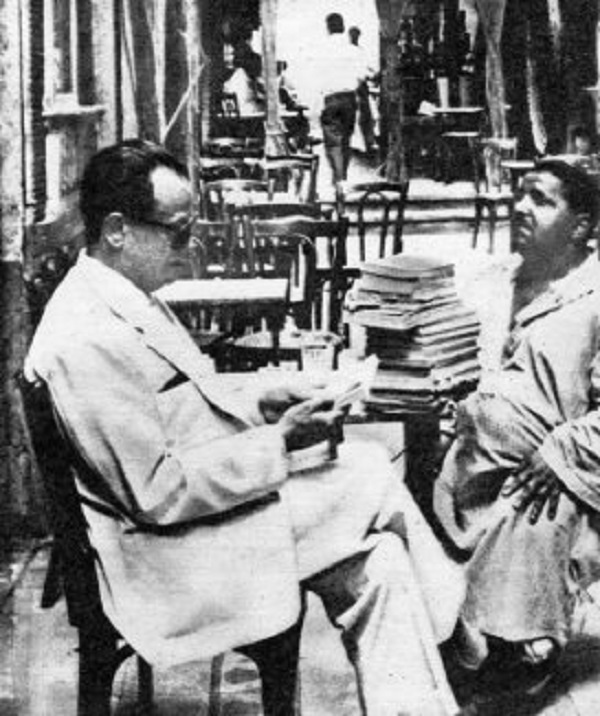
The wrong way to begin Naguib Mahfouz's Cairo Trilogy is to stand too far away from it. From a distance it looks like a monument: three long novels, a Nobel laureate, colonial Egypt, family saga, patriarchal household, nationalist ferment, modernity arriving in waves. All of that is true, but it can make the book feel like homework before it feels like fiction.
The better way in is smaller. Start with the house.
The Everyman's Library edition gathers Palace Walk, Palace of Desire, and Sugar Street into 1,368 pages, with the trilogy following three generations of the Abd al-Jawad family from 1917 to 1952.[1] AUC Press, introducing Palace Walk, frames the first volume as the opening of Mahfouz's masterwork and places the family inside British-occupied Egypt in the early twentieth century.[2] Those historical coordinates matter, but Mahfouz does not ask the reader to memorize a national timeline first. He asks the reader to learn who can leave the house, who cannot, who eats where, who knows what, and whose authority depends on everyone else misreading him.
That is the reader's first key. In The Cairo Trilogy, domestic space is not background. It is the first political system.
1. Read the front door as an instrument
Palace Walk begins by making household order feel physically enforceable. Amina, the wife of Ahmad Abd al-Jawad, is not simply "traditional" in some vague cultural sense. AUC Press's plot summary emphasizes that she is effectively confined by a social order in which a virtuous woman leaves home only under male escort.[2] That rule does more than define one character's restriction. It teaches the reader how space distributes knowledge.
The front door matters because it sorts the family into unequal worlds. Ahmad can move through Cairo as host, trader, pleasure-seeker, father, public man, and private hypocrite. Amina experiences the city through permitted routes, windows, visits, stories, and risk. The children inherit the split in different ways: Fahmy's idealism, Yasin's appetites, Kamal's inwardness, and the daughters' marriage futures all develop under a regime where movement is never neutral.
Read every room as a test of authority. Who is allowed to speak there? Who has to wait? Who can listen without being seen? Who treats obedience as love, habit, fear, or strategy? If you enter the trilogy through those questions, the scale becomes manageable. The house is not a preface to politics. It is where politics first becomes daily life.
2. Let the streets widen slowly
The trilogy's title can tempt a reader to look for one single "Cairo" immediately. Resist that. Mahfouz's Cairo widens by pressure. At first, a street name, a shop route, a mosque, a cafe, or a window matters because it changes the family's degrees of freedom. Only later does the reader feel the full national field around those movements.
This slow widening matches Mahfouz's own literary formation. The Nobel biographical note says he was born in Cairo in 1911, began writing as a teenager, and became famous across the Arab world after the appearance of the trilogy in 1957, which depicted traditional urban life.[3] Encyclopedia.com adds the useful local anchor: Mahfouz was raised in Cairo's Gamaliya district, a neighborhood that provided the background for the trilogy.[5] That biographical fact should not be used lazily, as if the novels were simple transcription. It helps because Mahfouz understands city life as a series of social thresholds rather than as a tourist panorama.
So do not read the streets as decorative realism. Read them as extensions of the house. The alley, cafe, mosque, school, shop, and political gathering each test what the household has tried to contain. The city does not merely offer escape. It also reproduces hierarchy, temptation, surveillance, and rumor in larger forms.
3. Keep Ahmad large, but not central enough to swallow the book
Ahmad Abd al-Jawad is the obvious gravitational force in the opening volume. Penguin Random House's description names him as the tyrannical patriarch ruling his household while maintaining a secret life of self-indulgence.[1] That doubleness is the trilogy's first big dramatic engine. He is frightening because his authority is real, but he is also readable because the fiction keeps showing the cost of that authority to everyone around him.
The useful reading move is to treat Ahmad as a system, not only as a villain. He embodies a style of patriarchal command that depends on theatrical consistency. At home, he must be severe. Outside, he can be indulgent, charming, musical, erotic, social. The scandal is not only hypocrisy. The scandal is that the household has been made to organize itself around a false performance of moral unity.
Still, do not let Ahmad eat the trilogy. Mahfouz's structure outgrows him. The later books are not just "what happens after the father weakens." They are about what remains when the old arrangement no longer explains the world fully. Children and grandchildren encounter new ideological languages, new risks, and new forms of longing. The patriarch is important because he gives the first model of power. The trilogy becomes great because it keeps asking what power looks like after his model starts to crack.
4. Use Kamal as a weather vane, not as the whole meaning
Kamal often feels like the reader's bridge into the trilogy's intellectual life. He grows into questions about faith, desire, education, nation, and selfhood. Nobel's facts page says Mahfouz's work repeatedly turns around fundamental questions such as time, society, norms, knowledge, faith, reason, and love, often using Cairo as the backdrop.[4] Kamal is one way those questions become novelistic rather than abstract.
But he is not a simple author surrogate to decode. Treat him as a weather vane. He registers changing pressure: school, books, philosophy, nationalism, family memory, erotic idealization, and disillusionment all pass through him. His value is not that he solves the trilogy's questions. His value is that he reveals how hard it becomes to inherit a world once its inherited explanations no longer hold.
This matters especially for readers who come to the trilogy expecting a neat historical arc from oppression to liberation. Mahfouz is more patient and less comforting than that. New forms of thought do not automatically produce freer lives. Political awakening can coexist with emotional immaturity. Education can sharpen self-consciousness without giving courage. Modernity opens windows, but it does not guarantee clean air.
5. Track the generations as competing clocks
One reason the trilogy's length is not ornamental is that Mahfouz needs time to become visible. The novels span the years between the First World War era and the approach to the 1952 revolution, while the family line moves from parents to children to grandchildren.[1] Those are not parallel timelines sitting side by side. They interfere with one another.
The older generation reads change as threat, temptation, or disorder. The middle generation experiences change as both release and injury. The younger generation inherits the arguments without necessarily inheriting the same emotional stakes. By Sugar Street, Penguin Random House notes, the family has produced grandchildren drawn toward divergent political and social directions, including communism, religious fundamentalism, and proximity to elite power.[1] The point is not to reduce characters to ideological labels. The point is to notice that the household has become too small to contain the futures it helped produce.
Read the generations as clocks running at different speeds. Amina's time is ritual, duty, and memory. Ahmad's time is appetite trying to preserve authority. Fahmy's time is historical urgency. Kamal's time is reflective delay. The grandchildren's time is ideological acceleration. The trilogy's force comes from placing these tempos inside one family record.
6. Do not rush the "national allegory"
It is tempting to say that the family stands for Egypt. That is partly useful and mostly too blunt. The trilogy does mirror national turbulence; PRH's edition description says the family's trials echo those of Egypt across the years between the world wars.[1] But "mirror" should not mean one-to-one code. Amina is not simply tradition, Ahmad is not simply patriarchy, Kamal is not simply modern consciousness, and the grandchildren are not simply political factions.
Mahfouz is stronger than allegory because he lets social meaning pass through appetite, embarrassment, jokes, illness, courtship, meals, study, mourning, and family vanity. The nation is not hidden behind the family like a secret answer. It is already inside the family's ordinary arrangements. That is why the reader should begin with doors, windows, visits, meals, schools, and cafes. The large pattern will appear, but it will appear as lived pressure rather than as a diagram.
This is also why the trilogy travels well beyond its immediate setting. Nobel's 1988 citation recognized Mahfouz for forming an Arabic narrative art with wide human reach, while the same Nobel page emphasizes that his work uses Cairo to ask large questions about time, society, reason, faith, and love.[4] The universal element is not a smoothing away of Cairo. It is the opposite. The books become durable because Cairo is rendered so specifically that large questions have a body.
A practical entry plan
Read Palace Walk slowly enough to learn the household map. Do not worry if the opening social rules feel dense; they are the operating system. Mark the moments when someone crosses a threshold, hears news from outside, or discovers that authority has a second face.
In Palace of Desire, watch for expansion and aftermath. The family has already been changed, but the old emotional habits do not vanish just because history has moved. This is the volume where desire, grief, education, and public life start pulling the younger generation into less stable shapes.
In Sugar Street, stop expecting the trilogy to restore the opening household. The point is not return. It is diffusion. The old house has produced people who now belong to different arguments about Egypt's future. The reader's reward is not a single verdict but a layered sense of how private life stores history, distorts it, and sends it forward.
The trilogy looks massive until you learn its first rule: read from inside outward. The house teaches the street. The street teaches the city. The city teaches the nation. And the nation, by the end, has already been speaking in the house all along.
Sources
- Penguin Random House, The Cairo Trilogy by Naguib Mahfouz, Everyman's Library edition page with translators, publication details, trilogy description, and product metadata.
- AUC Press, Palace Walk product page with plot summary, publication details, translator credits, and Mahfouz biographical note.
- Nobel Prize, "Naguib Mahfouz - Biographical," award-era biography covering Cairo, the trilogy's 1957 breakthrough, civil-service career, and later work.
- Nobel Prize, "Naguib Mahfouz - Facts," Nobel Prize in Literature 1988 facts page with life, work, language, prize context, and thematic overview.
- Encyclopedia.com, "Naguib Mahfouz," biographical entry covering Gamaliya, education, government work, and literary background.
- Wikimedia Commons, "File:Naguib Mahfouz in cafe.jpg," source page for the 1968 archival cafe photograph used as the article image.