A small boy walks through the woods carrying a wooden sword. He knows how a warrior should stand because he has studied the pictures in his father’s military books. When wounded men begin crawling past him, he eventually takes his place at their head. He has learned the posture of command before he can recognize the need for help.[1]
Ambrose Bierce’s “Chickamauga” makes that mismatch unbearable. The child sees a great deal: faces, gestures, abandoned equipment, a beautiful red light. What he lacks is a way of understanding what he sees. The story’s disturbing suggestion is that his education has contributed to that failure. Familiar pleasures keep supplying the wrong explanations.
This essay discusses the ending, including the deaths that bring the boy’s game to a stop.
A sword made from pictures
The opening first presents the child’s freedom as an inheritance. His ancestors have crossed continents, conquered territories, and passed their appetite for dominion down to him. The narrator’s grand historical sweep lands on a homemade sword so unconvincing that even the boy’s father might not identify it. Soon the supposed conqueror will be routed by a rabbit.[1]
That change of scale makes the heroic language ridiculous. It also exposes how much has been loaded onto this very small person. Before he can judge a battle, the boy has been assigned a place in a flattering history of conquest.
Bierce gives the inheritance a material route. The father, a former soldier and now a planter, keeps military books and pictures. The boy copies the “postures of aggression and defense” taught by “the engraver’s art.”[1] An image becomes a bodily habit. He can reproduce the stance without knowing its consequences.
The distinction matters because the story never suggests that imagination simply switches off when reality arrives. The boy’s imagination works energetically throughout the disaster. It sorts unfamiliar sights into familiar entertainments. A wounded face recalls circus paint; crawling men recall games at home. The problem is how successfully he can keep making sense of things on the terms he already knows.
His sword briefly acquires a different use after the rabbit frightens him. Lost and crying, he falls asleep still holding it, “no longer a weapon but a companion.”[1] The phrase allows us to feel the child’s vulnerability. A prop of conquest becomes something to clutch for comfort. Bierce can expose the fantasy without making its six-year-old carrier deserve what follows.
The game already played at home
When the men emerge from the trees, their movement breaks the military picture into separate bodily difficulties. Some crawl on hands and knees; others drag limbs they can no longer use. Men try to stand and fall. The repeated sentences make progress slow and effortful, while the boy’s curiosity moves easily among them.[1]
The narrator explicitly tells us that an older observer would notice more than the child does. We are given the injuries and deaths that his attention cannot organize. This creates a painful double view: we can understand his mistakes while seeing what those mistakes cost the people around him.
One remembered game makes the scene more troubling than an encounter between innocent childhood and an alien war. The boy has ridden the enslaved people on his father’s plantation as they crawled for his amusement. Now he climbs onto a wounded soldier’s back.[1] His action has a precedent. At home, another person’s body has already been made available as his toy.
Read in that light, the passage connects the fantasy of command to an everyday racial hierarchy. The boy need not consciously wish to hurt anyone to assume that a crawling adult is there to carry him. The story shows an expectation learned through pleasure, before it becomes an argument he could defend.
The soldier throws him off. His terrible wound finally frightens the child, but fright does not produce sustained concern. Soon the boy is again moving among the men, arranging them into a procession with himself as leader. The game can absorb even this interruption.
That is the essay’s central distinction between innocence and ignorance. The boy is vulnerable, and he cannot be held responsible as an adult would be. Yet his lack of understanding is already furnished with adult habits. He has inherited ways of using people before he understands what people can suffer.
A retreat mistaken for a following
The men are moving toward water. The boy gets ahead of them because his body is whole. He then adjusts his pace and looks back to ensure that his imaginary troops keep up.[1] A practical advantage becomes, in his mind, evidence of authority.
The order of events is exact and cruel. Their movement exists before his command. He appropriates it. Nothing in the men’s need for water confirms his leadership, but nothing has to: the performance supplies its own satisfaction.
Bierce keeps placing readable evidence on the ground. Discarded equipment and footprints going in both directions indicate an advance followed by a retreat. The child has no useful associations for these objects.[1] Pictures have taught him the appearance of a soldier; they have not taught him to read the aftermath of soldiering.
The fire ahead offers an even stronger attraction. Its light makes mist look golden and throws enormous shadows behind the crawling men. Beauty helps sustain the boy’s mistake. He crosses the stream and watches men lower their faces into it. Some lack the strength to lift them out again. The narrator supplies the explanation that the child cannot: they have drowned.[1]
The landscape’s beauty does not soften this fact. It makes the failure to recognize it more plausible, and more alarming. Readers are allowed to see the lovely light and the dying bodies together. We cannot claim that the spectacle hid its cost from us.
What the ending cannot repair
At the burning house, the boy dances and tries to add fuel. When the available objects prove too heavy, he throws in his sword. Only afterward does he recognize the outbuildings and understand that the house is his own. His mother lies dead nearby.[1]
The sequence prevents a consoling reading of the discarded weapon. He has not renounced war after acquiring wisdom. He feeds the sword to the spectacle while he is still enjoying it. Recognition arrives after the gesture that might otherwise look like moral growth.
The final revelation is that the boy is deaf and does not speak. It explains why the battle failed to wake him and changes our understanding of the story’s prolonged silence. It does not explain away the education provided by the pictures and plantation games. Those lessons have reached him perfectly well.[1]
Bierce’s language here also deserves scrutiny. The narrator compares the child’s cries to animal noises and calls them “the language of a devil.”[1] Those descriptions help produce the shock, but they also turn a grieving disabled child into something frightening to an imagined listener. We can recognize the ending’s force while questioning the terms on which the narrator makes him audible.
Nor does Bierce’s own battle writing permit an entirely simple verdict on military feeling. In “A Little of Chickamauga,” dated 1898, he mocks inflated reputations for bravery and describes an exhausted retreat. Yet he ends by honoring dead comrades and imagining angels among the fallen on both sides.[2] The veteran remains capable of tenderness and ceremonial grandeur. His writing knows their attraction from within.
That tension belongs to the story’s afterlife as well. A National Park Service anniversary program paired the fiction with the memoir in a tour of places associated with Bierce.[3] Reading them together preserves a useful distinction: a remembered battlefield, an eyewitness account, and a fictional child each make different demands on our sympathy. The story need not serve as a literal record to challenge how a battle is remembered.
“Chickamauga” closes with the boy standing still, his lips trembling. We are given no later life in which suffering turns into understanding. The knowledge acquired at the ruin cannot restore his mother, and the story does not promise that pain has made him wise. It leaves us with the earlier, teachable moments: a picture admired, a posture copied, a game accepted as ordinary. Long before the boy could recognize the wounded, he had been shown how to lead them.
Sources
- Ambrose Bierce, “Chickamauga,” in The Collected Works of Ambrose Bierce, Volume II (1909), Project Gutenberg — complete primary text, pp. 46–57; all story quotations and scene references.
- Ambrose Bierce, “A Little of Chickamauga” (dated 1898), in The Collected Works of Ambrose Bierce, Volume I (1909), Project Gutenberg — eyewitness memoir, pp. 270–278, including its closing commemoration.
- National Park Service, “151st Anniversary of the Battle of Chickamauga” — historical program pairing Bierce’s memoir and short story in a battlefield interpretation tour.
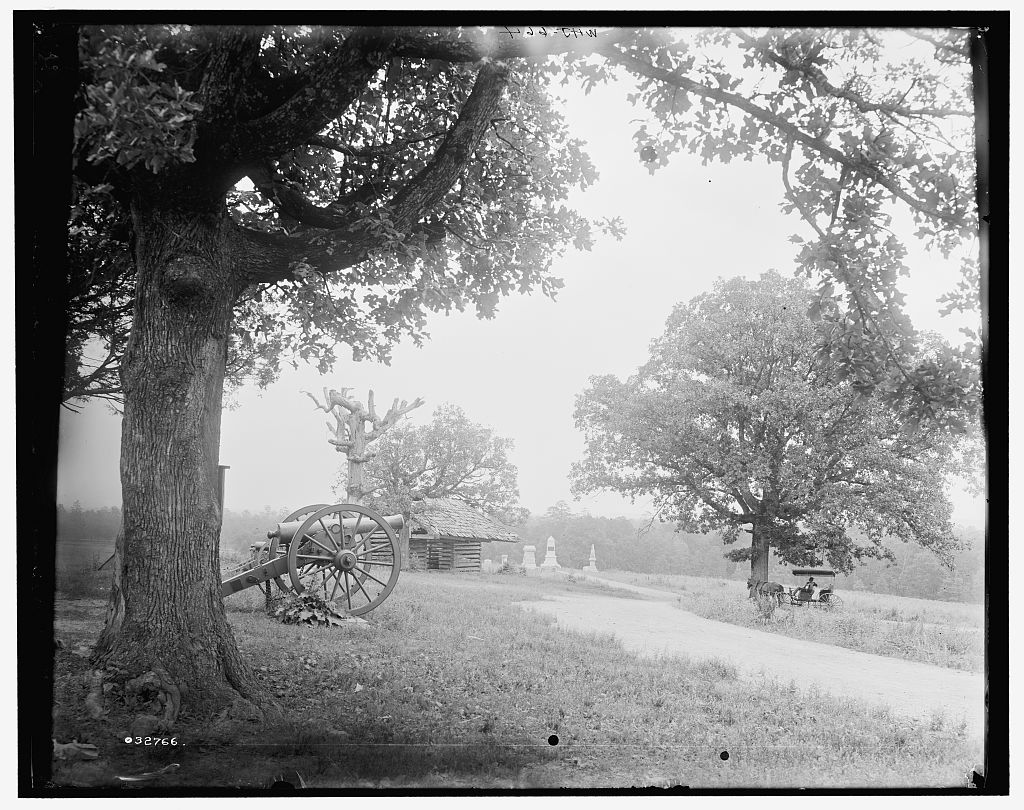
- Library of Congress, “Chickamauga, Ga., Snodgrass House, Thomas’ headquarters,” William Henry Jackson, dated between 1880 and 1930 — digitized glass-negative photograph, Detroit Publishing Company collection, LC-DIG-det-4a16851 (JPEG).