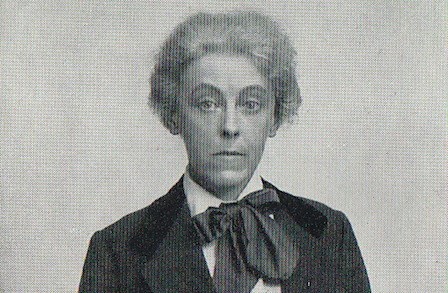
Charlotte Mew is easy to misplace if literary history is sorted by obvious schools. She was born in London in 1869, published her first major collection when Georgian poetry was visible, and died in 1928, after modernism had already begun redrawing the map.[2][3] Yet her poems do not read like a genteel survival from the Victorian room or a footnote to the modernist experiment. They read like narrow spaces under pressure. A bride cannot speak her marriage into consent. A room keeps the weather of past lives. A church does not quiet desire; it amplifies it. Mew's gift was to make voice sound trapped without making the poem itself feel trapped.
That is why a work-centered profile of Mew has to begin with architecture rather than biography. Her life was marked by family strain, mental illness in the household, financial anxiety, and a famously limited public career, and those facts matter.[2][3][4] But the poems are not interesting because they can be reduced to private suffering. They are interesting because Mew found forms for situations where ordinary social speech fails. Her speakers often stand at the edge of what can be said in public: a confession too raw, a refusal too dangerous, a memory too alive, a sympathy that cannot safely announce itself.
Wikisource's public-domain transcription of The Farmer's Bride identifies the 1921 volume as a new edition built from the original 1916 book plus additional poems.[1] That publication history is useful because it places Mew at a hinge. She is not writing from outside the early twentieth century. She is writing inside it, but with a vocabulary of pressure that refuses simple period labels. Her poems keep rhyme, stanza, narrative, dramatic monologue, and lyric compression in play, while making each inherited device feel slightly unsafe.
The Bride Who Cannot Be Made Legible
"The Farmer's Bride" remains Mew's most anthologized poem because it turns a domestic premise into an ethical disturbance. A farmer tells the story of his young wife, who has fled intimacy and now moves through the household like a frightened creature.[1] The poem gives him the speaking role, but not full moral possession. That is Mew's first technical stroke. The farmer's voice is plain, local, and wounded; it asks for sympathy. At the same time, the poem keeps showing the violence hidden in his assumption that marriage should have made the bride available.
The poem's famous animal imagery is not decoration. When the speaker describes the bride's alertness and distance, Mew lets rural comparison do double work: it records how the farmer sees her, and it exposes how quickly seeing can become capture.[1] He knows animals, fields, seasons, and labor. He does not know how to imagine a wife's inward life except through the terms of management. The voice is therefore heartbreaking and frightening at once. It is not a villain's confession. It is a socially ordinary voice revealing the limits of its sympathy.
This is why Mew's drama feels modern even when its surface is pastoral. The poem is not merely about failed marriage. It is about the mismatch between legal relation and interior consent. The farmer can narrate the household, but he cannot narrate the bride from inside. That gap is the poem's real subject. Mew gives the reader just enough access to his longing to prevent easy judgment, then withholds the bride's speech so that her silence becomes an accusation against the whole arrangement.
Poets.org describes Mew as a writer admired by figures including Thomas Hardy, Virginia Woolf, and Siegfried Sassoon, while also noting the compressed scale of her published career.[2] That combination matters. Mew did not need a large output to establish a distinct pressure system. In "The Farmer's Bride," she found a way to make a single dramatic voice contain a social order, a sexual contract, and an unsolved moral absence.
Rooms Remember What People Try To Outlive
If "The Farmer's Bride" turns marriage into enclosure, "Rooms" turns enclosure into memory. The poem begins from lived interiors rather than event. Rooms have hosted bodies, griefs, boredom, illness, sex, waiting, and departure; they keep human residue without becoming sentimental memorials.[1] Mew's title looks simple because the poem's intelligence is spatial. It asks what a room knows after people leave.
The opening phrase "I remember rooms" is deceptively mild.[1] It does not announce trauma or revelation. It begins like an inventory, then lets the inventory thicken. Mew's rooms are not neutral containers. They are witnesses with bad ventilation. They hold the pressure of what happened in them, but they do not explain it cleanly. That refusal is important. A weaker poem would turn each room into a symbol with one meaning. Mew lets rooms remain overfull, so that domestic space becomes a moral climate rather than an emblem.
This is where her work is closest to modernist interiority without adopting a recognizably high-modernist surface. She does not need stream of consciousness to make consciousness unstable. She can do it through a room, a remembered wall, a bed, a window, a tone of address. The self appears not as a sovereign speaker but as someone caught among traces. To remember a room is to be remembered by it.
Britannica's short biography emphasizes Mew's economical career and the posthumous gathering of her poems.[3] That spareness suits the work. Mew's poems often feel as though they have cut away the connective tissue another poet might have supplied. The result is not thinness. It is concentration. A room, a bride, a church, a farmer's field: each becomes a chamber where social and psychic pressure can collect.
Religious Address Without Comfort
Mew's religious poems are powerful because they do not use religion as a clean answer. "Madeleine in Church," one of her major dramatic poems, is built around address, desire, sin, exhaustion, and a speaker who cannot make doctrinal language behave politely.[1][4] The church setting does not simplify the crisis. It gives it echo.
That echo matters for Mew's larger method. Again and again, she places speech inside a structure that should regulate it: marriage, room, church, rural community, literary form. Then she lets the speech exceed regulation without breaking into shapelessness. In "Madeleine in Church," sacred language is not abandoned, but it is strained by bodily memory and emotional extremity.[1] The poem does not ask whether faith exists as an abstract proposition. It asks what prayer sounds like when the person praying cannot separate spiritual hunger from human hunger.
The Poetry Archive's Mew page rightly keeps attention on her voice and on the emotional intensity of the poems rather than turning her into only a biographical curiosity.[4] That is the right emphasis. Mew's distinctiveness lies in how she makes intensity formal. The poems may contain loneliness, dread, desire, and religious unease, but they are not loose outpourings. They are shaped acts of pressure management.
Why The Poems Still Feel Unsettled
Mew's afterlife has often depended on recovery: the story of a poet admired by major writers, then never quite stabilized in the canon.[2][3][4] Recovery is useful, but it can make the poems sound fragile, as if they need rescuing. They do not. They are tougher than that. Their power lies in how little they flatter the reader's wish for resolution.
In "The Farmer's Bride," Mew refuses to let sympathy solve domination.[1] In "Rooms," she refuses to let memory become decorative nostalgia.[1] In "Madeleine in Church," she refuses to let religious address wash away divided desire.[1] The pattern is consistent: she takes spaces that culture often treats as ordering structures and shows that they also preserve disorder. Marriage orders bodies; the bride's silence remains. Rooms order domestic life; memory leaks through. Church orders speech; the speaker's need will not stay purified.
That is also why Mew's line between old and new remains so interesting. She can sound ballad-like, Georgian, dramatic, devotional, or sparely modern depending on the poem, but those labels never hold her for long. Her work is not experimental in the loud sense. It is experimental in its moral acoustics. She tests what a familiar form will carry when the voice inside it cannot be made socially comfortable.
The archival photograph used for this article has the kind of stillness that can mislead: a seated poet, a composed profile, a historical distance.[5] Mew's poems undo that stillness. They ask what is happening under composure, what a room keeps after conversation stops, what a marriage sounds like when only one party can speak, and what prayer becomes when it has to carry the whole disorder of a life. Her best work has not lasted because it is quaint, neglected, or merely sad. It has lasted because it makes enclosure audible.
Sources
- Charlotte Mary Mew, The Farmer's Bride, Wikisource public-domain transcription; original 1916 edition and 1921 expanded edition context, plus cited poems.
- Academy of American Poets, "Charlotte Mew" (biographical overview, publication context, and reception by contemporaries).
- Encyclopaedia Britannica, "Charlotte Mew" (concise biography and publication overview).
- The Poetry Archive, "Charlotte Mew" (biographical and critical framing of Mew's poetic voice and reputation).
- Wikimedia Commons, "File:Charlotte-mew.jpg" (source page for the archival photograph used as the article cover).