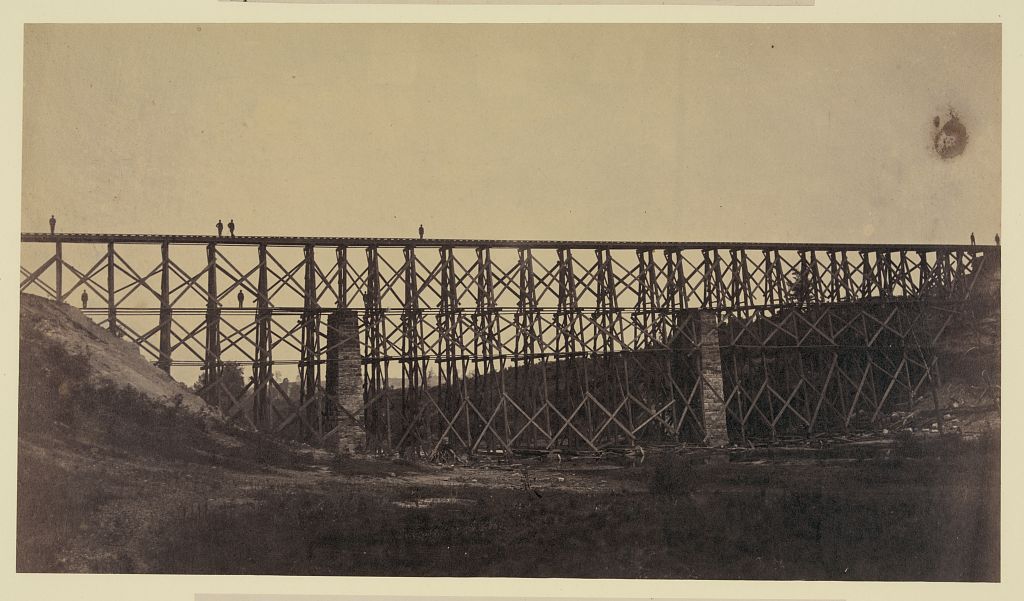
Ambrose Bierce's "An Occurrence at Owl Creek Bridge" is famous for its last-line reversal, but treating the story as a trick ending makes it smaller than it is. The surprise works because Bierce has spent the whole story teaching the reader to trust a body in crisis. We feel the bridge, the rope, the current, the forest road, the ache of return, and only then learn that the escape has unfolded inside the last instant before death.[1][2]
The passage is most powerful when read less as a puzzle than as a compression chamber. A man is being hanged by Union soldiers from a railroad bridge in northern Alabama. He is Peyton Farquhar, a Confederate civilian planter lured into sabotage by a disguised Federal scout. The setting is military, public, procedural; the inner experience is private, extravagant, and almost impossibly elastic.[1][3] Bierce makes those two scales collide. One side counts planks, sentinels, cords, and command positions. The other side expands one snapped moment into water, sunlight, road dust, stars, a gate, and a wife stepping forward.
That collision gives the story its lasting modernity. Britannica summarizes the premise cleanly: the narrative concerns the final thoughts of a Southern planter being hanged, who imagines his escape in the brief interval between the noose tightening and his neck breaking.[2] The summary is accurate, yet the prose makes the interval feel earned rather than explained. Bierce does not simply tell us that time slows. He changes the reader's sensory contract until a dying man's hallucination seems more immediate than the execution frame that contains it.
The Bridge Is Procedure Before It Is Symbol
The opening paragraph refuses melodrama. Farquhar looks down at the "swift water twenty feet below," but the sentence keeps attention on placement, restraint, and apparatus rather than on inner terror.[1] His wrists are bound. The rope is attached to a cross-timber. Loose boards form a temporary footing. Two Federal privates, a sergeant, a captain, and sentinels occupy the scene in a clean chain of authority.[1]
That procedural calm matters. Bierce served in the Union army during the Civil War, and Encyclopedia.com's account of the story stresses how his war experience fed the precision and harshness of his military fiction.[3] The opening does not treat execution as Gothic atmosphere. It treats execution as work. The soldiers do not need speeches because the arrangement already speaks. A bridge meant for transit has become a machine for stopping a body.
The sentinels are described in "a formal and unnatural position."[1] That phrase is small, but it unlocks the scene. Military form has taken over posture, gesture, and attention. The men at either end of the bridge are not asked to know the condemned man. They are asked to block the planking. The system functions by narrowing everyone's task until death can occur without anyone needing to experience the whole moral event.
The bridge therefore begins as infrastructure and becomes grammar. Railroad lines mattered intensely in the Civil War because troops and supplies moved through them; Encyclopedia.com notes that Farquhar is not being hanged for an ordinary violent crime but for trying to destroy a strategically useful railroad bridge.[3] Bierce's title calls the execution an "occurrence," a deliberately flat word for a human catastrophe. The bridge lets that flatness happen. It converts war, law, sabotage, and death into one local procedure.
The Mind Escapes By Becoming Too Alert
The transition into Farquhar's imagined escape is not a crude cut from reality to fantasy. It begins with heightened perception. Time seems to slow. Sounds separate from one another. The senses become, in Bierce's phrase, "preternaturally keen and alert."[1] This is the story's central seduction. The closer the body moves toward death, the more intensely the mind appears to possess the world.
That sensory abundance is why the reader follows the escape so readily. Farquhar does not drift into vague dream. He wakes into texture. He feels pain, water, suffocation, pressure, light, leaves, bullets, grains of sand, the rhythm of walking, and the shape of the road.[1] The fantasy becomes convincing because it is not weightless. It has friction.
The effect also reverses heroic war romance. Farquhar's patriotic desire for action has been exposed as vulnerable to manipulation: a disguised Union scout tells him exactly the story needed to draw him toward sabotage.[1][3] Once death arrives, however, the grand cause disappears almost entirely. The mind does not imagine banners, victory, or public honor. It imagines escape into the body: breath, unbound hands, swimming, running, home. Bierce strips war down to the panic beneath rhetoric.
This is where the story's cruelty is exact rather than merely cynical. Library of America lists "An Occurrence at Owl Creek Bridge" among Bierce's major works, and the reason is not only the twist.[5] The story understands how easily ideology gives way to sensation at the edge of death. Farquhar may have imagined himself useful to the South, but the last second of his life is not a political speech. It is a desperate effort to keep perception open.
The Road Home Is the Trap
The imagined road is the strangest part of the story because it grows both more beautiful and more suspicious. Farquhar reaches shore, escapes gunfire, enters the forest, and walks all day toward home.[1] The route seems at first like deliverance. Then it becomes too pure. The road is wide, straight, strangely empty. No fields border it. No houses appear. The forest feels interminable.[1]
Bierce is careful here. He does not make the fantasy collapse by becoming absurd all at once. He lets wrongness accumulate inside beauty. The road home carries the emotional logic of Farquhar's desire: if he can survive the bridge, the world should organize itself toward reunion. The problem is that this emotional logic is exactly what gives the illusion away. Real roads have interruptions. Dream roads obey longing.
The wife at the gate completes the trap. She is not developed as a full character because she does not need to be. In the final hallucination, she functions as the image of return itself: household, love, civilian identity, the life Farquhar believed he was defending when he moved toward the bridge.[1] He stretches out his arms toward her, and the story snaps back into bodily fact.
That final snap is not merely a revelation that the escape was imaginary. It is a restoration of scale. The reader has lived through pages of expanded sensation, but the body has remained under the bridge all along. The whole road home has occupied the instant of execution. The story's last image, Farquhar's body as it "swung gently from side to side," is devastating because it is so quiet.[1] Bierce does not decorate the death. He removes the mind's abundance and leaves the minimal motion of a hanged body.
Why the Twist Still Feels Severe
The story's structure is often described as non-linear: execution scene, flashback, imagined escape, return to the execution's outcome.[2][3] That is true, but the deeper structure is a fight over authority. Which account of reality gets to govern the reader's body? The military account says a condemned man drops and dies. The mental account says he breaks free, swims, travels, and nearly touches home. The final sentence gives authority back to the military and biological account, but it cannot erase the fact that the reader has already inhabited the other one.
That is why "Owl Creek Bridge" is more than a clever ancestor of later twist fiction. A cheap twist makes earlier perception feel wasted. Bierce's twist makes earlier perception feel tragic. The escape was not "fake" in the lazy sense; it was an experience generated by a dying consciousness under extreme pressure. It matters because it is false to the outer world and true to the mind's last demand.
Britannica's Bierce biography places the story within a career marked by bitter wit, war writing, and darkly memorable short fiction.[4] That darkness can be over-simplified as misanthropy. In this story, the bitterness is more disciplined. Bierce does not say human hopes are foolish because he enjoys crushing them. He shows that hope can be neurologically, aesthetically, and emotionally powerful while still having no leverage over the rope.
The ending also revises the reader's relation to Farquhar. He is not made innocent. He is a slaveholding Confederate sympathizer, a planter eager for military distinction without formally becoming a soldier.[1][3] Bierce gives him no clean martyrdom. Yet the story also refuses to make execution abstract. Farquhar's political position does not prevent his last second from feeling humanly intense. The tale's severity lies in holding both facts at once: the man is morally and historically situated, and his dying mind still opens into terror, beauty, and love.
That double pressure is why the passage still works after the twist is known. Rereading does not weaken it; rereading changes where the suspense lives. The first time through, we wonder whether Farquhar will escape. The second time, we watch how language manufactures escape under impossible conditions. The current, the road, the wife, and the gate become evidence of the mind's last artistry rather than clues in a puzzle.
Bierce's achievement is to make one second large without making it consoling. The story grants Farquhar a whole landscape and then takes it away. It grants the reader immersion and then withdraws permission to believe in it. What remains is not a moral about dreams being deceptive, but a harder recognition: consciousness can build an entire road home at the very moment the body has nowhere left to go.
Sources
- Ambrose Bierce, "An Occurrence at Owl Creek Bridge," Project Gutenberg HTML text, used for close reading and short quoted phrases.
- Encyclopaedia Britannica, "An Occurrence at Owl Creek Bridge" - publication context, plot frame, and final-thoughts summary.
- Encyclopedia.com, "'An Occurrence at Owl Creek Bridge'" - Civil War railroad context, Bierce's military background, plot structure, and war-realism discussion.
- Encyclopaedia Britannica, "Ambrose Bierce" - biographical context and placement of the story among Bierce's major works.
- Library of America, "Ambrose Bierce" - author page listing "An Occurrence at Owl Creek Bridge" among Bierce's major works.
- Wikimedia Commons, "File:Abierce.jpg" - source page for the circa-1866 archival photograph used as the article image.