Many readers postpone The Canterbury Tales for three reasons that seem perfectly sensible: the Middle English looks forbidding, the cast feels large before the stories even start, and the whole work is famous for being unfinished.[2][4] Those are real obstacles, yet they are also the wrong entrance. The cleanest way in is to stop treating Chaucer's book like a duty monument or a bag of isolated classics and to read it instead as a travel structure. A group forms, the road compresses unlike people into one moving company, stories begin as social performances, and each new tale changes the weather inside the group.[1][2][4]
That route matters because Chaucer never asks for one stable tone. The book can move from courtly seriousness to tavern mockery, from saint's legend to dirty joke, from anti-clerical complaint to philosophical patience, often within a few pages.[1][2] If a new reader expects one unified moral register, the poem can feel jagged or chaotic. If the reader keeps the pilgrimage frame in view, the apparent disorder starts making sense. These are not random shifts in genre. They are the social consequences of putting a knight, a miller, a reeve, a merchant, a wife of Bath, a pardoner, and many others on the same road and letting each voice answer the others in turn.[1][2][5]
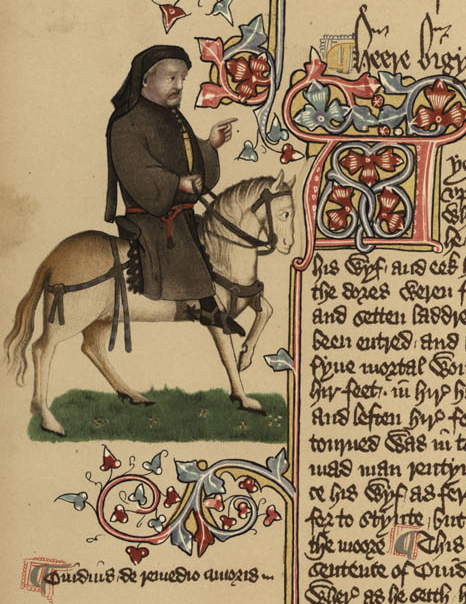
Image context: the cover uses a real archival manuscript image linked to the Ellesmere tradition instead of a generic cathedral photograph or a modern portrait of "medieval literature." That choice fits this guide because Chaucer's book is a physical and social artifact at once: a page, a voice, a rider, a company, a route.[4][6]
1) Start with the road before you start counting tales
The most useful first move is to remember that the work begins in motion. Readers often quote the opening because it is beautiful, yet the beauty is practical too. "Whan that Aprill..." is not there only to supply a seasonal flourish; it begins a chain of movement that leads to desire for travel and shared narration.[1] Soon the poem reaches its simplest social fact: "Thanne longen folk to goon on pilgrimages."[1] That sentence gives you the book's engine. People are leaving ordinary locations, ordinary rank enclosures, and ordinary habits of isolation in order to move toward a shrine in company.[1][2]
This is why the General Prologue should be read as more than a museum corridor of medieval "types." The Tabard Inn is a temporary mixing chamber.[1][2] Chaucer gathers people who would not usually hold the same social stage so long or so vividly. The pilgrimage lets him make a cross-section of late-medieval England feel mobile, noisy, and unstable instead of fixed in a diagram.[2][3][4] If you keep the road central, the book's variety stops feeling like a syllabus problem and starts feeling like the point.
2) Read the pilgrims as moving voice-types, not static specimens
One reason first-time readers freeze is that they try to memorize everyone as though the poem were an exam in medieval estates. A better method is to ask two questions of each pilgrim: what kind of social signal does this person emit, and what happens when that signal turns into narrative voice?[1][2]
The Knight matters because he brings prestige, public action, and a high register of storytelling; the Miller matters because he refuses to stay in that register for even one tale; the Reeve answers the Miller out of professional and personal irritation; the Wife of Bath turns lived experience into argumentative authority; the Pardoner sells holiness while exposing its theatrical machinery.[1][2][5] The portraits matter, but they matter chiefly because they forecast tale-voices. Chaucer is not pinning butterflies to a board. He is letting social posture become narrative method.
That means you do not need complete mastery on page one. What you need is a portable note system. Track each pilgrim by role, speech-energy, and likely friction. Ask who sounds authoritative, who sounds eager to puncture authority, who sounds theatrical, who sounds injured, who sounds amused by other people's decorum. Once you hear the company this way, the tales stop seeming like detachable modules and begin to feel like successive bids for control of the room.[1][5]
3) Expect argument across genres, not one moral tone
A newcomer can easily mistake the first famous tale for the book's stable identity. That is the wrong expectation. The Canterbury Tales is strongest when one story changes the terms for the next.[1][2] The Knight offers breadth, order, and elevated romance; the Miller immediately drags the company into bodily comedy, fraud, jealousy, and smashed idealism; the Reeve retaliates with another tale of humiliation and payback.[1] The point is larger than plot. Chaucer keeps showing that genre itself is part of social struggle.
The same logic helps later. The Wife of Bath's Prologue is not just background to her tale; it is a performance of authority, appetite, memory, and self-justification so forceful that it re-sorts the road around her.[1][2] The Pardoner's Prologue and Tale work similarly from another angle, because he reveals his own fraudulent method while still proving how powerful a practiced voice can remain.[1] A reader entering the book in 2026 should therefore stop asking, "What is the single correct tone of Chaucer?" and start asking, "What does this teller do to the social air, and who has to answer next?"
4) Use Middle English as a sound gate, not a gate that keeps you outside
The fear of Middle English is real, but it is best handled as a pacing issue, not as a permission issue. Harvard's Chaucer site is useful because it keeps the original text and translation apparatus close at hand, making comparison a reading aid instead of a scholarly ritual.[5] On a first pass, you do not need to decode every grammatical turn before moving on. Read a few lines aloud, catch the stress and propulsion, then use a modern gloss or translation when the surface thickens.
This matters because Chaucer's language carries social texture that flattening summaries can lose. A line like "Experience, though noon auctoritee" lands partly because of its argumentative snap in the Wife of Bath's voice.[1] The opening spring lines land because their sound is already full of thaw, motion, and gathering.[1][5] If you let the ear participate, the poem becomes less antique and more theatrical. You start hearing that each pilgrim is not only a moral case or social label but a rhythm entering the company.
So the practical rule is simple: alternate between sound and sense. Read enough of the original to hear the pressure of the voice, then move to glossed or translated help before fatigue turns into resentment. This keeps difficulty productive instead of punitive.[1][5]
5) Treat the incompletion as part of the book's force
Readers often apologize for The Canterbury Tales before they have even enjoyed it. Chaucer did not finish the grand design of two tales out and two tales back for every pilgrim, and the return journey never arrives.[2][4] That fact is important, but it does not make the surviving work a broken assignment. In some ways it sharpens the reading experience.
Because the project remains unfinished, the contest never settles into perfect symmetry.[2][4][5] The Host's authority stays partly provisional. The order of tales feels contingent, interrupted, and alive. Fragments form around quarrels, affinities, and performance opportunities rather than around a fully closed architecture.[2][5] The result is a book that preserves process inside prestige. You are not reading a sealed medieval monument. You are reading an ambitious literary machine that still shows gears, stoppages, detours, and counter-moves.
That is one reason the poem remains modern in feel. It knows that a social world does not become intelligible only when everything reaches completion. Sometimes pressure is clearest in interruption, rivalry, and incompleteness.
6) A practical entry route for 2026
If you want an actual route through the book instead of vague encouragement, take this one:
- Read the General Prologue first and underline only movement words, social cues, and moments when Chaucer sounds amused, admiring, or edged.[1][5]
- Read the Knight, Miller, and Reeve sequence as one argument about who gets to set the tone of the company.[1]
- Read the Wife of Bath's Prologue and Tale as the point where portrait, self-performance, and tale-making fuse most visibly.[1][2]
- Read the Pardoner's Prologue and Tale for the relation between rhetorical power and confessed fraud.[1]
- Read the Nun's Priest's Tale when you want proof that Chaucer can turn mock-heroic play into genuine verbal pleasure without losing irony.[1][2]
- Leave the longest stretches that feel resistant on first contact, such as Melibee or parts of the Monk, for a second pass rather than using them as a reason to quit the whole pilgrimage.[1][5]
That route gives you a real Chaucer, not a sanitized sampler. It lets you feel social range, tonal variety, and formal confidence quickly enough that the longer project can become an appetite rather than an obligation.
The best way into The Canterbury Tales, then, is not mastery first. It is company first. Keep the road in sight, hear the tale-voices as social actions, and accept the unfinished shape as part of the poem's truth. Chaucer built a book in which England starts speaking by traveling together, interrupting itself, and never fully arriving. That is why six hundred years later it still feels open.[1][2][4][5]
Sources
- Geoffrey Chaucer, The Canterbury Tales (Project Gutenberg HTML text, from Chaucer's Works, Volume 4).
- Encyclopaedia Britannica, "The Canterbury Tales."
- Encyclopaedia Britannica, "Geoffrey Chaucer."
- The British Library, "Geoffrey Chaucer's Canterbury Tales."
- Harvard's Geoffrey Chaucer Website, "Text and Translations" for The Canterbury Tales.
- Wikimedia Commons, "File:Page of The Ellesmere Chaucer 1.jpg" (lead image source page).