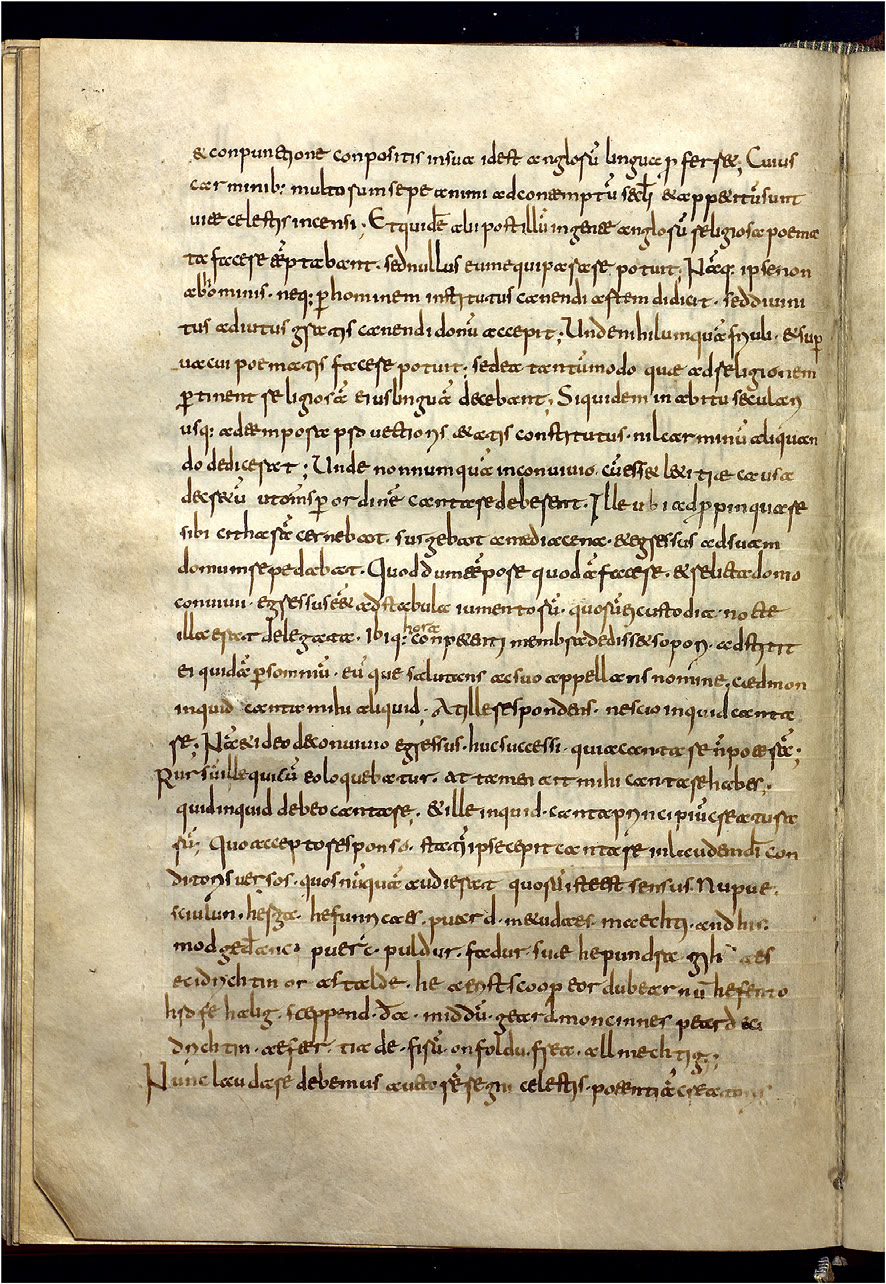
The surprise in the newly identified Rome copy of Cædmon’s Hymn is not a lost stanza. The poem still occupies nine compact lines. God still shapes heaven and appoints middle-earth for human beings. What has changed is smaller and, for a translator, more exciting: this witness gives the opening an explicit we, calls humanity the children of earth rather than the children of men, and uses dense, apparently word-separating dots at the poem’s beginning and end.[1]
Those details do not produce a new poem. They expose how unstable the familiar one has always been.
The hymn is often introduced as the earliest known poem in English, composed in the seventh century and preserved because Bede told Cædmon’s story in his Latin Ecclesiastical History. Its two oldest vernacular witnesses—the Moore Bede and the St Petersburg Bede—have long supplied the Northumbrian text printed in anthologies.[2][4] The Rome manuscript, copied at the Abbey of Nonantola in northern Italy between about 800 and 830, is now the third-oldest surviving witness. It was hiding in a book scholars knew, lost track of, and finally had digitized after a fresh inquiry in 2025.[1][3]
Its importance is not simply age. It is the earliest witness to the Northumbrian eordu recension, moving the latest date by which that recension must have existed back by more than three centuries.[1] Translation now has to listen harder to words that once looked late.
Begin with “now”—then account for “we”
Magnanti and Faulkner’s normalized critical edition opens:
Nu pue sciulun herga hefunricaes puard.
A deliberately plain rendering would be: “Now we must praise heaven-kingdom’s guardian.”[1][5]
Every word resists a little. Nu is “now,” but this is not merely a timestamp. It launches the poem as an action already due. Sciulun can become “must,” “shall,” or the softer “should.” Herga is praise as a verb, not admiration as a mood. The compound hefunricaes compresses “heaven” and “kingdom,” while the Continental scribe writes puard with <p> where an English exemplar would normally use wynn <ƿ>; the word names God as guardian or keeper.[1][5]
Then there is pue: we. The two older Northumbrian copies begin without an expressed pronoun, Nu scylun hergan, a construction whose difficulty has generated competing explanations. Editors may infer an unexpressed first-person plural subject or take uerc, “works,” later in the sentence as the subject, at the cost of unusually tangled syntax. The University of Toronto’s “Now let me praise” is a singular editorial rendering, not a singular voice encoded by those witnesses.[2][4]
O’Donnell treats the explicit pronoun as the easier, likely secondary reading: a scribe could have clarified the difficult construction, perhaps under the influence of Bede’s first-person-plural Latin paraphrase.[2] Rome does not overturn that argument or prove that Cædmon’s original began with “we.” It establishes that the explicit-we tradition existed by the early ninth century, and it gives a translator following this witness a textually explicit collective voice. “Let us praise” sounds invitational; “we must praise” sounds obligatory. Both keep the plurality Rome actually supplies.
Praise becomes a chain of made things
After its opening summons, the hymn does not retell Genesis scene by scene. It accumulates names for God and verbs of construction. He is the Measurer, the Glory-Father, the eternal Lord, the holy Shaper, mankind’s guardian, the almighty ruler. His might and modgeðanc—mind-thought, purpose, or design—become visible through puerc, work.[1][2][5]
That repeated naming gives the short poem its movement. “Creator” is convenient English, but using it every time would flatten the Old English sequence. “Measurer” suggests order and proportion. “Guardian” makes creation something kept as well as made. “Shaper” keeps the pressure of craft. “Glory-Father” imports the compressed strangeness of the compound instead of translating it into ordinary devotional prose.
The verbs matter just as much. In this translation, God “establishes” the beginning of wonders, “shapes” heaven, and later “appoints” middle-earth for people; “prepares” would also be possible. Creation is not a single flash repeated in synonyms. It moves from intention to making to arrangement.[1][2][5]
The poem’s most immediately pleasurable image is architectural: hefen to hrofe, heaven as a roof.[1][2][5] The phrase brings the largest possible scale into the experience of standing indoors. Heaven is not an abstract upper region; it is the shelter overhead. The next movement turns to middumgeard, the middle enclosure or middle-earth. Cosmic space becomes legible through the built environment: roof above, inhabited enclosure below, a world appointed for living people.
That is why a translation full of elevated Latinate words can miss the poem’s texture. Its theology is grand, but its imagination is handled. Might appears as work. Heaven behaves like a roof. The world is shaped for bodies that need somewhere to stand.
“Children of men” or “children of earth”?
At the hinge between heaven and the human world, the two oldest witnesses read aelda barnum: God first shaped heaven for the children of men. That wording yields the familiar “sons of men”; the University of Toronto rendering uses precisely that phrase.[2][4][5]
The Rome witness instead reads eordu bearnum: for the children of earth.[1][2][5]
Only one word changes, yet the poem’s center of gravity shifts. “Children of men” is genealogical: it uses a familiar formula to imagine humanity through descent. “Children of earth” is material and spatial. It names people through the earth, while the closing firum on foldu places them “on the land”; middle-earth, not the land itself, is what the verb says was appointed for them.[2][5]
It would be anachronistic to recruit that phrase as medieval environmentalism. The hymn remains Christian praise, not a modern ecological manifesto. Still, “children of earth” changes the relation created by the line. Humanity is not merely the beneficiary waiting below while heaven is built. Human beings are named through the substance and place of the created world.
Before the Rome discovery, O’Donnell had already argued that eordu bearnum could be the more difficult—and therefore potentially earlier—reading. “Children of men” was a familiar poetic formula; a scribe encountering the unusual but meaningful “children of earth” would have an obvious conventional substitute available. The reverse change is harder to explain.[2] That is an editorial argument, not a time machine: difficult readings are not automatically original.
The new witness changes the weight of that argument. Until now, the earliest known copy of the eordu recension came from the twelfth century. Rome pushes evidence for that recension back to the early ninth. Magnanti and Faulkner therefore conclude that “children of earth” may represent the original reading, while carefully stopping short of certainty.[1]
The responsible translation choice is not to declare a winner and hide the dispute. It is to choose a base text, translate it clearly, and keep the alternative visible. A Rome-based version should say “children of earth.” A note should tell readers that the two still older pages say “children of men.” The difference belongs to the poem’s life, not to an editor’s wastebasket.
The dots gather at the poem’s edges
On the manuscript page, the most unusual feature is quieter than either we or earth. The scribe combines spacing with puncti that are especially frequent in the opening lines and final one-and-a-half lines as modern editors arrange the poem; the middle is more lightly pointed. One dot even divides middum geard, which modern editors treat as a compound. No other surviving copy of Cædmon’s Hymn is punctuated this way, and comparable interword pointing is otherwise unknown in manuscripts containing Old English.[1]
The dots are not a performance score. They do not consistently mark half-lines or metrical pauses. Magnanti and Faulkner suggest they may descend from the Rome copy’s exemplar; the model remains uncertain, though inscriptions cut in stone are one possibility.[1] Visually, however, they make the vernacular look handled word by word. A scribe who seems not to have known English orthography well—he repeatedly substitutes p for wynn—still preserves a remarkably good text and gives many small units at the poem’s edges emphatic boundaries.[1]
Placement carries another kind of emphasis. Bede rendered the poem’s sense in Latin rather than recording the Old English lines in his original narrative. In the two older manuscripts, readers supplied the vernacular at the edge or end of the Latin book. In Rome, the Old English is copied directly into the main text, between Bede’s introduction and his Latin paraphrase, with no visual announcement that a foreign language has interrupted the page.[1][3]
That integration is an act of reception. By embedding the vernacular between Bede’s introduction and Latin paraphrase, the manuscript records an early Continental tradition in which the poem was treated as integral to this passage. The page cannot show whether the Rome scribe consciously corrected an absence or simply reproduced an exemplar.[1][3]
A working translation with its seams showing
Read from the Rome critical text, the hymn can sound like this:
Now we must praise heaven-kingdom’s guardian, the Measurer’s might and his mind’s design, the Glory-Father’s work—how the eternal Lord established the beginning of every wonder. He first shaped, for the children of earth, heaven as a roof, the holy Shaper; then mankind’s guardian, the eternal Lord, afterward appointed middle-earth for people on earth, the almighty ruler.[1][2][5]
This version chooses “must” to keep the opening pressure, “we” because Rome supplies the pronoun, and “children of earth” because it follows Rome’s recension. It varies God’s titles rather than smoothing them all into “Creator.” It also leaves the final syntax slightly compressed. The Old English stacks acts and titles so tightly that polished English can become less faithful precisely by becoming easier.
A different responsible translator could choose “let us,” “purpose,” “made,” or “prepared.” The point is not that the Rome manuscript has delivered a single perfect English version. It has made the cost of each version easier to see.
That is the deepest pleasure of the discovery. A very old poem has not become newly relevant because a manuscript conveniently made it agree with us. It has become newly alive because the manuscript gives old disagreements new physical evidence: pronounless or explicit-we openings, “children of men” or “children of earth,” ordinary word division or an unusually interpuncted witness. Translation begins there—not by erasing those alternatives, but by letting a nine-line poem keep the long history inside it.
Sources
- Elisabetta Magnanti and Mark Faulkner, “A New Early-Ninth-Century Manuscript of Cædmon’s Hymn: Rome, Biblioteca Nazionale Centrale, Vitt. Em. 1452, 122v,” Early Medieval England and its Neighbours 52 (2026), e9 — discovery report, critical text, textual history, punctuation study, and archival image source.
- Daniel Paul O’Donnell, “Filiation and Transmission,” in Cædmon’s Hymn: A Multimedia Study, Edition and Archive (SEENET/D. S. Brewer, 2005; online revision 2018) — recensional variants, the case for eordu bearnum, the explicit-versus-pronounless opening, and the closing syntax.
- Trinity College Dublin, “New copy of earliest poem in English language discovered by Trinity researchers in Rome” (April 30, 2026) — institutional account of the identification, provenance, digitization, and significance of the Rome manuscript.
- University of Toronto Libraries, Representative Poetry Online, “Cædmon’s Hymn” — transcriptions of the Moore and St Petersburg Northumbrian witnesses, a modern English translation, and reception context.
- Joseph Bosworth and T. Northcote Toller, An Anglo-Saxon Dictionary Online (Faculty of Arts, Charles University) — lexical reference used to check the Old English glosses and translation ranges.