A bunch of yellow flowers should be a small pleasure. In Edith Wharton's Bunner Sisters, it becomes a way of measuring how far two people have moved apart. The first time Evelina brings jonquils home, she arranges them for a man she hopes will change her life. Near the end, a child brings her the same flowers. Her sister remembers everything; Evelina falls asleep.[1]
Between those appearances lies a marriage, a separation, and the destruction of a small business. Yet the flowers have lost none of their freshness. That is the disturbing precision of Wharton's recurring objects: they remain available when the lives once gathered around them cannot be restored.
Written in 1892 and published in Xingu and Other Stories in 1916, the novella follows Ann Eliza and Evelina Bunner, who keep a modest shop near New York's Stuyvesant Square.[2] Hermione Lee's introduction to the Everyman's Library edition places it among Wharton's insufficiently recognized portrayals of people struggling to earn a living.[3] Its clock, flowers, and window carry that struggle into the love story. Each has a practical use before it acquires a symbolic burden.
The discussion below includes the ending.
The clock: a gift that needs tending
In Part I, section I, Ann Eliza gives Evelina a nickel clock for her birthday. The purchase is an extravagance within their household, though the narrator identifies it as the sort sold for a dollar seventy-five. That double valuation matters: an ordinary commodity can contain an extraordinary amount of someone else's care.[1]
Buying the clock introduces Ann Eliza to the repairer Herman Ramy. Its need for attention helps bring him into the sisters' home. The gift therefore does something more consequential than remind them that they are aging. It creates a route by which a stranger can enter an established domestic routine and become its authority. Before long, they consult him about their affairs.[1]
Wharton stages the cost of that change through a tiny movement in section V. Evelina and Ramy admire the jonquils, pleased to discover that they have made the same remark about spring. Ann Eliza moves away, remembering that she has neglected to wind the clock. While the younger sister enjoys the possibility of romance, the older one attends to the mechanism that keeps the room going. The gesture anticipates a division already forming between them: one may imagine an escape because the other remains available to do the work.[1]
Later, the clock's sounds measure the emptiness of Ann Eliza's waiting. In Part II, section X, the motif grows almost grotesquely large when she visits Ramy's former employer to seek news. A vast clock department surrounds her with competing noises and expensive cases. Here she learns that he was dismissed for drug use. The craft that seemed to guarantee his dependability cannot guarantee his conduct.[1]
But the birthday present never becomes a neatly cursed object. When Evelina returns ill, she discovers that Ann Eliza has given it to Mrs. Hawkins, who is kept awake by her baby. Evelina says, “I wish you'd never bought it.” Her regret is understandable; it does not prove that the gift caused everything that followed. The clock has passed into another household's ordinary needs. Wharton lets its usefulness outlive the disastrous hopes attached to it.[1]
The flowers: skill, desire, and unequal memory
The shop window initially displays artificial flowers among sewing materials and preserves. Their faded appearance suggests limited trade, but making them is skilled work. Evelina's talent for trimming bonnets helps sustain the sisters' livelihood. When she leaves, Ann Eliza cannot simply reproduce that talent, and customers drift away.[1]
That practical distinction prevents an easy reading in which artificial flowers mean falsehood and living flowers mean truth. The manufactured blossoms belong to the sisters' competence. The fresh jonquils, by contrast, accompany a deeply unreliable romantic prospect.
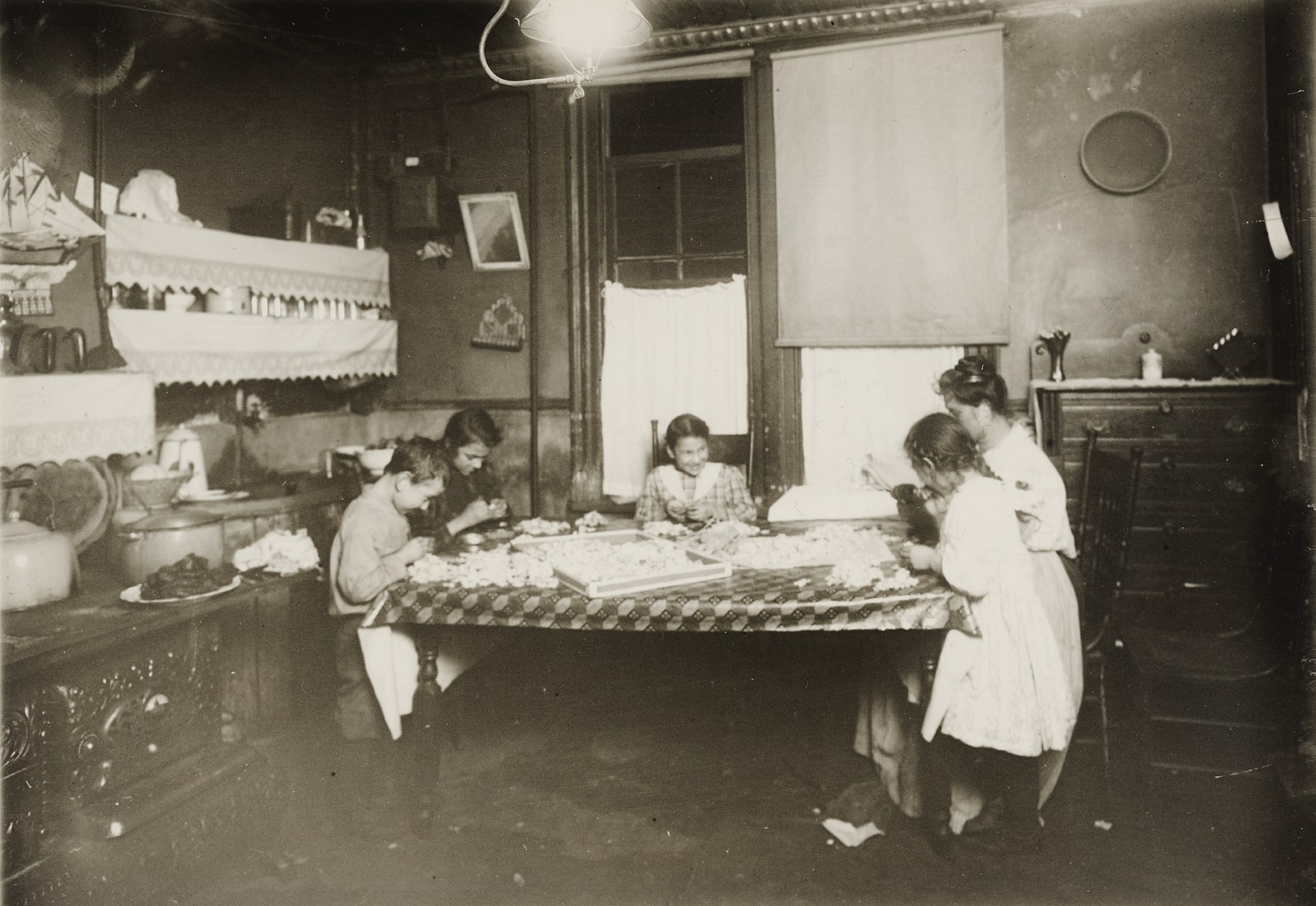
When Evelina buys jonquils in Part I, section V, she replaces dried grasses in a vase with fresh stems, lingering over their arrangement. For once, flowers answer her own desire for beauty. They are neither stock awaiting a buyer nor materials awaiting work. She is spending on pleasure.[1]
Then the arrangement becomes a little stage. The flowers stand between her and Ramy; Ann Eliza watches from the edge of their conversation. That night Evelina presses a jonquil into her prayer book with an air of wanting her sister to notice. The blossom becomes a keepsake almost before there is an event worth preserving. Evelina is helping a romance take shape by giving it an object.[1]
The return of the flowers in Part II, section XIII, reverses that process. Johnny Hawkins brings two jonquils that have blown off a flower seller's cart. No lover has bought them. The child simply gives away an unexpected possession. As Ann Eliza sews beside Evelina's sickbed, the machine's “click, click, click” recalls the old clock, joining sound and colour into a painfully vivid reconstruction of the earlier evening.[1]
The reconstruction belongs to Ann Eliza. Evelina's sleep interrupts the reunion her sister's memory seems to promise. Wharton gives the reader the satisfaction of recognizing a recurring image, then denies the characters a shared recognition. A motif can return on the page while its meaning fails to pass between people.
Soon afterward, Evelina asks to make artificial flowers again. Ann Eliza brings out the stems, petals, wire, and tools. The work slips from Evelina's hands. Once more, materials are ready for use when the person who knew how to use them is no longer able. Her brief revival of interest cannot restore either her health or their business.[1]
The window: from a place of work to a test of worth
In the opening section, the sisters' clean window offers relief from the neglected street. Its display may be tired, but someone has washed the glass, arranged the goods, and maintained an orderly interior. Wharton makes the shop's modest dignity visible through accumulated tasks.[1]
After Evelina's death, the window is empty. Ann Eliza closes the premises and walks toward Broadway, looking for work. At another shop she finds the things hers might once have become: bright goods, fresh curtains, a thriving appearance. There is even a notice: “Wanted, a Saleslady.”[1]
The resemblance initially gives her courage. It also prepares the final cruelty. The young proprietor assumes that Ann Eliza has come to recommend someone else. Her requirements include youth, pleasing manners, and good looks: “Not over thirty.” Ann Eliza leaves without explaining why she entered.[1]
The window has changed sides. Once it displayed what she and Evelina could make and sell. Now it advertises a vacancy for which Ann Eliza herself must meet the shop's standards of attractiveness. Her years of work have left her with experience, but the encounter never reaches the point where experience can be considered.
Outside, spring makes the city appear full of “innumerable beginnings.”[1] The phrase offers no promise that Ann Eliza will share in them. Like the jonquils, the season returns with perfect indifference to the possibility of recovery.
She continues looking for another sign. Wharton leaves that movement intact: Ann Eliza is still trying. But the repeated objects have taught us to distinguish persistence from renewal. A clock can find another use, flowers can bloom again, and another shop can flourish. None of those continuities gives the sisters their life back.
Sources
- Edith Wharton, Bunner Sisters, Project Gutenberg ebook 311 — primary text; especially Part I, sections I and V, and Part II, sections IX–XIII.
- Judith E. Funston, “Bunner Sisters,” in the Edith Wharton Society's “Summaries and Discussion Questions” — composition date, publication context, and setting.
- Hermione Lee, introduction to Ethan Frome, Summer, Bunner Sisters, Everyman's Library, 2008 — publisher-hosted excerpt on Wharton's treatment of poverty and work.
- Lewis Hine, Pollinni family making artificial violets, January 29, 1912 — Preus Museum reproduction, “Child Labor in United States 1912a.jpg,” Wikimedia Commons; image provenance and description.