Many first-time readers approach Buddenbrooks as a duty novel: a large German family chronicle one is supposed to respect, summarize, and file away under "decline of the bourgeoisie."[3][4] That is not wrong, but it is a poor entrance. The cleaner way in is to stop asking the book to move like a plot machine and instead watch the three instruments by which it measures pressure: the ledger, the dining room, and Hanno's music.[1][2] Once you read those rhythms, Thomas Mann's first novel stops feeling bulky and starts feeling exact.
That approach also fits the book's public afterlife. Britannica defines the novel through a double movement that matters for any reader now: it is both the fall of a merchant family and an early expression of Mann's ambivalence between artistic inwardness and bourgeois life.[3] The Nobel Prize page sharpens the same point from another angle, calling Buddenbrooks the breakthrough work that earned Mann recognition and noting that its subtitle in German means "a family's decline."[4] Read as guidance rather than monument, the novel becomes easier to enter. Its real question is not simply what happened to the Buddenbrooks. It is what a house built on continuity can still hand down once taste, nerves, money, religion, and art stop reinforcing one another.
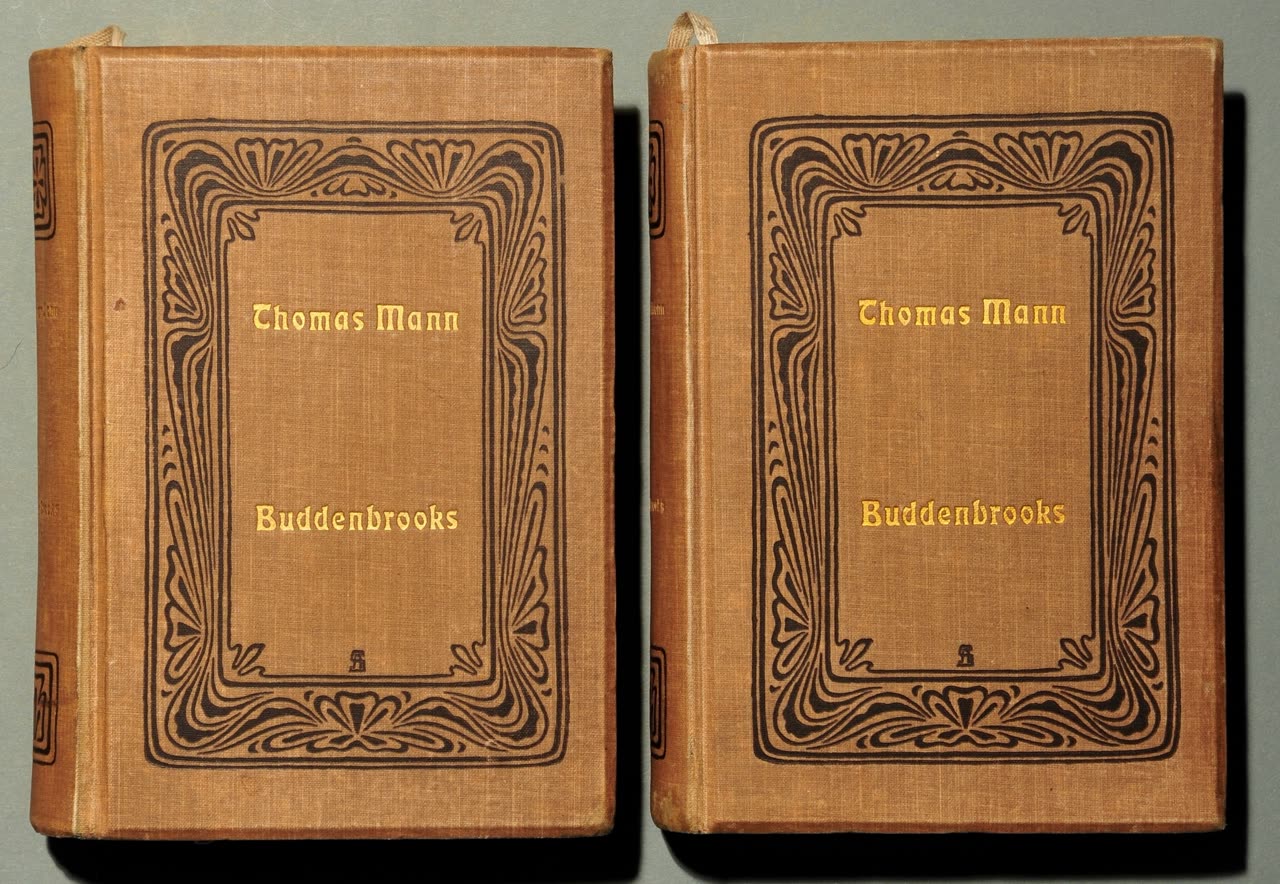
Image context: the cover uses a real photograph of the 1901 first-edition two-volume Buddenbrooks from Wikimedia Commons rather than a generic stock image of old Europe. That choice keeps the emphasis on the novel as a material object of inheritance and record, which is exactly how the book wants to be read at first: as something a family writes itself into, then slowly out of.[6]
1) Start with the house and the book of records, not with the whole genealogy
The novel is broad, but your first reading should begin locally. Start with the Mengstrasse house, the office, the business hand, the rooms in which people eat and are looked at.[1][5] Mann does not ask you to memorize four generations before anything matters. He asks you to feel what kind of world this is: a north German merchant household where continuity lives in furniture, signatures, meal hours, marriage plans, and the confidence that the family name belongs to the future.[1][3][5]
The scene that gives away the method arrives when Tony reads in the family history-book.[1] Mann lingers over the reverent way births, illnesses, schools, confirmations, and marriages have been entered there in a "stately but simple chronicle style."[1] That scene is a practical key for readers. Buddenbrooks is not only narrating a family; it is showing a family imagining that life can be stabilized by correct entry. The first useful question, then, is not "Who is the protagonist?" It is "What does this family think can be preserved by writing, counting, and recording?"
Once that question is in place, the novel's scale becomes less intimidating. You no longer need to hold everything equally at once. You can read for what gets entered into the record, what escapes the record, and which members of the family feel suited to live inside such a system.[1][4]
2) Treat dinners, visits, and Thursday gatherings as diagnostic scenes
Readers sometimes hurry past Mann's meals, calls, and domestic assemblies as if they were Victorian upholstery. That is a mistake. In Buddenbrooks, the dining room is one of the book's most reliable measuring devices.[1] Dinners tell you who still belongs, who is performing composure, who is being managed, and how much wealth must be converted into ritual in order to look secure. The Mengstrasse house is remembered not only for business and piety but, pointedly, for "such good dinners."[1]
This is why so many apparently social scenes do structural work. The Thursday gatherings, the religious visits, the marriage arrangements, the return invitations, the holiday meals: these are not pauses in the story; they are the story's testing ground.[1] A bourgeois family does not decline only when the balance sheet worsens. It declines when hospitality becomes heavy, when ceremony has to substitute for conviction, and when the table can still be laid beautifully after the inward basis of confidence has started to fray.
If you read this way, even repetition helps rather than hinders. Each recurring dinner or visit lets Mann retake the family's pulse under slightly altered conditions.[1][3] One of the book's quiet technical achievements is that economic history keeps arriving as manners first.
3) Read Thomas, Tony, and Christian as three different answers to inheritance
A second good route into the novel is to stop sorting the main Buddenbrook children into fixed moral types. Thomas is not only duty, Tony not only family comedy, Christian not only weakness. They are three competing responses to the problem of inheritance.[1][2]
Thomas tries to inhabit succession as form. He believes in the office, the title, the maintained front, the usefulness of self-command, and the burden of representing continuity even when continuity has grown expensive.[1] Tony lives closer to the theatre of the family: names, humiliations, marriages, memories, social narration, pride wounded but never fully surrendered.[1] Christian, by contrast, makes the body into a running commentary on the difficulty of bourgeois function. His nerves, complaints, and evasions may look comic, but they also expose how badly this house handles human material that does not convert easily into reliability.[1]
This triad helps because it keeps the novel from shrinking into a lesson about "good" and "bad" descendants. Mann was writing out of a merchant background he both knew and resisted.[4][5] The tension is inside the book from the beginning. What matters is not whether one sibling deserves the inheritance more than another; what matters is what kind of life the inheritance is capable of supporting.
4) Let Hanno's music arrive late and change the meaning of everything before it
The last major adjustment for a first-time reader is Hanno. If you try to read him too early as the secret center of the whole novel, you flatten the earlier volumes. If you treat him as merely the final weak heir, you miss the book's deepest change.[2][4] The best method is to let him arrive on the novel's own schedule and then let his inwardness travel backward across what you have already read.
Mann tells you exactly what kind of pressure Hanno carries. In one crucial scene, he becomes aware of music as "an extraordinarily serious, important, and profound thing in life."[2] That sentence matters because it marks the point at which the family's energies are no longer flowing primarily toward commerce, marriage placement, and civic durability. They are flowing toward sensation, refinement, fragility, and a mode of life the merchant house cannot comfortably house without weakening itself.[2][3][4]
Thomas's hope that the boy might show practical aptitude makes the contrast even clearer.[2] Hanno can still receive the family name, the meals, the rooms, and the habits of distinction; what he cannot easily receive is the old confidence that money, discipline, and public role are enough to organize a life. That is why Buddenbrooks remains more than a business decline saga. The real crisis is reproductive in a larger sense: the family can reproduce status longer than it can reproduce conviction.
5) A practical route through the novel now
If you are reading Buddenbrooks in 2026, keep four running questions beside you:
- What is being entered, counted, preserved, or publicly repeated in this scene?
- What work is the dining room doing here: celebration, repair, concealment, hierarchy, or exhaustion?
- Which family member is carrying inheritance as duty, which as performance, and which as strain?
- Does art or inwardness in this passage deepen the family's life, or quietly pull it away from mercantile continuity?
Those questions keep the novel from becoming either a mere timeline or an abstract thesis about decadence. They turn it back into what it is: an unusually tactile record of a house discovering that its finest sensitivities may also be the agents of its end.[1][2][3][4][5]
That is also why the novel still feels alive. The Nobel citation's "steadily increased recognition" makes sense once you stop reading Buddenbrooks as a museum piece and start reading it as a machine for converting public continuity into private cost.[4] The ledger, the dinner, and Hanno's music are enough to get you in. After that, the family history begins to read itself.
Sources
- Thomas Mann, Buddenbrooks, volume 1 of 2 (Project Gutenberg HTML text, Helen Tracy Lowe-Porter translation).
- Thomas Mann, Buddenbrooks, volume 2 of 2 (Project Gutenberg HTML text, Helen Tracy Lowe-Porter translation).
- Encyclopaedia Britannica, "Buddenbrooks" (publication context, family decline, and art-versus-bourgeois-life framing).
- Nobel Prize Outreach, "Thomas Mann - Facts" (prize motivation and work summary).
- Thomas Mann International, "Lubeck" (Buddenbrook-House history and the novel's setting in the Mann family world).
- Wikimedia Commons, "File:1901 Thomas Mann Buddenbrooks.jpg" (source page for the lead image of the 1901 first edition).