Before Machado de Assis lets Brás Cubas tell us how he died, he lets a worm reach the body first.
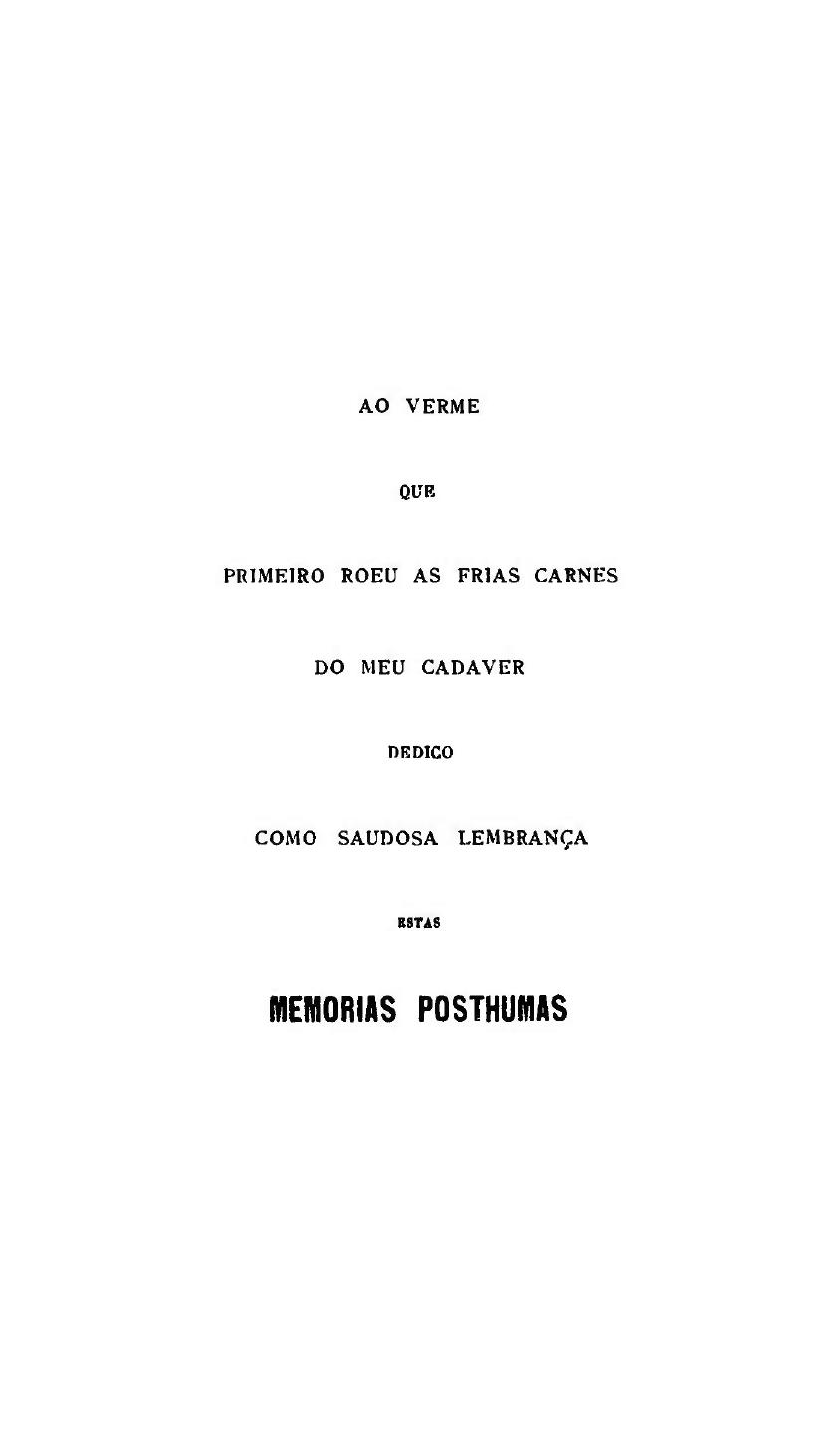
The gesture occupies only a few lines before Chapter I of The Posthumous Memoirs of Brás Cubas. Set apart like an inscription, it reads:
AO VERME QUE PRIMEIRO ROEU AS FRIAS CARNES DO MEU CADÁVER DEDICO COMO SAUDOSA LEMBRANÇA ESTAS MEMÓRIAS PÓSTUMAS.[1]
Literally: to the worm that first gnawed the cold flesh of my corpse, I dedicate these posthumous memoirs as a wistful remembrance. It is a dedication, an epitaph, a joke about readership, and a miniature theory of the novel. The usual dedication sends a book upward or outward—to a patron, beloved, predecessor, or public. Brás sends his downward, into the grave, to an animal that cannot read it. The first audience named by this memoir has already consumed the author in the most literal way possible.
That is why the passage does more than announce a dead narrator. It establishes the terms on which the living reader will be allowed to proceed. We are late. The worm has priority. We may imagine that reading is nobler than appetite, but the dedication puts eye and mouth into uncomfortable alignment: both take in what a dead man has left. Brás flatters us with a book while quietly classing us among its scavengers.
The novel first appeared in installments in Revista Brasileira from March through December 1880, then in book form in 1881.[1][2] Its famous formal games—brief chapters, interruptions, blankness, direct address, false starts—begin before the numbered narrative. This tiny page is the overture. Machado does not ask whether a life can be represented faithfully. He asks who gets to handle the remains.
The page makes the eye descend
The dedication's visual arrangement is part of its meaning. The words do not run as an ordinary sentence. They descend in short centered units: worm, gnawing, cold flesh, corpse, dedication, remembrance, memoir. Reading becomes a controlled drop from recipient to body to book.[1]
That descent reverses the upward motion promised by memorial writing. Memoirs ordinarily rescue a name from death. They gather a life into sequence and offer continuity: the body is gone, but the voice survives. Brás claims that privilege, yet his first page refuses to keep voice and matter cleanly separated. The memoir is not placed above decomposition as its spiritual victory. It is handed to decomposition as a keepsake.
The phrase saudosa lembrança sharpens the absurdity. Saudade carries longing for what is absent; lembrança can mean memory or token of remembrance. But who is meant to remember whom? The worm has no sentimental relation to Brás. Brás, speaking from beyond death, is hardly in a position to miss the creature that ate him. The tender diction has nowhere stable to land. It hangs between corpse, animal, book, and reader until commemoration begins to sound like parody.
Yet the passage is not merely anti-sentimental. Its affection and disgust cannot be pulled apart. Cold flesh is repellent; the formal dedication is ceremonious. The worm is lowly; being first gives it rank. The dead man appears abject; authorship lets him stage the abjection beautifully. Machado's comedy works because every degradation contains a little promotion, and every promotion carries a stain.
Mail Marques de Azevedo identifies the dedication as black humor and places it inside Machado's darker transformation of the comic tradition he inherited from writers such as Sterne.[6] That framing catches the doubleness of the page. Death is not pushed away by laughter; it is brought close enough for laughter to become uneasy. The joke's victim is the dead man, but its target also includes the reader who enjoys his timing.
The worm wins the race for precedence
The quietest important word is “first.” Brás does not dedicate the memoir to worms in general, or even to the worm that ate the most. He honors the one that arrived before the others. Decomposition acquires a winner.
That comic ordinal prepares the status games of the life to come. Brás belongs to the comfortable slaveholding class of nineteenth-century Rio de Janeiro; his story repeatedly converts inheritance, education, romance, office, reputation, and other people into measures of his own distinction.[1][4] Alfredo Bosi's account of the novel insists that its narrator must be read at several levels at once: as a formal experiment descended from Sterne, as a melancholy humorist, and as a social type formed inside the Brazilian Empire. No one frame is sufficient by itself.[4]
The worm condenses those levels. Formally, it is a startling addressee. Existentially, it makes bodily extinction ridiculous and unavoidable. Socially, it introduces a kind of equality that Brás cannot manage: the grave does not preserve the hierarchies by which he understood his life. But even there he cannot resist ranking. There must be a first worm, and the dead proprietor will decide who receives the dedication.
The page therefore does not offer death as moral purification. It offers death as one more scene Brás can arrange. Denise Guimarães describes the dead-author viewpoint as an audacious technical device that lets the narrator move between metaphysical and memoiristic irony while criticizing his material, his readers, and language itself.[3] The freedom is real. So is the arbitrariness. Because Brás can no longer suffer social consequences, he can say what the living man concealed; because he still controls the narrative, candor can become another style of possession.
A preface withholds the reader's dignity
The short address “To the Reader” makes that possession explicit. Brás predicts an audience smaller than Stendhal's imagined hundred—perhaps ten, perhaps five. He calls the book the work of a dead man, describes its mixture of mockery and melancholy, and anticipates pleasing neither grave readers nor frivolous ones. Then he refuses a long explanatory preface, offers the book itself, and dismisses an unsatisfied reader with a figurative flick of the finger.[1]
This is salesmanship performed as disdain. Scarcity makes the reader feel selected: perhaps you are one of the five refined enough to continue. The insult then prevents comfort. You may be chosen, but you are not sovereign. Brás can interrupt, double back, deny explanation, or end the exchange whenever he likes.
The university library at UFRB puts the point cleanly in its institutional reading note: Brás directs his skepticism at humankind and makes the reader one of the victims of his irony.[2] “Victim” need not mean a passive dupe. The novel gives us pleasure, evidence, and ample chances to resist. But it refuses the safer contract in which a memoirist confesses and the reader judges from outside. Brás keeps judging us back.
The worm dedication supplies the physical model for that contract. A worm does not debate its meal. It cannot demand coherence from the corpse or correction from the author. By naming such a creature as his ideal first recipient, Brás imagines an audience with appetite but no reply. The living reader's task is to refuse that role—to enjoy the voice without letting its elegance turn every evasion into truth.
The dead man's frankness is still a performance
It is tempting to treat death as the novel's truth serum. Removed from ambition, shame, and punishment, Brás can admit vanity, cruelty, failure, and waste. He tells his life backward from extinction, so every worldly project arrives already stripped of its claim to permanence.
But disclosure is not the same as accountability. Brás can admit a fault and hurry away before the admission changes how he understands another person. He can make self-indictment charming. He can expose the selfishness of his younger self while collecting the artistic credit for exposing it. Death removes the need to protect a future reputation; it does not remove the pleasure of controlling a present audience.
This is where the dedication earns its place as more than a memorable gag. Brás appears to abase himself by showing us his gnawed corpse. At the same moment, he turns that corpse into a perfectly timed opening effect. He cannot stop decomposition, but he can decide its typography, recipient, rhythm, and punch line. Even abjection becomes authored.
Bosi's three critical registers help preserve the tension.[4] A purely formal reading may admire the audacity and miss the social authority behind the voice. A purely moral reading may condemn Brás and miss how the book recruits our delight. A purely sociological reading may explain his class position while flattening the strange intimacy of a dead man whispering to whoever holds the page. The dedication keeps all three active in eighteen words.
A first edition makes the joke tangible
The digitized 1881 edition still lets the joke arrive as an object. Its title page uses the period spelling Memorias Posthumas de Braz Cubas and names the Typographia Nacional in Rio de Janeiro.[1] The aged page reminds us that “afterlife” here is not only a theme. This particular arrangement of ink and paper has outlasted its author, its original readers, and the bodies of the printers who made it.
Its English-language afterlife has been less continuous. Writing alongside a new translation in 2020, Dave Eggers presented the novel to many readers as an astonishing rediscovery and emphasized its wit, direct address, short chapters, and formal playfulness.[5] That reception is appropriate to a book that makes belatedness its opening condition. English readers arrive after Brazilian readers, modern readers after the serial and first-edition public, every reader after Brás, and Brás after his own death. The worm remains first.
Translation can alter cadence, pun, and the emotional weight of saudade. It cannot dissolve the dedication's central mechanism. A book addressed to the creature that ate its author makes every later act of reading feel both elevated and animal. We turn pages; the worm worked through flesh. We seek meaning; it sought food. Yet both encounters depend on remains.
That resemblance is not an insult to reading so much as a warning against innocence. Readers consume, sort, discard, remember, and sometimes mistake possession for understanding. Brás knows this because he is doing the same thing to his own life. He selects its usable parts, arranges them for effect, and leaves the rest to darkness.
Before Chapter I, then, Machado gives us the whole contest in miniature. A corpse tries to become a book. A book admits that it is still an object. A worm receives a literary honor it cannot appreciate. And the living reader, amused enough to continue, has already accepted the dead man's most dangerous invitation: to believe that our appetite is discernment.
Sources
- Machado de Assis, Memorias Posthumas de Braz Cubas (Typographia Nacional, 1881), Biblioteca Brasiliana Guita e José Mindlin, University of São Paulo—digitized first edition used for the passage and lead image.
- Universidade Federal do Recôncavo da Bahia, “Dica de Leitura: Memórias Póstumas de Brás Cubas”—1880 serial history, 1881 book publication, dead-narrator frame, and reader-directed irony.
- Denise Azevedo D. Guimarães, “Perspectiva narrativa e estatuto do personagem Brás Cubas,” Revista Letras 24 (1975)—study of the dead-author viewpoint, irony, and the narrator-character split.
- Alfredo Bosi, “Brás Cubas em três versões,” Teresa 6–7 (2005)—formal, existential, and sociological traditions in the novel's critical reception.
- Dave Eggers, “Rediscovering One of the Wittiest Books Ever Written,” The New Yorker (June 2, 2020)—English-language reception and discussion of the novel's direct address and formal playfulness.
- Mail Marques de Azevedo, “Aspectos da comicidade em A vida e as opiniões do cavalheiro Tristram Shandy e Memórias Póstumas de Brás Cubas,” Revista Letras 45 (1996)—comparative study of the worm dedication, black humor, and Machado's comic-pessimistic mode.