The most famous sentence in James Joyce’s The Dead is so often quoted as pure lyrical weather that readers can miss its technical force. The snow at the end is not decorative atmosphere. It is the mechanism that lets the story change scale—from one embarrassed husband in a hotel room to a whole island held under the same falling element.
That shift is why the ending still lands. Joyce does not finish by solving Gabriel Conroy’s marriage or by reducing Michael Furey to a romantic rival from the past. He finishes by redistributing attention. Private jealousy, social performance, memory, burial ground, geography, and mortality all enter the same sentence system.[1][2][3]
1) Why the hotel matters before the snow matters
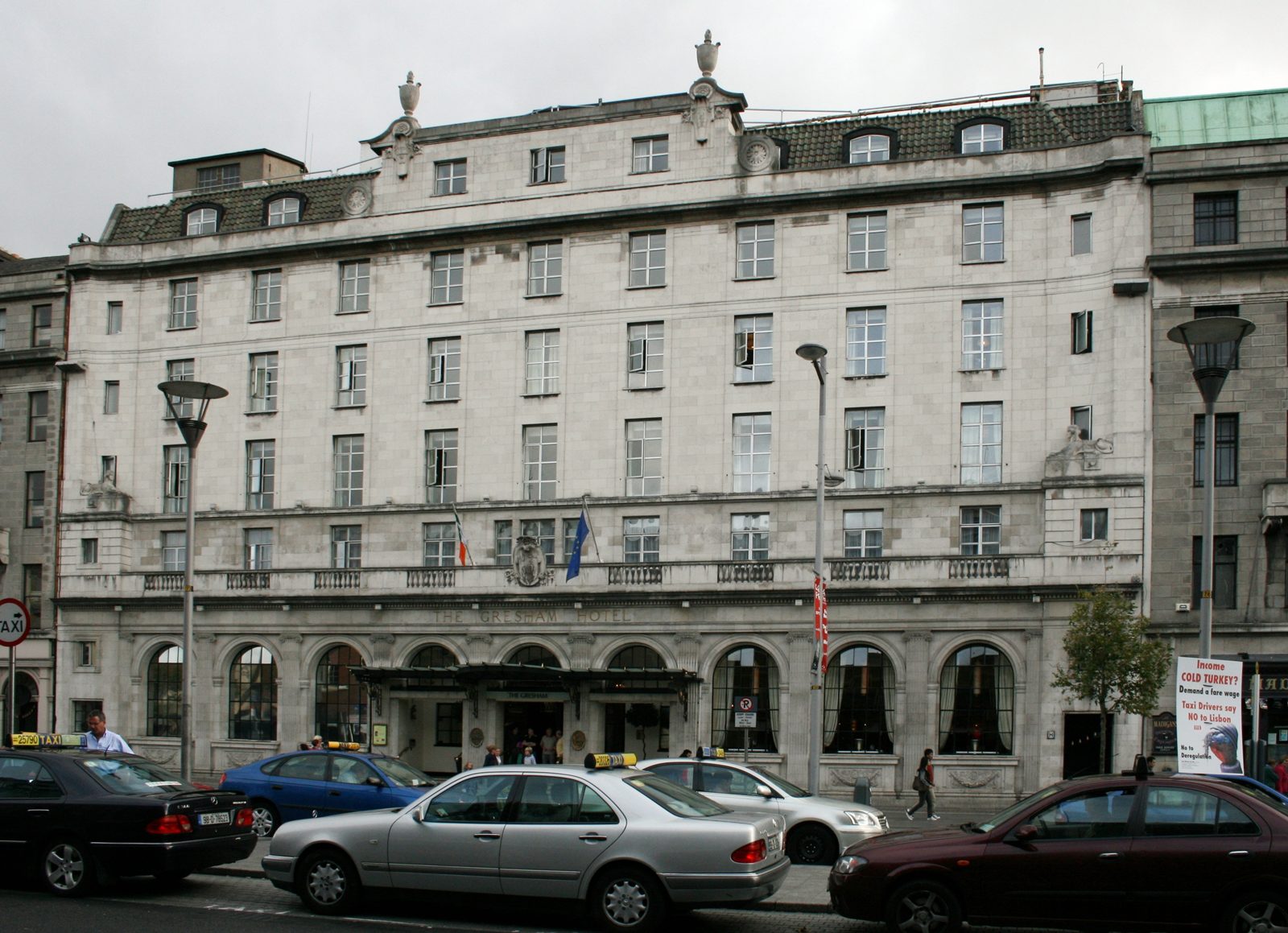
The close reading has to begin one step earlier than the final paragraph. Joyce places Gabriel and Gretta at the Gresham Hotel after the annual holiday party, in a space that feels briefly outside ordinary duty. The James Joyce Centre’s Dublin map highlights the line from the story exactly: at the hotel door Gabriel feels that they have “escaped from their lives and duties” and “run away together with wild and radiant hearts to a new adventure.”[5]
That matters because the scene first presents itself as an erotic reset. Gabriel thinks the night is turning toward intimacy. Instead it turns toward asymmetry. Gretta is absorbed by “The Lass of Aughrim,” then by the memory of Michael Furey, the boy who, in her recollection, stood out in the rain and died young. The hotel matters partly because it is borrowed, not domestic: a rented room where Gabriel briefly imagines he can restart the marriage on neutral ground, only to discover that no room is neutral once memory arrives. The hotel therefore functions as a pressure chamber: social noise is gone, and what remains is a marriage suddenly forced to admit an earlier weather system inside it.[1][2]
Joyce’s technical cruelty is precise. Gabriel is not defeated by an active lover in the present. He is displaced by a memory that reveals how incomplete his knowledge of his wife has always been.
2) The ending begins as a window scene, then refuses to stay local
Joyce starts small: “A few light taps upon the pane made him turn to the window. It had begun to snow again.”[1]
This is ordinary stage business, almost minimal. But the sentence immediately pivots into motion and direction. Gabriel watches the flakes in the lamplight, and then comes one of the most consequential directional phrases in the story: “The time had come for him to set out on his journey westward.”[1]
That westward movement is not travel planning. It is a mental reorientation. West means Galway, where Gretta’s earlier life and Michael Furey belong. West also means the story leaving Dublin drawing-room intelligence and moving toward burial, weather, and the edge of the island. Joyce turns geography into emotional syntax.
This is where the ending stops being merely beautiful and becomes architecturally exact. The snow does not just fall outside Gabriel; it gives his thought a route.
That route also explains why the story refuses to stay inside adultery logic or private confession. Joyce is not asking Gabriel to solve a triangle. He is moving him out of a hotel room and onto a national weather map, where one marriage becomes only one local point inside a much larger distribution of memory, distance, and mortality.
3) Repetition turns weather into distribution
The famous paragraph works through recurrence rather than surprise:
“Yes, the newspapers were right: snow was general all over Ireland.”[1]
Then Joyce repeats the action again and again—“falling” over the central plain, “falling softly” on the Bog of Allen, falling into the Shannon waves, falling upon the churchyard where Michael Furey lies buried.[1]
A weaker writer might have used snow as a symbol and stopped there. Joyce uses it as a distribution system. The repeated verb carries the reader outward from hotel window to national map without losing tactile sensation. We keep hearing the same motion while the field of reference widens.
That is why the ending feels both intimate and continental. The language never becomes abstract enough to leave the room entirely, yet it refuses to stay trapped in the room’s marital drama. Snow becomes the medium through which private humiliation is rescaled into shared finitude.
The numerical and structural facts sharpen this effect. The Dead is the 15th and final story in Dubliners, published in 1914, and the collection itself is arranged as a widening set of social and psychological exposures.[3][4] Britannica’s summary of Dubliners calls “The Dead” the jewel of that structure.[3] The ending earns that position by gathering the collection’s long concern with paralysis, disclosure, and missed vitality into one weather event.
4) Michael Furey changes the meaning of “love,” but the paragraph resists melodrama
One of the best known sentences before the snow paragraph is Gabriel’s inward acknowledgment: “Better pass boldly into that other world, in the full glory of some passion, than fade and wither dismally with age.”[1]
Taken alone, that line can sound like a romantic surrender to the dead boy’s superiority. Read in sequence, it does something more complicated. Gabriel is not simply crowning Michael Furey as the truer lover. He is discovering that intensity exists outside the managerial self-image he has built all evening—speechmaker, reviewer, educated host-nephew, husband who assumes interpretive control.
The ending does not reward that discovery with triumph. It thins Gabriel out. The self that spent the evening calibrating jokes, class signals, and nationalist discomfort gives way to a consciousness that can finally imagine being one finite being among others.[1][2]
This is where critical afterlife matters. Critics and teachers have long returned to the story because the final movement joins tenderness to ego-loss without sentimentality; T. S. Eliot’s praise and later commentary helped fix it as one of the great endings in English prose.[2] That reputation persists because the passage keeps resisting single-key interpretation. It is grief-struck, erotic, national, theological, and anti-grandiose at the same time.
5) “All the living and the dead” is an equalization, not an erasure
The last line remains devastating because it does not separate the living from the dead into stable camps:
“His soul swooned slowly as he heard the snow falling faintly through the universe and faintly falling, like the descent of their last end, upon all the living and the dead.”[1]
The force of the line sits in that final pairing. Joyce does not say the dead replace the living, or that Gabriel should envy the dead, or that memory is more real than marriage. He writes an equalization under shared descent. The dead continue to act inside the lives of the living, and the living are already moving toward the condition of the dead. Snow gives that continuity form.
At the sentence level, Joyce makes that descent audible. “His soul swooned slowly” loosens the rhythm into something nearly exhaled, and the doubled “faintly” turns repetition into drift rather than emphasis. The paragraph does not only describe Gabriel’s diminishing self-importance; it performs that diminishment in sound.[1][2]
That is why the paragraph feels larger than “epiphany” in the simplified classroom sense. It is not a neat lesson learned. It is a reduction of personal vanity under a wider atmospheric order. Gabriel’s real discovery is not that Gretta once loved someone else. It is that every intimate life contains prior claims, buried seasons, and inaccessible depths that no amount of social fluency can master.
In 2026, that remains a modern feeling. We still live among people whose visible present is only the top layer of their actual emotional history. Joyce’s ending survives because it refuses the fantasy of full possession. It gives us, instead, a sentence in which weather becomes ethics: attention leaves the self, crosses the country, touches the graveyard, and returns with a quieter understanding of what it means to be alive among the not-fully-knowable.
90-second reread drill (for the last page only)
If you reopen the story and want to feel the ending’s machinery instead of only admiring its beauty, try this sequence:
- Start at the taps on the pane: notice how Joyce begins with almost trivial stage business before the paragraph widens into national weather.
- Underline every directional or place signal: “westward,” the central plain, the Bog of Allen, the Shannon, the churchyard—these place markers are what turn emotion into map.
- Read the last sentence aloud for sound, not paraphrase: the repeated “faintly” and the drag of “swooned slowly” matter because Gabriel’s shrinking self-importance happens in the sentence’s breath-pattern.
Sources
- James Joyce, Dubliners (Project Gutenberg full text of “The Dead”)
- Encyclopaedia Britannica, “The Dead”
- Encyclopaedia Britannica, “Dubliners”
- Encyclopaedia Britannica, “James Joyce”
- James Joyce Centre, “Joyce’s Dublin” (Gresham Hotel entry)
- Joyce’s Dublin podcast note, “The Dead. Sex, love and longing at The Gresham Hotel”
- Wikimedia Commons, source image page for Gresham Hotel exterior