Before Miles Coverdale can help remake society, an old man asks him for a favor. Coverdale is willing, provided it involves “no special trouble to myself.” Then he goes home to his fire, cigar, and excellent sherry. The communal adventure has barely begun, and its narrator has already supplied a reason to watch him closely.[1]
This is a welcoming entrance to Nathaniel Hawthorne's The Blithedale Romance. Its reformers, mysterious visitors, and concealed attachments can look forbidding from a distance. Up close, the book is funny about comfort and exquisitely alert to the pleasures of curiosity. Begin by enjoying Coverdale's company. Then notice what happens when his pleasure in understanding people becomes a wish to arrange them.
The guide below follows the opening and middle chapters, leaving the final revelations for a first reading.
Take the farmhouse seriously
A little history helps establish what the characters hope to change. Brook Farm, the Massachusetts community that informed the novel, operated from 1841 to 1847. Its participants combined work and education; the community included craftspeople and farmers alongside intellectuals, and ran schools. A fire and financial difficulties contributed to its end.[2]
In his preface, dated May 1852, Hawthorne acknowledges using memories of his own time there. He also insists on his freedom to invent the institution and its inhabitants, and declines to present the romance as a verdict on socialism. That distinction gives a first reader useful room: the historical experiment makes the aspiration concrete, while the fiction asks what these particular people do with it.[1]
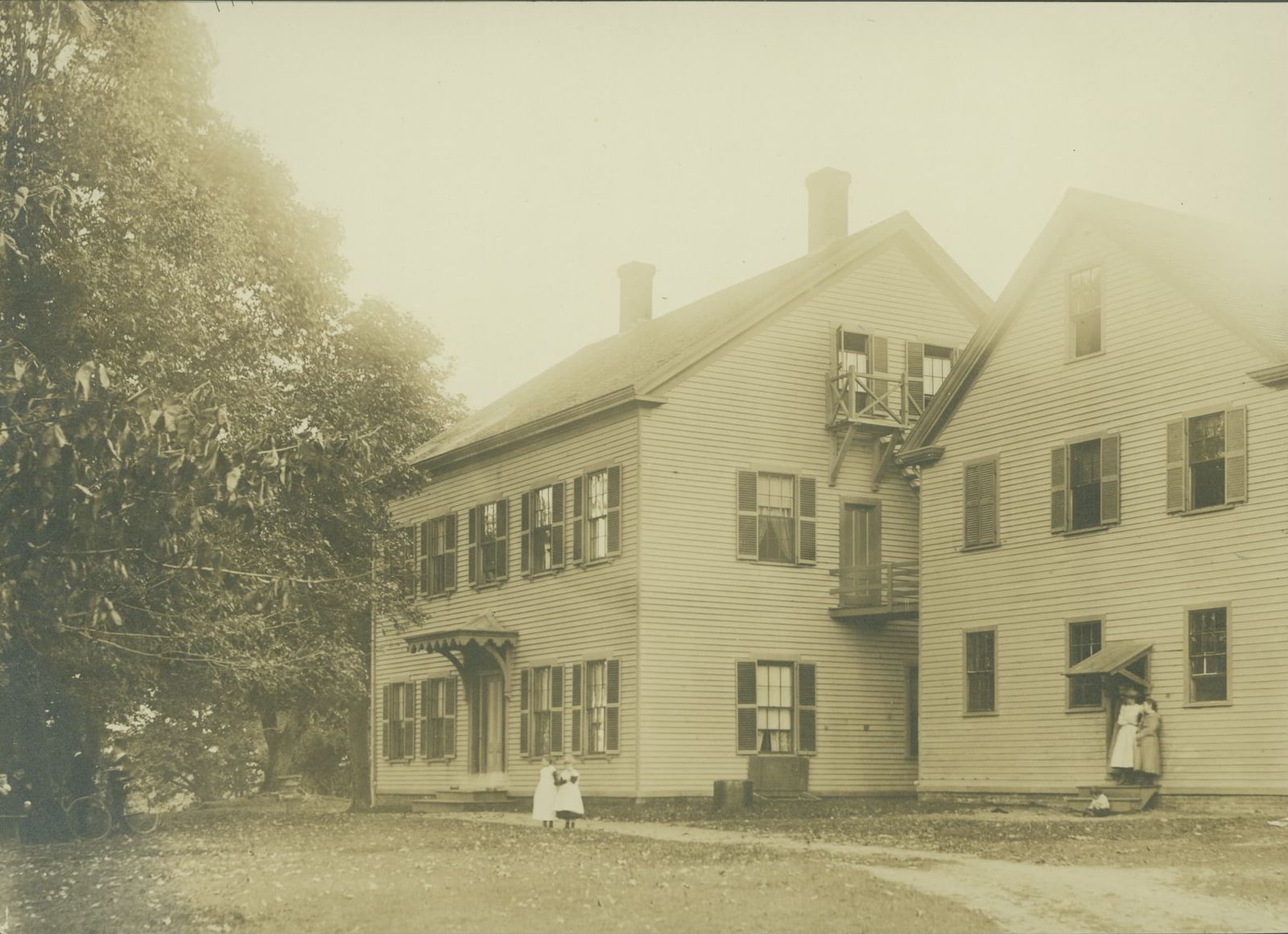
Historic New England's undated photograph preserves another view of Brook Farm: a substantial building, a drive, children outside. The archive does not date the picture to Hawthorne's residence. Look at it for the physical scale of a place where collective life had to happen, with doors to enter and rooms to maintain.[3]
Chapter III brings that maintenance indoors. Zenobia welcomes the newcomers, then explains the cooking, washing, and sewing that the women will initially undertake. Coverdale wishes household labor could disappear from their system. Zenobia answers his fantasy of Eden with the snow outside and the supper she must prepare. Soon the men are discussing humanity's future beside the fire while the women work in the kitchen.[1]
Stay with the jokes about food and warmth. They make the ideals tangible: every declaration about a new society must eventually decide who gets dinner ready.
Meet each person twice
Coverdale introduces people with such vividness that his impressions can feel like their settled identities. Try meeting each character a second time through what that person says or does.
Zenobia, a writer and advocate of women's rights, appears with a striking flower in her hair. Coverdale lingers over her body and interprets the flower as an expression of her character. Meanwhile, she is welcoming guests, organizing supper, and teasing his impracticality. Her activity gives you something against which to measure his portrait.[1]
Hollingsworth is absorbed in reforming criminals. Yet in Chapter VI, when Coverdale falls ill, he also supplies attentive, comforting care. Remember that tenderness when his purpose becomes more demanding. A first impression of generosity and a later impression of severity can both have evidence behind them.[1]
Priscilla arrives shy, poorly dressed, and intensely drawn to Zenobia. Coverdale repeatedly makes her seem fragile and mysterious. Keep noticing her work as well: her skill with a needle belongs to the same person whom his imagination turns into an apparition.[1]
This habit preserves the book's human friction. You can enjoy a beautiful description while allowing its subject more room than the description grants.
Read the qualifications aloud
Coverdale often tells us when his knowledge runs out. The difficulty is that he can produce an enchanting explanation immediately afterward.
In Chapter VI he wonders whether Zenobia has been married. He acknowledges, twice, that he has no factual basis for the speculation. Still, he goes on to interpret her laugh, voice, and freedom of manner as clues. The admission of uncertainty never quite checks the appetite for a story.[1]
Listen for the small shifts between seeing, supposing, and remembering. They are especially revealing in Chapter XII. From a concealed perch, Coverdale overhears fragments of a conversation between Zenobia and Westervelt. Before reproducing their dialogue, he warns that his recollection may have been “patched together by my fancy.”[1]
Hawthorne places the warning where it can easily disappear under the excitement of the exchange. Slow down for it. What you are about to read has passed through a witness's incomplete hearing and later imagination. That does not make every word false; it changes how confidently you can use the scene to judge its participants.
For a first reading, a light pencil mark beside these qualifications is enough. Let the plot move, but keep track of the moments when your guide supplies the missing pieces himself.
Enjoy the view from the tree
Coverdale's retreat in Chapter XII is one of the book's loveliest places: a hollow among pine branches, enclosed by a climbing grapevine. It offers moving air, birds, the scent of the woods, and seclusion for making poems. He cherishes it as “my one exclusive possession” within the communal enterprise.[1]
The shelter also has viewing holes. From above, he observes others working and hears Hollingsworth driving the oxen. His physical height encourages an expansive judgment about the philanthropist's wish to drive humanity. The metaphor is clever. The position from which he makes it is also comfortable.[1]
Then he imagines sending Priscilla a message through a passing bird. He concedes that even his concern for her attaches to the imaginative decoration he has bestowed on her. The admission is startlingly intimate: someone can matter intensely to you while you remain inattentive to the life they actually lead.[1]
Read this chapter slowly enough to feel the attraction of the refuge. Its beauty helps explain Coverdale's behavior. Retreat gives him privacy and language; it also lets observation feel like participation. The reader receives the pleasure of that arrangement before having to reckon with its cost.
Stop at the curtain
The watching continues when Coverdale returns to town. In Chapter XVIII he looks from his hotel toward rooms across the way, where he recognizes familiar figures. Distance prevents him from distinguishing expressions, but he keeps interpreting relationships. Eventually Zenobia sees him and lowers a curtain.[1]
Her gesture puts a practical limit on the narrator's access. Coverdale immediately describes even this rebuff in theatrical terms, as though the people across the way were actors whose performance had paused. A private room has become a stage because he has been looking into it.
Carry that tension into the remaining chapters: what does Coverdale owe the people who make such absorbing material? His curiosity gives us the novel, including moments of sympathy and self-exposure. It can also make another person's crisis feel like an overdue development in a plot.
The free Gutenberg text supplies the chapter numbering used here. Readers who want a print companion can consult the Penguin Classics edition; its publisher foregrounds the distance between the community's ideals and its members' desires.[4] That is a useful question to bring along, provided the answer remains open long enough for the characters to complicate it.
After the last page, return to the old man's request in Chapter I. Coverdale's modest condition on kindness will sound different once you have spent a whole book enjoying his attention.
Sources
- Nathaniel Hawthorne, The Blithedale Romance — primary text, especially Chapters I, III, IV, VI, XII, and XVIII, in Project Gutenberg's edition; the author's May 1852 preface is available in Washington University's text transcription.
- National Park Service, “Utopias in America” — Brook Farm section: the community's dates, membership, educational work, and dissolution.
- Historic New England, “Exterior view of Brook Farm, West Roxbury, Mass., undated” — archival photograph, General photographic collection, reference PC001.02.01.USMA.3320.0070.001.
- Penguin Classics, The Blithedale Romance — edition information and the publisher's account of communal ideals and private desires.