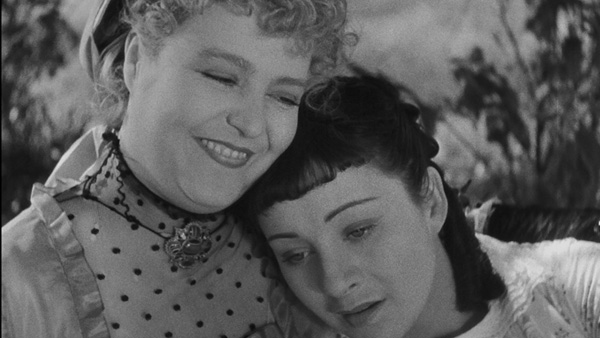
Henriette remembers every evening. That small measure of time survives the journey from Guy de Maupassant's “A Country Excursion” to Jean Renoir's A Day in the Country. What changes is what surrounds it: the man's wording, the years between meetings, the space a face occupies. An adaptation can preserve a sentence while making us hear it differently.[1][3]
The discussion includes the endings of the story and film. Translations from the French texts are my own.
Maupassant's 1881 story takes a Parisian family to the countryside, where Henriette and her mother go boating with two young men. Renoir filmed his adaptation in 1936; production stopped before completion when he left for The Lower Depths. His team assembled the surviving footage into the film released in 1946. Its approximately forty-one minutes contain an afternoon, a separation, and a return.[2][4]
That delayed release belongs to the film's history, but it need not become an explanation for everything mournful on screen. The more revealing comparison is smaller: put the two endings beside each other and listen to what each lets Henri say.
Sundays and every evening
Maupassant brings the pair together again the following year. Henriette has married the young man who accompanied her family; he sleeps beside her. Henri says he often visits the spot on Sundays, resting and thinking of various memories. She answers: “I think of it every evening.” Her husband wakes and announces that it is time to leave.[1]
The mismatch is quietly devastating. His recollection has a place in a leisure routine; hers has a place in each day's ending. We need not decide that one memory is sincere and the other false. The sentence makes a finer distinction between having somewhere to revisit and carrying something home. Frequency becomes an emotional measure without becoming an exact scale of suffering.
There is a trap here for anyone eager to make Renoir the kinder artist. Maupassant explicitly says that Henri never forgot the encounter. The film does not create his attachment. It changes how openly he declares its value.[1][3]
In the screenplay excerpt reproduced by La Colline, Henri calls these his “best memories.” Henriette retains her nightly remembrance. The shift from various memories to best memories gives his recollection a declared rank. A listener can still doubt how much the words promise, but they now offer her something more definite to answer.[3]
That is where I locate the adaptation's tenderness: in the opportunity for recognition. Recognition remains a very small gift. It cannot return the intervening time or establish what either person would have done with a different life. The scene offers the pleasure of being remembered and the pain of discovering how little that knowledge can change.
The beauty does not settle the encounter
Reading backward from the reunion makes the earlier afternoon harder to classify. In the French story, Henriette resists Henri's kiss; he presses his body over hers and persists before the narrator describes her reciprocating. The nightingale's extravagant song eventually gives way to a human sob. These details interrupt any account of the excursion as uncomplicated happiness.[1]
The difficulty belongs inside the literary reading. A narrator can move from resistance into the language of desire without making those stages ethically interchangeable. Nor does Henriette's later attachment authorize us to erase the earlier resistance. Remembering an encounter, wanting something from it, and having freely chosen everything that happened are different propositions.
Renoir's critical afterlife shows how readily the film's beauty invites a romantic vocabulary. Heather Stewart's BFI appreciation emphasizes the swinging movement, Joseph Kosma's yearning score, and Sylvia Bataille's performance. She reads the close-up as a passage from hesitation into love. That response helps explain the film's attraction: its landscape and music make feeling seem expansive enough to fill the world.[5]
Gilberto Perez's Criterion essay attends to a more confined image: Henriette's face tightly cropped, one tearful eye visible as Henri lies above her. Perez interprets the tears through awakening sexuality and fear that the romance will end. His interpretation is a reading of the image, rather than a verdict the image compels.[4]
A close-up can give a character overwhelming presence while leaving her feelings difficult to name. That is part of its force here. The audience receives the face without receiving an instruction adequate to everything in it. Read beside Maupassant, the shot asks for attention that the words idyll and seduction can too easily abbreviate.
The reply becomes visible
The film also lengthens the separation. Its intertitle announces that years have passed. In the published screenplay, Henri's declaration and Henriette's reply receive successive close-ups; Anatole wakes, she cries, and another close-up returns to Henri. After the husband's instruction to leave, the script allows her a tearful assent. Maupassant ends with the husband's words.[1][3]
Le Cinéma, cent ans de jeunesse's account of the finished sequence adds a useful spatial detail: a branch separates the pair as the camera alternates between them. The husband occupies the same place that preserves the earlier encounter. The lovers can return to the location without recovering the arrangement of people that once made it possible.[6]
These choices make the ending last beyond the interruption. On the page, the husband's final sentence shuts the scene. On screen, a response has a body and takes time. We must remain with the person who has heard the command. Her departure becomes something experienced as well as something announced.
Renoir's afterlife for the story therefore rests on more than beautiful scenery or a sympathetic performance. It exposes how much emotional weight can move when reported speech becomes a declaration, when a reply receives its own shot, and when an ending stays long enough to register its cost. Henriette's sentence survives. The adaptation changes how long we have to sit with it.
Sources
- Guy de Maupassant, “Une partie de campagne,” in La Maison Tellier, P. Ollendorff, 1891, pp. 231–256; Wikisource transcription linked to the scanned edition — the encounter and final reunion.
- The Criterion Collection, A Day in the Country — production history, 1936 filming, 1946 release, runtime, and credits.
- Jean Renoir, screenplay excerpts reprinted in La Colline's Liliom programme, printed pp. 22–23, PDF page 12; citing Le Livre de Poche, 2008, pp. 82 and 86 — time transition, final dialogue, and shot directions.
- Gilberto Perez, “A Day in the Country: Jean Renoir's Sunday Outing,” The Criterion Collection, February 10, 2015 — literary context, critical interpretation of Henriette's close-up, and source of the photographic film still.
- Heather Stewart, “BFI Recommends: Partie de campagne,” British Film Institute, April 29, 2020 — a romantic reading of performance, camera movement, and music.
- Le Cinéma, cent ans de jeunesse, “Une partie de campagne” — written analysis of the final sequence, its branch, shot/reverse-shot arrangement, and departure.