The watches in Owen Warland’s shop face away from the street. A passerby can look at their cases but cannot use them to tell the time. Before Nathaniel Hawthorne explains the young watchmaker’s secret ambition, his window has already made a small, awkward distinction between displaying something and being useful to someone.[1]
In “The Artist of the Beautiful,” Owen spends years making a mechanical butterfly. His neighbours struggle to see why. Yet the story’s objects refuse to settle into a simple division between art and ordinary work. A blacksmith supplies an indispensable tool; a delicate needle destroys; a huge finger becomes a landing place. Following the watches, hands, and butterflies reveals how often the meaning of an object changes with its use.
This essay discusses the ending. Paragraph references follow the numbered edition in source 1.
The clocks work when their keeper gives up
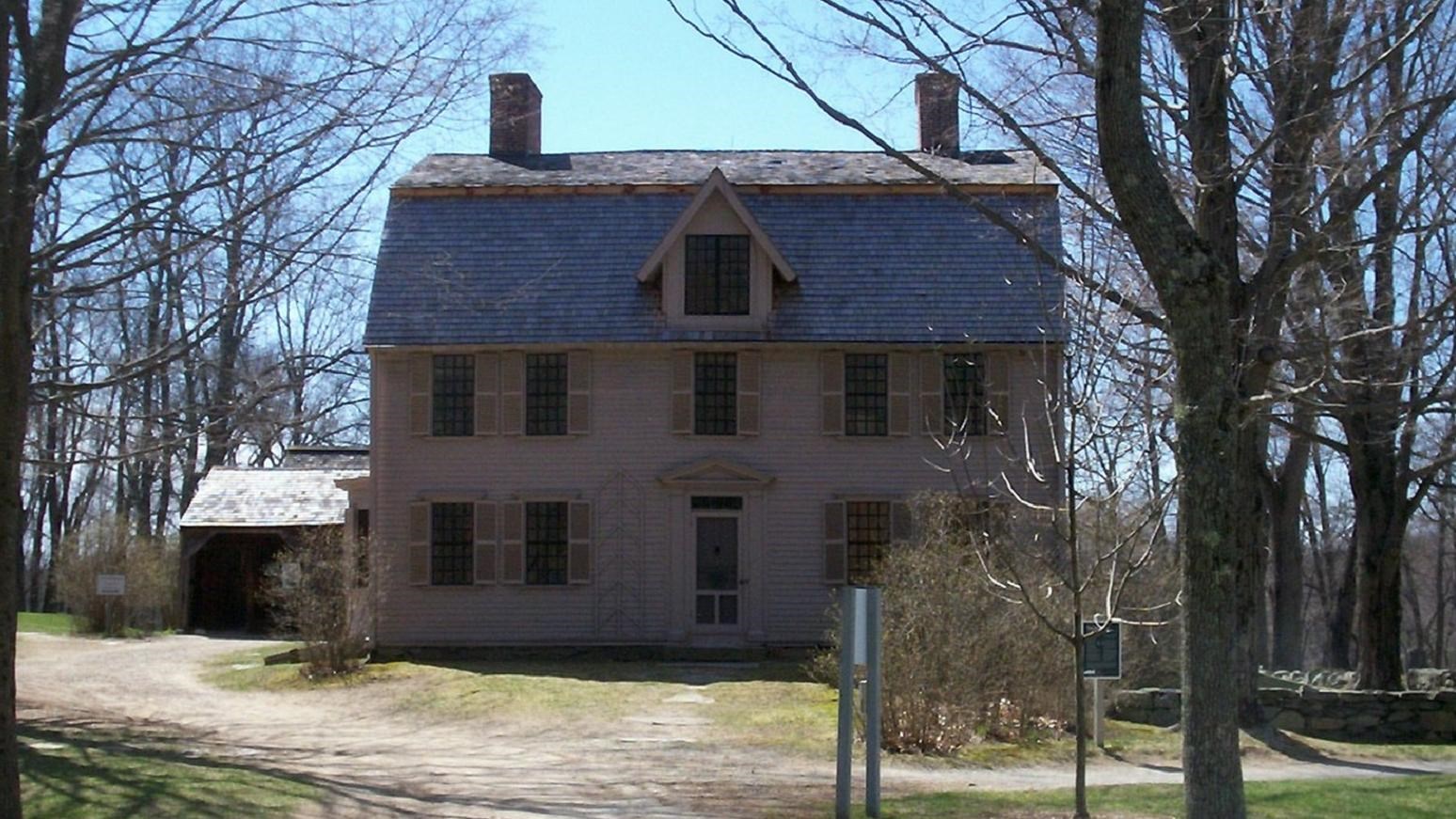
The story appeared in June 1844 and entered Mosses from an Old Manse in 1846. Its collection title points toward a real household: Nathaniel and Sophia Hawthorne lived at the Old Manse in Concord from 1842 to 1845. The story itself places the struggle over creative work in a shop, where a customer’s reasonable expectations can collide with the maker’s private purpose.[1][2]
Owen’s trouble is not that he cannot understand a watch. He grasps the mechanism unusually quickly. His apprenticeship is meant to put that talent to practical use, but once he has a business of his own, repairs become opportunities for invention. He adds music to watches and moving figures to family clocks. Customers who wanted reliable timekeeping receive his interpretation of passing time instead (paragraphs 12–13).[1]
There is comedy here, including some at Owen’s expense. The owner of a familiar clock has not commissioned a miniature funeral procession. Hawthorne lets us feel the attraction of the embellishment without pretending that everyone must welcome it.
After Owen damages his secret project, he becomes an excellent repairer. His successful work on the church clock helps merchants, a nurse administering medicine, lovers arranging a meeting, and households awaiting dinner. These are tangible benefits. At the same time, he loses the ornamental flourishes he once engraved on silver spoons (paragraph 28).[1]
The clock therefore does more than represent oppressive regularity. It coordinates a town. The unsettling part is the coincidence between its improved performance and Owen’s diminished spirits. His neighbours can measure his recovery only by how well he now serves them.
Later, as he returns to his project, the clocks under his care become unreliable again. Hawthorne preserves the inconvenience. Owen’s artistic renewal does not automatically settle his obligations to other people.
A hand can help before it hurts
Robert Danforth, the blacksmith, lays his enormous hand beside Owen’s delicate one and boasts of his strength. Owen calls strength an “earthly monster.” But Robert has just brought him a small, specially made anvil, and Owen has approved its workmanship (paragraphs 16–18).[1]
That tiny anvil complicates their argument. The coarse-looking craft has supplied what the finer craft needs. Robert also offers further help. His inability to understand Owen’s ambition coexists with practical generosity; the artist depends on a form of work he dismisses.
Nor does the first disaster come from Robert smashing anything. After the visit, Owen makes the damaging stroke himself. He attributes his error to the blacksmith’s disturbing influence. The distinction matters: another person’s judgment has unsettled the hand doing the work (paragraphs 23–25).[1]
Annie Hovenden, whom Owen loves, brings a different kind of threat. She arrives with a worn thimble needing repair and remembers his childhood idea of putting spirit into machinery. For a moment, she appears capable of understanding him. Then she touches his mechanism with the point of a needle and undoes months of work. Owen seizes her wrist hard enough to make her scream (paragraphs 41–53).[1]
The fine tool can destroy, and the supposedly fragile man can hurt someone. Hands do not carry fixed moral meanings according to their size. What matters is the relation between the person touching and the thing—or person—being touched. Annie’s curiosity lacks the care the mechanism requires; Owen’s anguish briefly overwhelms his care for Annie.
The butterfly leaves its box
Long before Owen finishes his invention, living butterflies guide his attention. He studies their movements outdoors. One enters a room where he is drinking and recalls him to work. Nature repeatedly provides an occasion to begin again (paragraphs 39 and 56–59).[1]
The finished butterfly arrives in a carved ebony box. On the lid, a boy pursues a butterfly that becomes a winged spirit; the pursuer follows it upward. This small sequence supplies an image of aspiration before the mechanism itself appears. Then Annie puts her fingers on the edge, and something that seemed confined to decoration begins to move (paragraph 84).[1]
The lid and the creature perform different kinds of enchantment. The carving asks us to imagine a pursuit; the butterfly seems to act independently. It flies, circles, returns. Annie keeps asking whether it is alive. Its achievement is inseparable from her uncertainty about what she is seeing.
As it passes between people, the hands return in new roles. Robert’s large finger supports it safely. He admires it, then spoils the compliment by measuring years of artistic labour against one useful hammer blow. Peter Hovenden, Annie’s father and Owen’s former master, approaches with contempt; the butterfly’s light fades. Transferred to Annie’s child, it briefly shines with renewed intensity (paragraphs 93–104).[1]
The scene makes appreciation bodily: attitudes seem to alter colour and movement. But the glow cannot guarantee safety. The child reaches for the hovering creature and crushes it. Robert must force open the small hand to reveal the fragments. Strength has changed roles again, now uncovering what another hand has destroyed.
What survives the closed fist
Owen remains calm. The final paragraph says he has caught a “far other butterfly,” shifting the recurring image from a living model, through a manufactured object, to an inward achievement.[1]
That ending quickly acquired a life beyond the story. Near the opening of his 1850 essay “Hawthorne and His Mosses,” Herman Melville quotes its final sentence while imagining books praised independently of their authors. Hawthorne’s account of an artist’s relation to his work becomes a resource for another writer thinking about literary recognition.[3]
In a later reading, Wilfred M. McClay argues that Owen’s long struggle has ultimately cultivated his own soul. The material loss discloses a possession that the world cannot take away.[4] The story supports that interpretation, but its sequence deserves attention: before the child closes his fist, Owen has already ceased to depend on Annie’s perfect approval. He even declines to explain that a monarch might pay richly for his invention (paragraph 97).[1]
His confidence precedes the destruction. We need not turn the child’s act into a necessary kindness or pretend that the broken work has cost nothing. The butterfly was beautiful in a room, among other people, for a brief time. The ending protects the maker’s accomplishment without preserving that shared experience.
The clocks can be repaired; the butterfly is gone. Owen’s change lies in what that difference can now do to him. He can lose what he made without becoming someone who never made it.
Sources
- Nathaniel Hawthorne, “The Artist of the Beautiful,” first published in 1844; The New Atlantis annotated edition based on the 1854 edition of Mosses from an Old Manse—primary text, numbered paragraphs, and publication note.
- National Park Service, “The Old Manse”—the Hawthornes’ residence, the house’s literary context, and the photograph credited to Midnightdreary under CC BY-SA 3.0.
- Herman Melville, “Hawthorne and His Mosses,” The Literary World, August 17 and 24, 1850; transcription hosted by ibiblio—opening use of the story’s final sentence.
- Wilfred M. McClay, “A Far Other Butterfly,” The New Atlantis, no. 33, Fall 2011, pp. 111–124—critical interpretation of Owen’s artistic labour and inward transformation.