In August 1923, the best time to leave the coast with a load of mail depended on where the sun would set over Nebraska. During a four-day trial, pilots set out from either end of the American transcontinental route at dawn. By dusk they reached the stretch between Chicago and Cheyenne where the Post Office had installed lights. They could follow those lights through the night and emerge into daylight for the rest of the trip. One investment in the middle of the country served mail traveling in both directions. [1]
An appointment at dusk
A pilot crossing the country in daylight could pick out a railroad, follow a road to a fork or recognize a field by the ravine beside it. In 1921 the Post Office published route notes assembled from pilots’ descriptions of landmarks like these. Their remarkable specificity also tells us what a pilot stood to lose at dusk. A ravine could still lead straight to an airfield after sunset. The difficulty was picking it out in time to turn. [1]
The Army had already tried rotating lights on a short route between Dayton and Columbus, Ohio. As each beam swept past, a pilot saw a flash about once every ten seconds. The Post Office took over the system in 1922 and hired civilian technicians to maintain it. When Congress funded airway lighting the following year, postal official Paul Henderson applied the Ohio experiment to some 885 miles of prairie. Acetylene beacons marked the way at roughly three-mile intervals. Emergency fields gave pilots somewhere to come down between the major stops. [1][2]
There were changes inside the trial aircraft too. The de Havilland pilots had instruments they could read in the dark and flares they could drop by parachute. The distinction mattered. A pilot needed to read a dial within arm’s reach, pick up the next light miles ahead and judge the ground beneath the airplane on approach. Each job called for light in a different place. By July 1924 the lighted section extended from Cleveland to Rock Springs, Wyoming. Scheduled eastbound mail could cross the country in a little over 29 hours. [1]
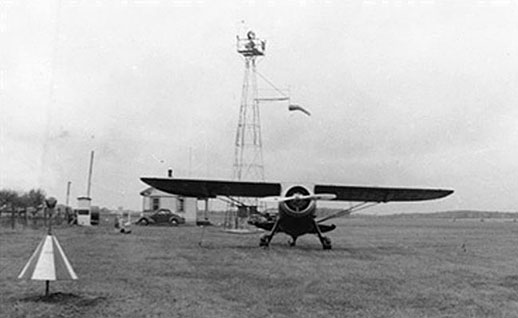
Which light am I looking at?
As the network grew, a standard tower carried a rotating light at the top and two course lights below. The lower lights faced in opposite directions along the airway and flashed a code identifying the station. A bright sweep on the horizon helped a pilot find the tower. Reading its number put the airplane at a particular point along a route where the towers otherwise looked much alike. By day the same station offered a different set of clues. A number painted on the equipment shed could be read from above, and a concrete arrow on the ground pointed toward the next higher-numbered station. [1][3]
Terrain changed what a pilot could do with that information. On the plains, builders could set out towers in a straight line. In the Alleghenies, they had to find high points visible from the cockpit that a crew on the ground could also reach. Those sites made an irregular line. Pilots on the New York–Cleveland leg steered by compass and used sightings of the beacons to check their position. The mechanic’s need to reach the tower helped determine how the pilot flew past it. [1]
The road to the tower
Under the Air Commerce Act of 1926, the Commerce Department took on responsibility for navigation aids. Within Commerce, the Lighthouse Service had districts and staff accustomed to tending lights over long distances. Its Buffalo district acquired a stretch of airway from Bellefonte, Pennsylvania, to Bryan, Ohio. An airway mechanic, then called a mechanician, looked after a section of about 175 miles and traveled with tools and spare parts in a truck. Local caretakers changed bulbs and fuses and reported faults that needed the mechanic’s attention. [2]
By 1927 private operators had taken over flying the mail. The division of labor is easy to see at a beacon near Moline, Illinois, on the Chicago–Dallas route. When the light went into service in December 1926, the federal government assigned a mechanic named A. J. Baldwin to visit it periodically. The name on the airplane carrying a letter could change. The next pilot approaching Moline after dark would still be looking for the light that Baldwin drove out to tend. [2][4]
Sources
- National Park Service, American Aviation Heritage, draft theme study, pp. 66–68 and 83.
- Terry Kraus, FAA’s Unsung Heroes: Maintenance Techs Celebrate 100 Years of Service, Federal Aviation Administration.
- Federal Aviation Administration, The Foundation, historical photo album including the National Archives landing-field photograph.
- Lyndon Baltazar, Airmail Comes of Age, FAA History Office, on the transfer to contract carriers.