
One motorist had an exceptionally good chance of appearing in a Miles Brothers picture. His California license plate was 4867. On a Saturday afternoon in April 1906, he drove past a movie camera on San Francisco's Market Street, circled back, and did it again. Film historian David Kiehn counted six appearances and identified the driver as Jay Anway. On a first viewing, each passing automobile adds to the impression of a city filling up with cars. On a second, there is the pleasure of spotting someone who has already been by. [1][2]
Harry Miles cranked the camera as a cable car carried him from near Eighth Street toward the Ferry Building. He and his brothers had a particular customer in mind. A Hale's Tours theater seated patrons in a space fitted out like a railway carriage. The screen supplied the view that passengers might expect through a window. A steady forward journey was something an exhibitor could sell. For the opening minute of the Library of Congress upload, try keeping the Ferry Building's clock tower in sight. Then watch the street immediately ahead of the camera. The two views occupy the same frame and move at quite different speeds. [1][2][3]
A camera with a right of way
The tower grows almost imperceptibly. Down at track level, a person can enter the picture, cross the rails and disappear in a few seconds. The distance between the rails opens toward the bottom corners of the screen, giving the viewer an unusually good sense of where the camera will be next. A pedestrian angling across that space can make a seated viewer flinch. The pedestrian has an advantage over us. They can look to either side, judge the cable car's speed and choose when to step across. We inherit the position of a passenger who can only look ahead. [1]
That peculiar way of seeing the street came out of a practical difficulty. The brothers had tried mounting a camera on a tripod in a car. Over cobblestones the image shook and blurred. United Railroads gave them the use of a cable car, and the rails did two jobs at once. They steadied the camera and supplied a repeatable line of travel. A motorist who wanted another turn in front of Harry Miles knew exactly where to find him. The camera's course was fixed even as the people it filmed were free to improvise. [2]
Reading the plate
If you wanted to learn how San Franciscans shared a road, the film would give you evidence a still photograph struggles to preserve. Watch how long a wagon occupies the track ahead, or how a pedestrian crosses behind one moving vehicle and emerges in front of another. Those intervals disappear when you freeze the picture. If you wanted to estimate the proportion of automobiles to horse-drawn vehicles in the city, however, even a careful tally of every crossing would give you trouble. Anway alone could supply six marks in your notebook for a single car. The camera also sampled one route on one afternoon, with a conspicuous piece of equipment attracting attention as it went. [1][2]
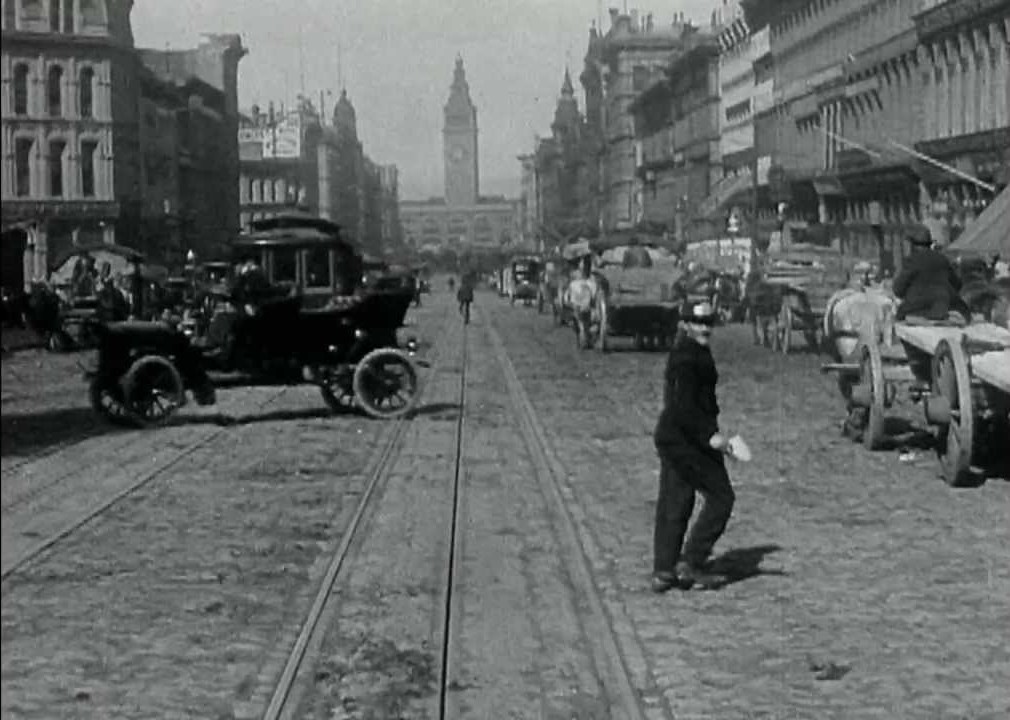
A plate can answer a different question with considerable precision. For years the picture circulated with a 1905 date. One car visible on screen carried plate 5057, which Kiehn traced to a registration issued in February 1906. That gives the historian a firm earliest possible date for the picture. Pinning it to a particular Saturday required other evidence, including contemporary newspapers and weather records. Kiehn dates the journey to April 14. The driver who brought his new car into view left behind a piece of dating evidence small enough to miss while watching the film at speed. [1][2]
The words added afterward
Four days later, on April 18, an earthquake struck San Francisco early in the morning. Fires spread through the city. The brothers lost their Market Street studio, but the film had already left for their East Coast office. The words before the fire became part of its title. Think of the difference those three words make to the passenger in the theater. A spectator could once have spent the journey wondering whether the next pedestrian would clear the track. Now there was a reason to look past the pedestrian at a whole row of buildings. [2][3][4]
At the waterfront the car turns. For most of the journey the rails have held our gaze in one direction. Now the street swings back into view and newsboys wave at the camera. Their gestures are addressed to someone standing a few feet away, turning a crank. It takes an effort, knowing the date, to imagine the modest future those boys could reasonably have had in mind for their performance. Somewhere, perhaps in a room dressed up as a railway carriage, a stranger would see them wave. [1][2]
Sources
- Library of Congress, “A trip down Market Street before the fire,” film by the Miles Brothers.
- David Kiehn, “A Trip Down Market Street,” National Film Registry essay, Library of Congress.
- MIT Open Documentary Lab and IDFA DocLab, Moments of Innovation, “Location,” entry on the Market Street film and its exhibition history.
- US Geological Survey, “The Great 1906 San Francisco Earthquake,” account of the April 18 earthquake.