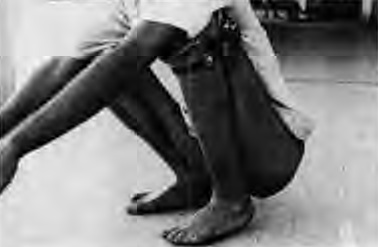
A person settling into a deep squat can keep both soles on the ground while the knees travel forward. Look at the movement from the side and the angle between shin and foot gradually closes. One early prosthetic foot built in Jaipur could bend under that load. It bent in the middle of the sole. As the wearer descended, the bottom of the foot took on the curve of a rocking chair. The workshop had given the foot some flexibility and, in the process, shown how much it mattered where the foot gave way. [1]
What came home from the clinic
At S.M.S. Medical College Hospital in Jaipur, some patients from rural communities had stopped using limbs that the workshop judged well fitted. P. K. Sethi and his colleagues described what they learned by asking why. Shoes cost money to replace after repeated trips through water and mud. People took them off to enter kitchens and places of worship. A foot designed to stay inside a shoe could make simply crossing a threshold awkward. Once indoors, the wearer might need to sit on the floor. [1]
Sitting cross-legged makes a different demand on a foot from squatting. Its outer edge meets the floor, and the forefoot has to turn inward relative to the leg. With a stiff wooden core running along the foot, that twist can travel up the artificial shin to the socket, where it presses against the wearer’s residual limb. Someone could walk into a room quite comfortably and feel pain on sitting down. The sequence gives a fitting team two distinct movements to investigate before changing anything about the socket. [1]
Where the rubber went
The workshop’s early experiments kept the wooden core of a conventional solid-ankle, cushioned-heel foot. The team cut a wedge out of the wood and filled the gap with sponge rubber. The narrowing gap let the core fold at the cut, producing that rocker-shaped sole. A later prototype separated the wooden pieces entirely. A larger block of layered sponge rubber between them could compress on one side or twist under an uneven load. The foot now had room to yield in several directions without a metal ankle hinge. [1]
Different parts still had to be stiff enough to do their jobs. In a 1995 account of the design, the bolt securing the leg sat in a wooden ankle block. Underneath it, pieces of cellular rubber formed the heel and forefoot. Reinforcing cord held the assembly together, and the sole had its own abrasion-resistant tread compound. A person looking down at the bare foot would see little of this division of labor. Yet it was what allowed the same object to take a bolt at one end, meet a rough path at the other and deform between the two. [2]
What a walking test can see
Also in 1995, researchers had three people with below-knee amputations walk across a force plate using Jaipur, Seattle and conventional cushioned-heel feet. The cushioned-heel model absorbed shock better in that experiment. That finding matters to someone choosing a foot for repeated heel strikes. The plate recorded forces during a step, though. Nobody in that comparison was lowering themselves to the floor, and three walkers give little basis for predicting any particular wearer’s preference. [3]
Even a measurement as familiar as walking speed changes when the examiner rearranges the route. In a study published in 2024, people wearing Jaipur feet chose slower speeds over shorter straight paths and around tighter circles. The researchers varied the course while participants kept their prostheses. A speed measured on a long straight path would therefore give a poor account of how those same people moved across a small room and around its furniture. [4]
The 1978 photograph records something the force plate and the stopwatch leave open. Follow the line from the knee to the sole. The shin has come forward, the heel is down, and the wearer has reached the floor on their own feet. For a person who wanted to work or rest in that position, the last few inches of the descent belonged in the fitting room too. [1]
Sources
- P. K. Sethi and colleagues, “Vulcanized rubber foot for lower limb amputees,” 1978. Original workshop report and photograph on printed page 132.
- “Different approaches and cultural considerations in third world prosthetics,” Prosthetics and Orthotics International, 1995. Construction of the barefoot prosthesis.
- “A biomechanical comparison of the SACH, Seattle and Jaipur feet using ground reaction forces,” Prosthetics and Orthotics International, 1995.
- “Walking speeds are lower for short distance and turning locomotion,” PLOS ONE, 2024. Experiments with Jaipur foot users.