Suppose two machinists take their annual hearing tests. In the left ear, each can just hear three high tones at the same settings on the dial. One receives a letter about a change in hearing. The other goes back to work without one. What could the hearing technician see in those identical results? The answer is on an older sheet of paper. Under the US Occupational Safety and Health Administration’s noise standard, each worker brings a different point of comparison into the booth. [1]
The quiet before the first test
The noise standard gives unusual attention to the hours before a baseline audiogram. A worker entering a covered hearing conservation program generally gets this first test within six months of exposure at the action level, an eight-hour average of 85 dBA. The standard calls for at least 14 hours free of workplace noise before that test and allows hearing protectors to stand in for that quiet. Employers must also tell workers to avoid high noise away from work during those hours. [1]
Think of a machinist who comes straight from a loud shift. If it takes a louder tone than usual to hear a beep that afternoon, the first test could set the reference point too high. Every later comparison with that ear would inherit the error. Those hours of quiet protect a measurement that might still be doing its job years after the technician who took it has left. [1]
One ear, two sheets of paper
On an audiogram, a threshold is the level at which a person can just detect a tone of a given pitch. A higher number means the tone had to be louder. The annual exam tests each ear separately at six or more pitches. For the calculation that triggers follow-up, the standard singles out three of them, at 2,000, 3,000 and 4,000 hertz. It compares the current thresholds with the corresponding baseline thresholds in that ear. A worsening that averages at least 10 decibels across the three qualifies as a standard threshold shift. [1]
Give both machinists a current left-ear threshold of 20 decibels at each of those pitches. On the first machinist’s baseline sheet the readings were 5, 10 and 15. It now takes an extra 15 decibels to hear the first tone, 10 for the second and 5 for the third. The average change is 10. On the second machinist’s baseline sheet all three readings were already 20. The change is zero. Assume stable right ears and no adjustment for age. A single current sheet could tell the technician exactly where each worker pressed the button and still leave the question in the headline unanswered. [1]
The letter has a deadline. Once the employer determines that a shift has occurred, the worker must receive written notice within 21 days. The rule allows a retest within 30 days of the annual test, whose result can serve as the annual audiogram. Follow-up reaches onto the shop floor. Unless a physician determines that work neither caused nor aggravated the shift, a worker already using hearing protectors must have them refitted, receive training in their use again and get stronger protection if needed. [1]
What makes it into the log
A second federal rule asks whether the employer must enter a case on the OSHA 300 injury and illness log. OSHA published revised recording criteria on July 1, 2002, effective January 1, 2003. Read beside the noise standard, the recording rule gives the same three tones a second job. The employer considers both the change from the worker’s baseline and the ear’s current level relative to audiometric zero, the standardized reference on the test scale. [3][4][5]
Take the first machinist again. Even if the shift persists and work caused it, the current average is 20 decibels. Recording requires a work-related shift and a current average of at least 25 decibels in the same ear. The worker can therefore have the letter in hand and newly fitted earplugs in place while the hearing-loss entry on the log stays blank. [1][3]
That blank has a consequence for anyone trying to read a workplace’s history from its injury log. A year with zero recorded hearing-loss cases is compatible with a year in which workers received letters and protectors needed refitting. To find the earlier warning in our machinist’s case, someone would have to put two dated audiograms side by side. [1][3]
Sources
- Occupational Safety and Health Administration, Occupational noise exposure, 29 CFR § 1910.95, especially paragraphs (c), (g) and (h).
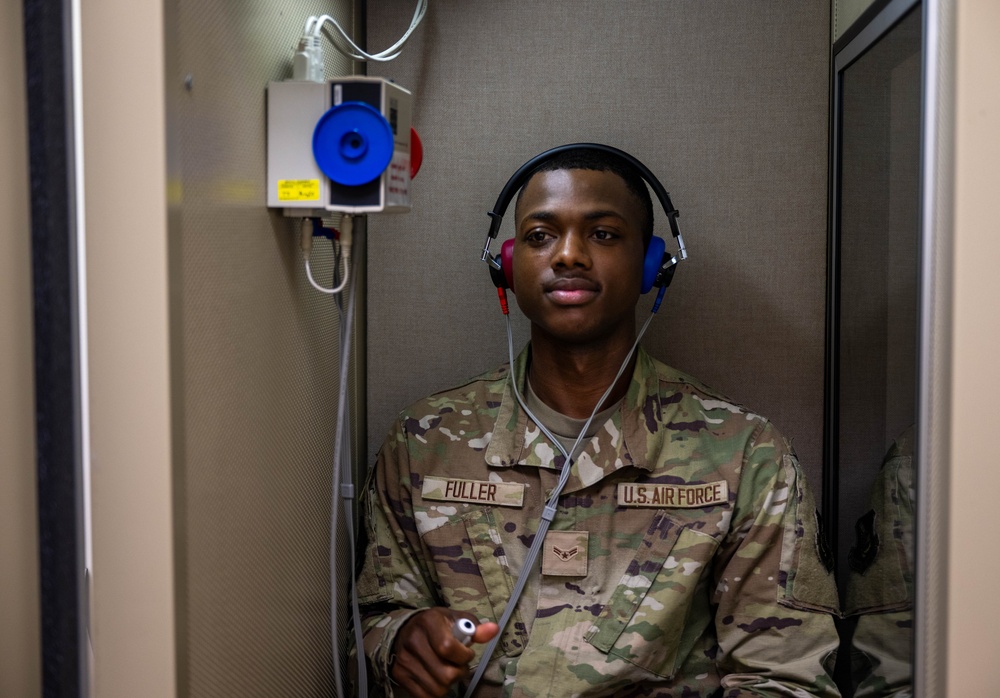
- Caroline Strickland, photograph from the 15th Operational Medical Readiness Squadron audiogram series, April 21, 2025. Defense Visual Information Distribution Service.
- Occupational Safety and Health Administration, Recording criteria for cases involving occupational hearing loss, 29 CFR § 1904.10.
- US Department of Labor, 2003 regulatory agenda entry for occupational injury and illness recording, documenting the July 2002 final rule.
- US Government Printing Office, 2002 Code of Federal Regulations, title 29, volume 5, § 1904.10 effective-date note and revised text.