In December 1932 the chief clerk of the U.S. Census Bureau sent the Librarian of Congress a list of papers the bureau could spare. Item 22 took a few words to describe a country’s worth of households. In the transcription published by National Archives historian Kellee Blake, it reads “Schedules, Population . . . 1890, Original.” A schedule was the sheet on which an enumerator entered the answers a family gave. The word worth lingering over is the last one. The government had already counted these people and published the results. Here were the papers that let someone go back and find a person. [1]
What the camera could settle
Twelve years earlier, on January 10, 1921, fire had broken out in the Commerce Building in Washington. The 1890 schedules stood on pine shelves in a basement room outside the records vault. Firefighters cut through the floor above to pour water into the cellar. A newspaper photographer recorded the aftermath. Looking at the room, one can see why a reader might come away believing the census had perished that night. To know how much writing could still be read, someone had to open the volumes. [1][2]
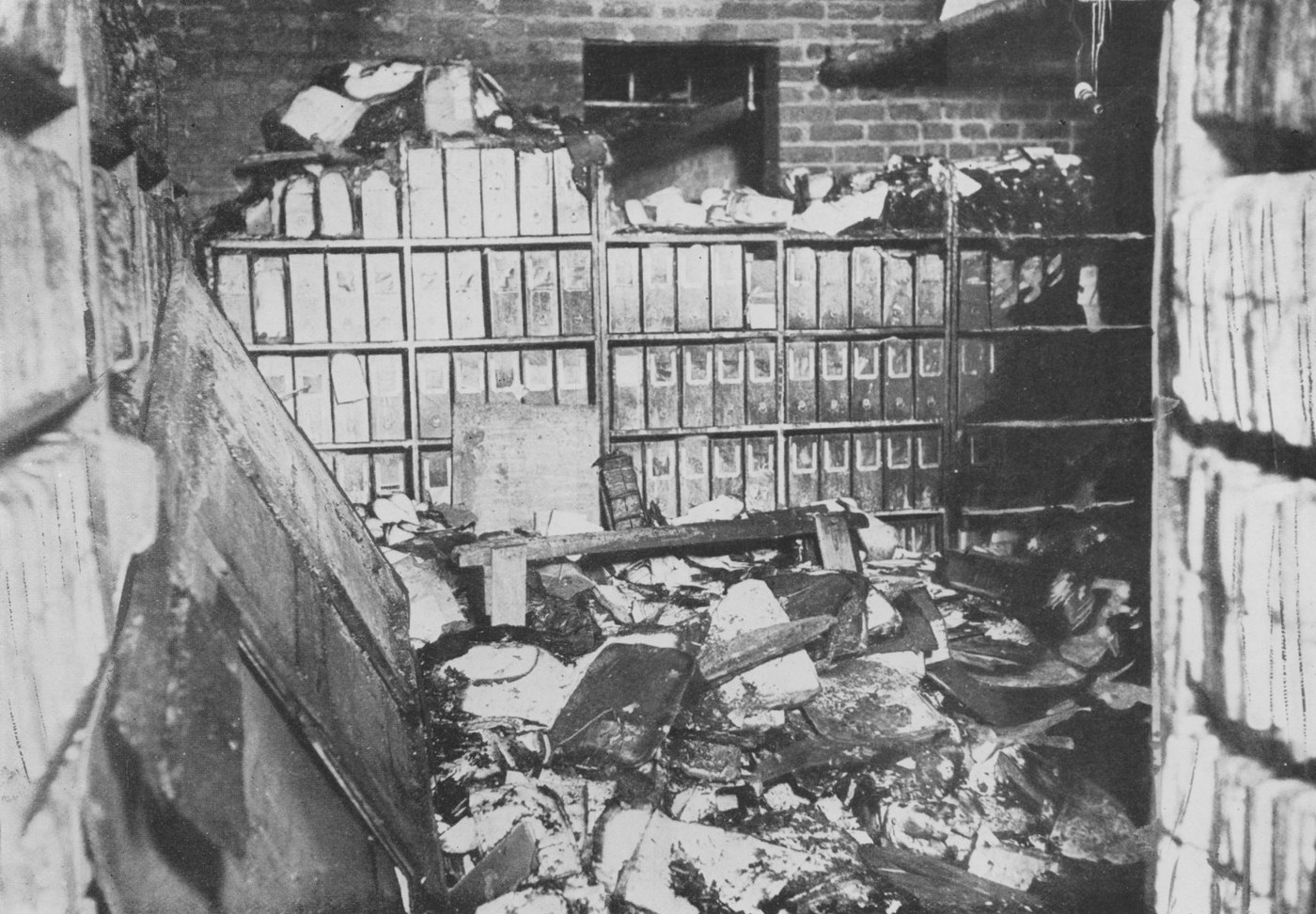
The morning after the fire, Census Director Sam Rogers estimated that a quarter of the 1890 schedules had been destroyed. Of what remained, he thought half had suffered damage. Those estimates leave a considerable distance between an injured collection and a missing one. A clerk who spoke to reporters doubted that writing in a soaked volume could be recovered. The bureau nevertheless considered copying damaged records and reckoned the work in years. Neither assessment amounted to a page-by-page inventory. Both men were looking at the beginning of a salvage problem. [1]
What the clerk asked
The list that reached the librarian in 1932 answered a different question. The bureau had finished with certain papers in the course of its ordinary business. Did the librarian see a historical reason to retain any of them? That division of labor matters. A census office could justify retiring a form once its figures had been tabulated. A historian might want the same form precisely because it preserved answers too particular to appear in a table. The procedure gave that second reader a chance to intervene. No item was singled out for permanent retention, and on February 21, 1933, Congress authorized destruction. [1]
Blake found two different dates for the disposal itself. One account gives 1935. A handwritten note in a bureau file gives 1934 and records the geographer’s disapproval. The note establishes that someone took the trouble to put dissent on paper. It gives us little purchase on who first proposed item 22 or whether anyone inspected the volumes again. For a reader trying to date the loss, the firmest date belongs to the permission Congress gave. The day the paper went is harder to recover. [1]
What a name could still do
One piece of the geographer’s business gives “Original” a practical meaning. In September 1901, officials preparing a bulletin on Delaware agriculture questioned a passage about Black farmers. An unsigned memorandum proposed checking the earlier census. Clerks started with 818 Black farm operators enumerated in Delaware in 1900 and looked for the same people ten years earlier. By December the chief of the Geographer’s Division could report matches for 454. Among the people operating farms in 1900, the clerks found a schoolteacher, a hotel waiter and two blacksmiths in the returns for 1890. [3]
Think of what it took to find the waiter. A published table might give the number of waiters in Delaware in one year and the number of farmers a decade later. Even perfectly accurate totals would leave open whether a single person figured in both. A name gave the clerks a way to follow someone from one column to the other across ten years. Their letter also preserved the limits of the exercise. Hundreds of the farmers remained unmatched, so the occupations the clerks found could tell only part of the story. [3]
The geographer kept the working lists. Today they offer a way into the lives of some Delaware residents whose original schedules have disappeared. Elsewhere a few pieces of the population schedules themselves survived. The National Archives describes three rolls of microfilm holding fragments from ten states and the District of Columbia. Delaware is absent from that set. Its waiter’s trace survives because a clerk once needed to check a sentence about farming, copied what the census said, and filed the result somewhere else. Item 22 closed off the chance to do that work again for another household, with another question. [3][4]
Sources
- Kellee Blake, “First in the Path of the Firemen,” Prologue, Spring 1996. Archival reconstruction with the disposal entry and bureau file note.
- National Archives, “Census Records Come to the National Archives.” Includes photograph 64-NAD-264.
- National Archives, “1890 Census, Delaware.” Includes the September memorandum and the December 1901 letter reporting the occupational matches.
- National Archives, “1890 Census.” Holdings guide to surviving population schedules and related records.