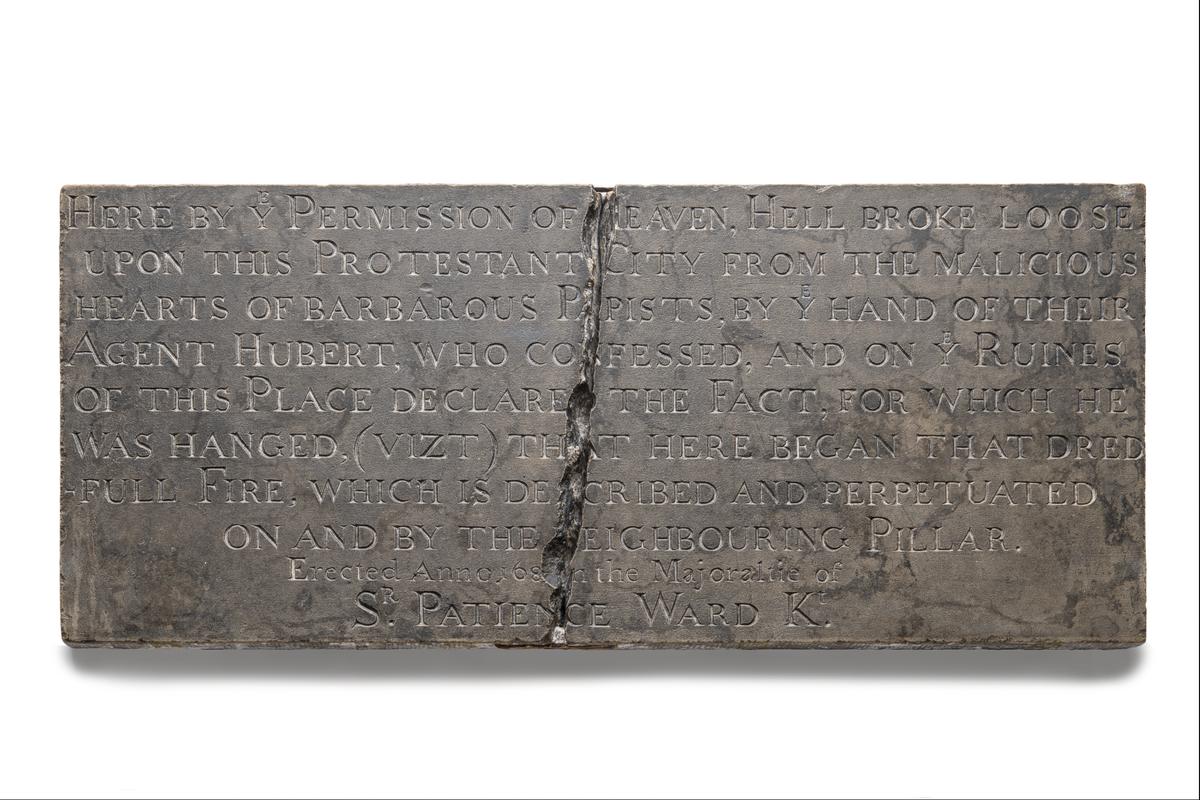
The first word on the stone is “Here.” In a museum it takes a moment to work out where that means. In 1681, mounted at the site of the Pudding Lane bakery where the Great Fire of London began, the word did its work at once. A passerby stood on the very ground in question. The rest of the inscription spent the credibility of that one true word on a false accusation. It named a Frenchman, Robert Hubert, as the agent of Catholics who had supposedly set London on fire. Anyone wanting to know more could follow the slab’s directions to the great column on Fish Street Hill. [1][2]
Two addresses for one story
Fifteen years lay between the fire and the plaque. In September 1666, while Londoners were still trying to locate relatives and possessions, several explanations circulated at once. In a letter of 18 September, Henry Griffith told a relative about arrests of French and Dutch suspects, attributed the disaster himself to divine judgment, and promised to look for a trunk that someone had carried out to the fields and stolen. The trunk makes the letter particularly good evidence of what it was like to hear those stories. Griffith had news to pass on and a piece of family business he could actually investigate. [3]
Hubert confessed, changed his account and was hanged that October. One particularly damaging piece of evidence survives in a book printed in 1713. It reproduces a statement dated 1681 from Laurence Peterson, captain of the ship that brought Hubert to London. Peterson placed his passenger’s first step ashore two days after the fire began. The captain could speak to his passenger’s movements. That narrow fact was enough to undo the story on the stone, whatever had ignited the bakery. [1][4]
How did the charge get onto the Monument in the first place? A pair of instructions to the lord mayor survives. On 23 June 1681 the Court of Aldermen asked him to put the accusation in two places, the pillar and the house where the fire started. On 12 July the aldermen dealt with a practical difficulty. There was already lettering on the pillar. They gave the mayor discretion to have as much of it as necessary cut out and engraved afresh. The column was already standing when Titus Oates’s allegations of a Catholic plot revived fears of conspiracy. The mason who had to clear space for new words could have told a visitor something the finished monument concealed. The accusation was a later addition. [2]
Read the two sites together and the arrangement has a kind of ingenuity. At the bakery a reader got a name, a confession and an execution. At the column a reader encountered a civic account of destruction and rebuilding. The little slab expressly referred anyone standing before it to the neighbouring pillar. Someone who walked from one to the other could take the agreement between them as corroboration. Behind both stood the same instruction to the same mayor. [1][2]
What came off the wall
The record of 16 September 1689 catches the City in the act of changing the story again. The offending inscriptions had come down under the Catholic James II. With William and Mary on the throne, the Common Council voted unanimously to put both back in their former places. The minute even assigns officers to see that the work gets done. A Londoner too young to remember the first installation might have seen the restored words and reasonably supposed they had been there since childhood. [1][2]
The two stones eventually parted company. An order of December 1830 directed the removal of the accusation from the Monument. An etching published in 1834 let readers see the erased text on paper. The fate of the bakery plaque is harder to pin down. London Museum records a tradition that it came down in the eighteenth century because people stopping to read it obstructed the street. The City’s conservation plan suggests it may have come down around the time the column was edited. Building work supplies the next firm location. In 1876 the slab turned up in the backyard of 25 Pudding Lane. [1][2][5]
In the museum the stone can answer a question that would have made little sense to the passerby directed up Fish Street Hill. Who put these words here? The plaque itself gives a date and a mayor. The aldermen’s minutes supply the commission. For Hubert himself, the crucial line survives on paper. When the bakery caught fire, his captain recalled, Hubert was still aboard ship. [1][2][4]
Sources
- London Museum, Great Fire Pudding Lane plaque, object 7211. Photograph, transcription and recovery history.
- City of London, The Monument Conservation Plan, volume 1. Inscription history and extracts from the City’s orders.
- London Museum, Henry Griffith’s letter of 18 September 1666, object 42.39/1.
- London Museum, A Protestant monument, printed in 1713, object 42.39/62. Catalogue account of Laurence Peterson’s statement.
- London Museum, Inscriptions engraven on the base of the Monument, 1834 etching, object 80.501/402.