Robert Smalls is often remembered through one clean scene: before dawn on May 13, 1862, an enslaved pilot took a Confederate steamer out of Charleston Harbor, passed the forts, reached the Union blockade, and won freedom for himself, his family, and the others aboard. The scene deserves its fame. But it becomes more powerful when read as a microhistory rather than a miracle story. Smalls did not simply run away in a stolen boat. He turned the whole working logic of slavery against the Confederacy: forced expertise, routine trust, harbor discipline, military codes, family vulnerability, and the assumption that Black labor could operate a system but never command it.[1][2][3]
That is why the Planter mattered as evidence. The sidewheel steamer was not a symbol floating outside the war. Built in Charleston in 1860, it became a Confederate dispatch and transport vessel, moving troops, arms, and harbor-defense material among Charleston's forts and batteries. The National Park Service describes it as a 147-foot sidewheel steamer leased to Confederate service, with white officers above an enslaved Black crew that performed the daily work of the vessel.[2] When Smalls brought it out, he delivered more than people and property. He delivered a contradiction the Confederacy could not easily explain: an enslaved man had mastered one of its military work systems well enough to remove it from Confederate control.
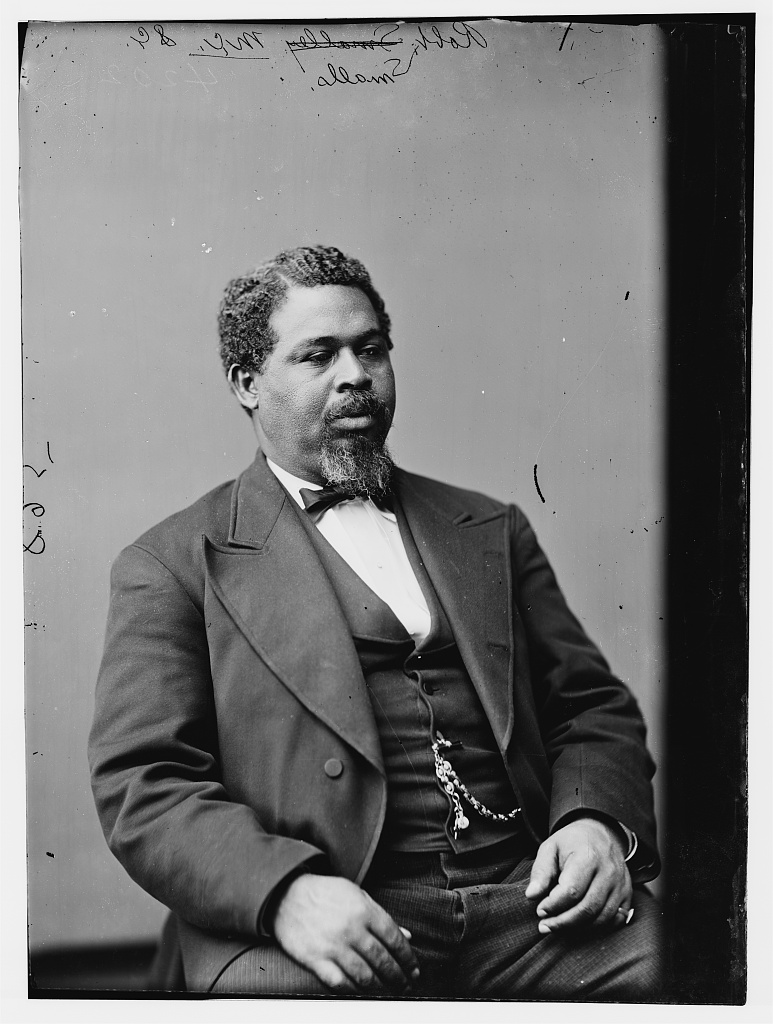
Image context: the cover photograph is an archival portrait, not a diagram, chart, or generated visual. It fits the article because Smalls's later public career is not an afterword to the harbor escape. It is part of the same argument: technical competence, political judgment, and public authority had been present before slavery admitted any of them.[7]
The harbor made skill political
Smalls was born in Beaufort, South Carolina, in 1839, enslaved with his mother, Lydia Polite. As a child he lived behind the McKee house on Prince Street; at about twelve, in 1851, he was sent to Charleston to be hired out. There he moved through jobs that made him intimate with the city as a working system: hotel service, waterfront labor, rigging, sailing, and navigation. The House historian's biography stresses that he became an expert navigator of the South Carolina and Georgia coasts; the NPS account places him on Charleston's docks, where he married Hannah Jones around 1856.[1][5]
This was not incidental background. Charleston Harbor was a geography of power: wharves, tides, channels, forts, signal customs, patrol habits, and racial hierarchy all fitted together. Enslaved maritime workers were expected to know enough to make the system run and yet remain politically invisible inside it. That contradiction created Smalls's opening. The Confederacy needed his knowledge, but the ideology it defended made it underestimate what that knowledge could become.
By the outbreak of war in 1861, Smalls was working on the Planter. The vessel's crew, as the NPS reconstructs it, included three white officers and seven enslaved crewmen: Smalls as helmsman, John Small and Alfred Gourdine as engineers, and Abraham Jackson, Gabriel Turner, David Jones, and Jack Gibs as deckhands. The white officers' habit of leaving the boat overnight violated standing orders but had become routine enough to create opportunity.[2] That routine is the small hinge on which the larger event turned.
The plan was built from ordinary knowledge
The escape did not begin with a theatrical disguise. It began with meetings, timing, families, and a route. In early May 1862, the enslaved crew and several other men planned to gather family members and run through the harbor under cover of darkness and fog. The NPS identifies the danger precisely: the Union blockade lay only about ten miles from the Charleston wharves, but the route passed armed fortifications and batteries capable of destroying the steamer if the deception failed.[2]
On the afternoon of May 12, the crew decided the moment had arrived. The Planter had recently moved artillery pieces and carried extra guns in addition to its usual armament. That made the seizure more valuable and more dangerous. After nightfall, family members waited near the North Atlantic Wharf while the crew readied boilers at the Southern Wharf. Around 3:00 a.m. on May 13, Smalls and the crew moved the steamer up the Cooper River, picked up the waiting freedom seekers, and headed toward the channel.[2][3]
The usual retelling emphasizes the captain's hat, and it should. The detail matters because it shows how exact the operation had to be. Smalls knew the signals to give; he understood what sentries expected to see from the vessel; he could reproduce enough of the boat's normal behavior to make suspicion arrive too late. The NPS account says he donned a captain's hat and used the proper signals as the ship passed Confederate forces at Fort Sumter and Fort Moultrie.[1] The "disguise" worked because it was embedded in operational literacy. Without the whistle, the flags, the course, the timing, and the confidence of a pilot who knew the water, a hat would have been costume.
There were sixteen freedom seekers aboard, including women and children.[3] That number keeps the story from shrinking into a single heroic portrait. Smalls was central, but the act was collective. It required engineers to manage steam, deckhands to keep the vessel moving, family members to wait under mortal risk, and a network of trust strong enough to survive secrecy. The operation was not only an escape from slavery. It was a claim that enslaved people could plan, coordinate, and command under conditions designed to deny all three capacities.
The Union received testimony in the form of a ship
When the Planter reached the Union blockading squadron, the reception almost became disaster. A dispatch later printed in the Poughkeepsie Eagle News and reproduced by the American Battlefield Trust says the USS Onward was preparing to fire before its commander recognized the white flag.[4] That near miss matters. Smalls had passed one military system by mimicking it, then had to survive another by surrendering visibly enough to be believed.
The same dispatch reported what had arrived: an armed Confederate steamer, eight Black men, five women, three children, a 32-pounder, a 24-pound howitzer, and four additional guns being transported for Confederate use. Du Pont's forwarding language also emphasized that Smalls carried useful knowledge. The dispatch called him intelligent, noted the importance of his information, and said he would continue to be employed as a pilot for inland waters.[4]
The language is paternalistic and constrained by the racial vocabulary of the Union military in 1862, but the practical judgment is unmistakable. Smalls had not merely deprived the Confederacy of a boat. He had brought a working map of Charleston Harbor in his head. The NPS account likewise notes that he supplied valuable intelligence and later served as a pilot on Union vessels, including the ironclad Keokuk, where he was injured in action in April 1863.[1] The harbor knowledge once extracted from him as enslaved labor became Union naval intelligence.
That conversion is the heart of the microhistory. Smalls forced the war to acknowledge a form of Black expertise that slavery had depended on while pretending it did not exist as authority. The Confederacy's mistake was not that it trusted him personally. It was that it treated skill as separable from judgment. The Planter proved otherwise.
Recognition arrived early, late, and unevenly
Smalls quickly became famous in the North, and the escape helped Union audiences see Black military service as practical rather than theoretical. But recognition did not come in one clean wave. It arrived through prize money, wartime employment, symbolic celebration, political opportunity, and delayed federal compensation, each with its own limits.
During the war, Smalls served the Union as a pilot and eventually received command of the Planter. In 1864, he took the vessel to Philadelphia for overhaul. There, while awaiting repairs, he was removed from an all-white streetcar. The House historian and NPS accounts connect his response to one of the country's early mass boycotts of segregated public transportation; Philadelphia streetcars were integrated by law in 1867.[1][5] The episode is often treated as a side note, but it shows continuity. Smalls's politics did not begin when he entered office. They began with the same insistence visible in the harbor: public systems could be challenged where their operating rules were most exposed.
By January 1864, Smalls had used prize money from the Planter episode to purchase the Beaufort house of Henry McKee, the man who had enslaved him. The symbolism is obvious, but the practical meaning is just as important. Land, a house, business ties, church networks, and local reputation helped make him a Reconstruction leader in Beaufort.[1] The escape had given him freedom and fame; the Lowcountry community gave that fame a political base.
In 1868, Smalls served in the South Carolina constitutional convention and advocated public education. He entered the state House that year, served in the state Senate from 1870 to 1874, and then won election to Congress from a majority-Black coastal district. The House historian notes that he served part of five terms between 1875 and 1887, often under violent electoral pressure and amid organized efforts to undo Black political power in South Carolina.[5] The biography is therefore not a simple ascent from slavery to office. It is a story of authority gained, used, attacked, and partially stripped away as Reconstruction collapsed.
The federal government also struggled to settle the material meaning of the Planter episode. On May 18, 1900, the House passed a measure to reimburse Smalls for commandeering the Confederate ship and surrendering it to the Union Navy. The House historical highlight says the original bill sought $20,000, the committee reduced it to $5,000, and President William McKinley signed the bill on June 5, 1900.[6] Nearly four decades after the escape, Congress was still deciding how to price an act that had carried people, weapons, intelligence, and propaganda value out of Confederate hands.
What the Planter revealed
The Planter story is easiest to flatten into courage, and courage is certainly there. Detection could have meant death. But courage alone does not explain why the episode mattered. Its force came from the way one event exposed several systems at once.
It exposed the military vulnerability of Confederate Charleston. A harbor defended by forts, signals, batteries, and armed vessels could still be penetrated from inside by people whom slavery had trained and discounted.[2][4] It exposed the instability of the Confederacy's racial assumptions. Smalls and the other freedom seekers did not need outsiders to rescue them; they used inside knowledge to create a rescue. It exposed the Union's own dependency on Black expertise, because Smalls became useful immediately as a pilot and source of local intelligence.[1][4]
It also exposed the limits of memory. Smalls died in Beaufort in February 1915, after southern Democrats had largely rebuilt white supremacist control and after the Lost Cause had worked to rewrite Reconstruction as failure rather than as a contested democratic experiment. The NPS account notes that the achievements of people like Smalls disappeared from mainstream narratives until later public-history work in Beaufort helped restore the Reconstruction story.[1] That disappearance was not accidental. Remembering Smalls fully requires remembering not only a dramatic escape, but also Black officeholding, public education campaigns, armed service, labor knowledge, and the violence that sought to bury those achievements.
The reason to return to May 1862 is therefore not to isolate it from the rest of his life. It is to see the pattern that runs through the life. In Charleston Harbor, Smalls read a system, found the weak point, and moved people through it. In wartime service, he turned local knowledge into military value. In Philadelphia, he challenged segregated transit. In Beaufort and Washington, he tried to make Reconstruction's promises administrative: schools, harbor improvements, representation, public rights, and local power.[1][5]
The Planter did not make Robert Smalls capable. It made his capability impossible to deny. That is the distinction the story should preserve. Slavery had already forced him to learn the harbor, the ship, the signals, and the white officers' habits. What changed before dawn on May 13, 1862, was ownership of that knowledge. For a few dangerous hours, the expertise that had been coerced into Confederate service answered to Smalls, his crew, and their families. By sunrise, it had become evidence against the world that had claimed to own them.
Sources
- National Park Service, "Robert Smalls" - official biography covering Beaufort childhood, Charleston labor, the Planter escape, Union service, Reconstruction politics, and later memory.
- National Park Service, "The Planter" - vessel history, crew structure, Confederate use, planning context, and escape-route risk.
- National Park Service, Reconstruction Era National Historical Park, "The 'Planter': A Strike for Freedom" - account of the sixteen freedom seekers and the May 12-13, 1862 route from Charleston to the Union blockade.
- American Battlefield Trust, "Robert Smalls: 'This Bold Feat So Skillfully'" - transcription of the May 1862 Du Pont dispatch as printed in the Poughkeepsie Eagle News.
- U.S. House of Representatives, History, Art & Archives, "SMALLS, Robert" - congressional biography with wartime, Reconstruction, election, and legislative details.
- U.S. House of Representatives, History, Art & Archives, "The House Reimburses Robert Smalls of South Carolina for Commandeering the Confederate Ship Planter" - May 18, 1900 historical highlight on delayed compensation.
- Library of Congress, "Robert Smalls, S.C. M.C. Born in Beaufort, SC, April 1839" - direct Brady-Handy glass-negative portrait image file used as the article image.