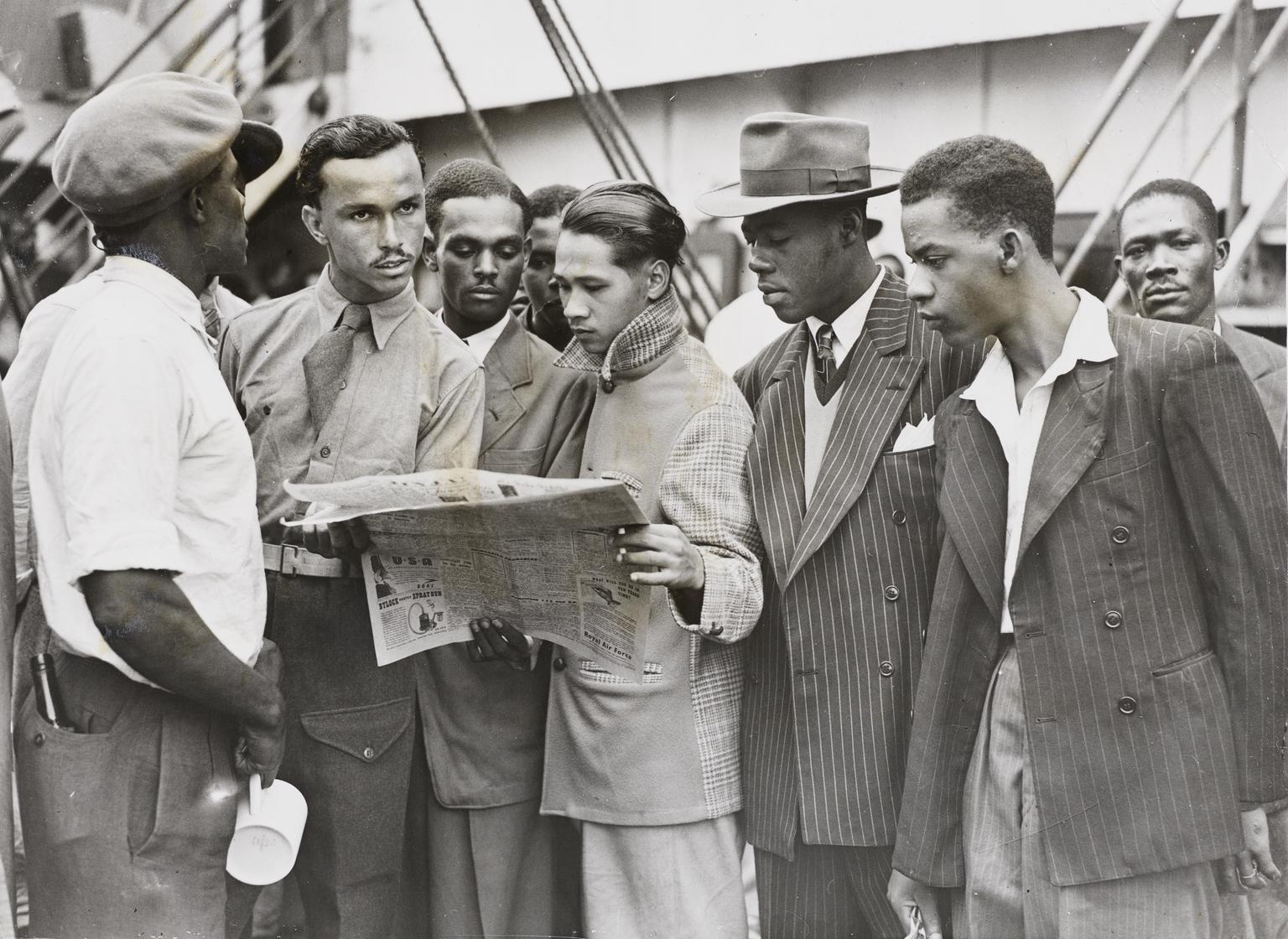
Windrush memory usually begins with a ship. That is understandable, because the image is powerful: passengers on the Empire Windrush, cameras waiting at Tilbury, a postwar Britain trying to describe people who were not strangers to empire but were newly visible in the metropole.[1][2] Yet the sharper historical point is that Windrush became more than an arrival story. It became an archive problem.
The ship arrived at Tilbury on June 21, 1948, and passengers disembarked the next day.[3] Many had served in British forces during the Second World War, and many arrived under the legal world created by the British Nationality Act 1948, which the British Library frames as establishing common citizenship and enabling British subjects to settle permanently in Britain.[2] The later phrase "Windrush generation" compressed a wider movement into one vessel: people who came from the Caribbean to Britain in the postwar decades, especially between the Windrush arrival in 1948 and the Immigration Act 1971.[6]
That compression is useful, but it is also risky. If Windrush is remembered only as a hopeful gangplank, it becomes too neat. The record is fuller and more demanding. It includes the newspaper photograph, the passenger list, the hostels and labour interviews, the later national day and Waterloo monument, and the much darker fact that decades afterward some members of the generation were treated as if their lawful belonging needed proof they had never been told to preserve.[1][3][4][5][6]
The first memory was press attention
The Science Museum Group's Daily Herald photograph is unusually self-aware as an image. It does not simply show arrival. It shows passengers reading newspapers about their arrival while still aboard the ship.[1] The caption preserved with the photograph identifies Tilbury, June 22, 1948, and describes people preparing to disembark, with some heading toward friends, service enlistment, labour interviews, or temporary arrangements.[1] The moment is not private migration turned later into history. It is history being watched, reported, and framed immediately.
That matters because Windrush's symbolic power did not come only from numbers. Earlier and parallel Caribbean migration existed, and the National Archives explicitly places Windrush beside the Ormonde and Almanzora, ships that carried postwar Caribbean passengers before 1948.[3] Windrush became the shorthand partly because it was highly visible. The press turned one voyage into a national scene.
The British Library's 2018 exhibition framing helps correct the sentimental version. It described the Windrush passengers as "welcomed by some" and vilified by others, and placed the voyage inside slavery, colonialism, rebellion, decolonisation, music, labour, and Black British cultural life rather than treating it as the cheerful first page of multicultural Britain.[2] In memory terms, that is the right correction: Windrush was not a simple beginning. It was a visible crossing inside a much older imperial relationship.
The passenger list made belonging legible
The most consequential artifact may be less dramatic than the ship photograph: the passenger list. The National Archives education page presents a page from the M.V. Empire Windrush passenger list, catalogued as BT 26/1237, with columns for names, age, proposed address, occupation, last permanent residence, and intended future residence.[3] It is ordinary bureaucratic paper, but that ordinariness is the point. Lawful movement entered the state through forms.
Read as commemoration, the list does two things at once. It restores individual specificity to a group too often spoken about in aggregate, and it exposes how fragile paper belonging can become when later institutions demand documents that were never distributed as personal survival kits. The same name that could sit plainly in a 1948 passenger ledger might, decades later, have to be reassembled from fragments if a person needed to prove residence, employment, tax payment, or arrival history.[4][5]
This is where Windrush memory changed after the scandal. The Windrush Lessons Learned Review exists because people with long-standing rights in Britain were later forced through a documentary test that celebration alone could not answer.[5] The official Windrush Day grant scheme also reveals the repair impulse that followed: commemoration became a public programme meant to educate, preserve stories, and recognize contribution, not only to stage an anniversary.[4]
Windrush therefore asks a harder question than "who arrived?" It asks what a state owes to people whose legal status it once made ordinary, then later made difficult to evidence. The archive is not background. It is part of the historical event's afterlife.
Commemoration now has to hold two truths
National commemoration arrived late. The government established Windrush Day in 2018, with an annual grant scheme that began in 2019 to support community projects.[4] In 2022, the National Windrush Monument by Basil Watson was unveiled at London Waterloo Station, a location chosen because many Caribbean arrivals travelled through Waterloo after reaching Britain and dispersing across the country.[6] The monument's three figures climbing a mound of suitcases are meant to honor courage, family, aspiration, and contribution.[6]
That is a legitimate public memory. It would be absurd to remember Windrush only through administrative injury. The people grouped under the Windrush name helped staff hospitals, transport, public services, factories, cultural institutions, churches, music scenes, neighborhoods, and family networks.[2][4][6] A monument can give that contribution a visible civic place.
But the monument sits after the scandal, not before it. That sequence changes its burden. It cannot only say: these people arrived and contributed. It also has to imply: these people belonged, and the state later failed some of them by losing the practical meaning of that belonging.[5][6] In that sense, the Waterloo monument and the Tilbury passenger list belong in the same memory system. One gives public honor; the other gives evidentiary texture.
The best Windrush commemoration therefore refuses the clean postcard version. It starts with 1948, but it does not stop at the railings of the ship.[1][3] It includes the legal status created in that year, the much wider Caribbean migration before and after the Windrush voyage, the mixed reception in postwar Britain, the cultural and labour contribution, the documentary vulnerability exposed in the twenty-first century, and the effort to repair memory through days, grants, reviews, archives, and monuments.[2][4][5][6]
Windrush became durable because it joined image, law, and memory. The ship made the movement visible. The passenger list made it administratively legible. The scandal showed that legibility can fail if institutions forget their own records and responsibilities. The monument, if read well, does not close that history. It keeps all three records in view.
Sources
- Science Museum Group Collection, Daily Herald Archive photograph file for "Photograph of people reading a newspaper aboard the 'Empire Windrush'" - archival image made at Tilbury on June 22, 1948, and source of the article image.
- British Library, "Windrush: Songs in a Strange Land" - exhibition framing Windrush through Caribbean voices, decolonisation, culture, labour, and the mixed British reception in 1948.
- The National Archives, "Ormonde, Almanzora and Windrush" - archival context for the Empire Windrush passenger list and earlier postwar Caribbean migration ships.
- GOV.UK, "The Windrush Day Grant Scheme" - official guidance on the 2018 establishment of National Windrush Day and grant-funded community commemoration projects.
- GOV.UK, "Windrush Lessons Learned Review: information" - official page for Wendy Williams's 2020 review into events leading up to the Windrush scandal.
- GOV.UK, "National Windrush monument unveiled at London Waterloo Station" - official announcement of Basil Watson's 2022 monument, its location, design, and commemorative purpose.