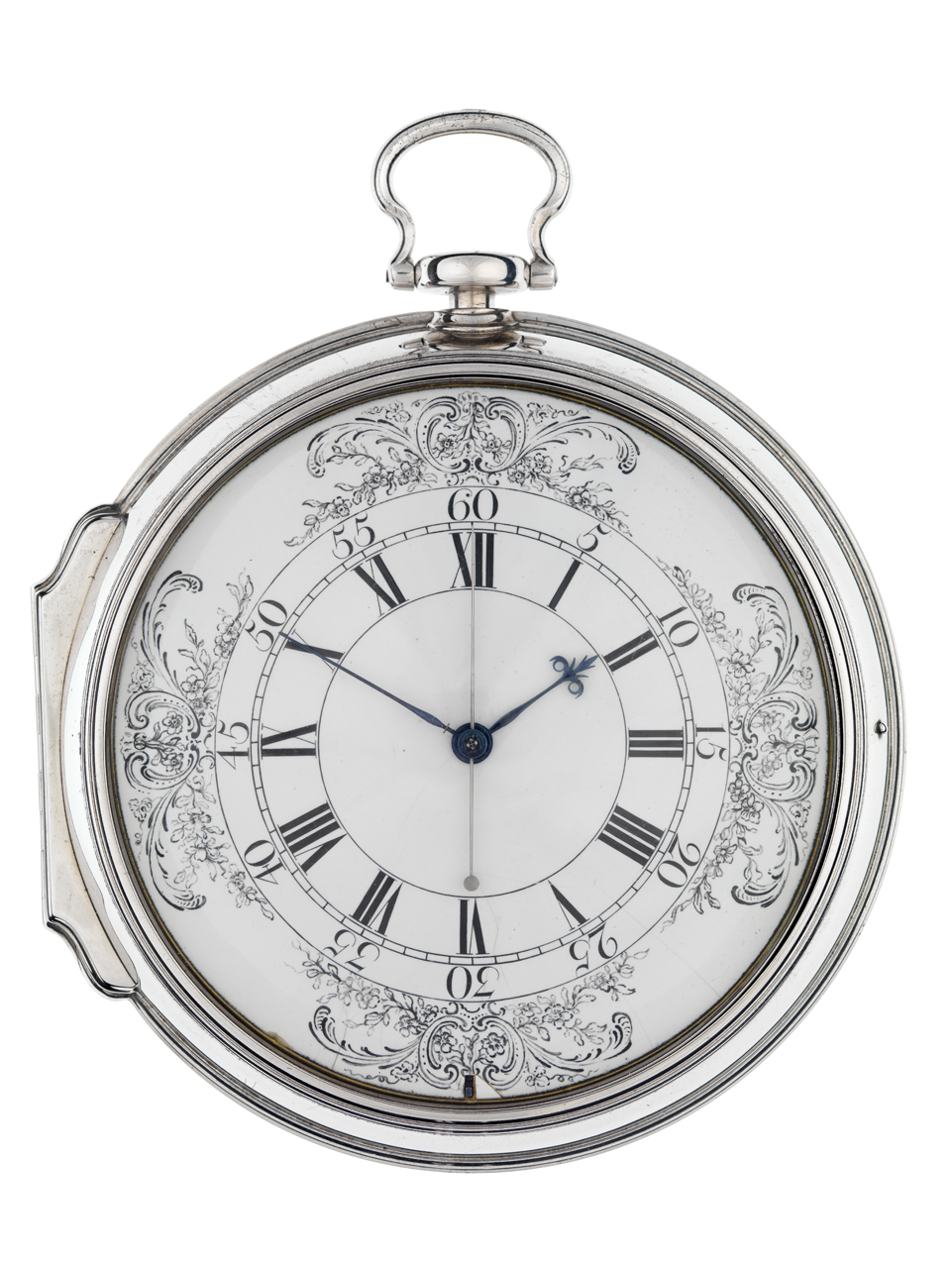
Longitude at sea became solvable when it stopped being treated only as a sky-reading problem and became a time-transfer problem. John Harrison's H4 did not make the heavens irrelevant. Navigators still needed observations, tables, and discipline. What H4 changed was the working chain: if a ship could carry reliable home-port time across an ocean, local noon could be compared with that reference, and the east-west difference could be turned into position. The causal mechanism was simple in principle, brutal in practice: preserve time through motion, salt air, temperature change, winding, and weeks of human handling.[1][2]
That is why the story should not be reduced to "a genius built a clock." The 1714 Longitude Act offered rewards because Parliament understood that existing methods were promising in theory but hard to use reliably at sea. The act framed longitude as a public problem tied to faster voyages, safer ships, preserved lives, trade, and national honor.[3] Harrison's achievement was to make one proposed route to the answer operational: not just a clever instrument, but a device that could be tested, argued over, copied, and eventually folded into navigational practice.[2][4]
The problem was not knowing the idea
The time method was conceptually older than H4. If Earth turns 360 degrees in 24 hours, then one hour of time difference corresponds to 15 degrees of longitude. The catch was practical. A clock ashore could be excellent and still be useless on a rolling ship. A pendulum that behaved in a workshop did not behave the same way under pitch, roll, vibration, humidity, and temperature swings. A watch small enough to travel could be convenient and still drift too much to be trusted over an Atlantic crossing.
The Longitude Act's wording makes that gap visible. It did not claim that no one had ever imagined a solution. It said that several methods already discovered were true in theory but difficult in practice, and it invited improvement or invention.[3] The statute therefore rewarded a method that could survive use. A successful longitude instrument had to carry precision out of the observatory and into the unstable workplace of a ship.
Harrison's early route was not a pocket watch. Royal Museums Greenwich describes H1 as a marine timekeeper brought to London in 1735 and tested on a Lisbon voyage in 1736. Its paired balances were meant to escape the pendulum problem by making the machine less vulnerable to ship motion.[2] The result was impressive enough that commissioners met on June 30, 1737 and authorized money for further work.[2] But the sequence from H1 to H3 also shows the hidden difficulty. H3, begun in 1740, absorbed 19 years of effort and still did not settle the problem.[2]
H4 changed scale and frequency
H4 was the pivot because it made the solution smaller while making its rhythm more stable. The Royal Museums Greenwich object record identifies H4 as Harrison's prize-winning longitude watch, completed in 1759, after work began in 1755.[1] RMG's narrative adds the crucial design turn: a watch made by John Jefferys around 1751-1752 pointed Harrison away from the large H3 and toward a high-performance watch-form timekeeper.[2]
The word "watch" can mislead. H4 looked more like a large pocket watch than a sea clock, but it was not an ordinary portable ornament. RMG emphasizes its stable high-frequency balance, and notes that H4 ticked five times a second.[1][2] That mattered because a faster, stable balance gave the instrument a better chance of smoothing disturbance into regularity. The mechanism's job was not to deny that the ship moved. It was to keep the oscillator's rate from translating every motion and temperature change into navigational error.
The physical object also explains why H4 was both convincing and suspicious. It was compact, refined, and visually unlike the earlier sea clocks. The RMG object record gives its dial diameter as 102 mm and overall dimensions as 165 mm by 124 mm by 28 mm, with a weight of 1.45 kg.[1] That portability was the breakthrough. It was also the beginning of the Board's next concern: if the solution rested in one extraordinary handmade watch, was it a national method or only Harrison's artifact?
Trials turned accuracy into governance
The first major sea trial put that question under pressure. In 1761, the commissioners allowed Harrison's son William to prepare H4 for a voyage to Jamaica. RMG's account says the trial seemed to go well and that William used the timekeeper to predict an earlier landfall at Madeira than the crew expected.[2] The drama here is not only that the watch kept time. It is that the watch made a falsifiable navigational claim before land appeared. A good timekeeper could change the ship's expectation of where it was, not merely confirm a position after arrival.
Yet the successful trial did not end the dispute. The Board considered the test insufficient, and the relationship between the Harrisons and the commissioners deteriorated.[2] A second trial followed in 1764, with Barbados as the destination and Nevil Maskelyne involved in determining the island's longitude through astronomical observations.[2] When the Board met in February 1765, RMG says it was confirmed that H4 had kept time within the most stringent limits of the 1714 Act.[2]
This looks at first like bureaucratic obstruction after a clear win. Part of it was. But the Board's objection also reveals a real institutional problem. The Cambridge Core chapter on the Board of Longitude argues that the "John Harrison affair" helped turn the Board into a more regular standing institution in the early 1760s through disputes over trials, disclosure, replicability, rewards, and accusations of self-interest.[4] The H4 conflict forced the state to define what counted as proof. Was one excellent voyage enough? Did Harrison have to reveal principles? Did another maker have to reproduce the instrument? Who judged competing methods such as lunar distances?
The answer was not purely technical. It was administrative. A longitude method had to become governable before it could become public infrastructure.
Replication was the missing bridge
The Board's demand for disclosure and replication is easy to read only as unfairness to Harrison, especially because he had spent decades working toward the reward. But from the viewpoint of navigation policy, a single watch was not enough. A navy, merchant fleet, or imperial survey project could not be organized around an uncopyable masterpiece. The invention had to cross the bridge from proof object to producible class.
That is why K1 matters. RMG's Board of Longitude educational record describes K1 as Larcum Kendall's copy of H4. After two successful sea trials of H4, the Board commissioned Kendall in 1766; he completed K1 in 1769; and the Board issued it to Captain Cook for testing on his second round-the-world voyage, where it worked very well.[7] K1 did not erase Harrison's priority. It made the mechanism portable in a second sense: the idea could travel from maker to maker and from one ship to another.
The Royal Observatory Greenwich chronometer-trial history shows the longer institutional afterlife. It states that on April 26, 1766 the Board resolved that H4 and Harrison's three earlier seagoing clocks should be tested at the Observatory, and it links the later digitized records of trials and comparisons for H1, H2, H3, H4, and Kendall I.[5] That testing culture mattered because it moved longitude timekeeping into routines of rating, comparison, record-keeping, and evaluation. The chronometer was not just an object; it became a system of trust around an object.
Harrison solved the mechanism before he won the settlement
The human ending remained bitter. A 1768 National Maritime Museum print record states plainly that H4 met the Board's required accuracy standards, but that the Board refused the full reward because it questioned the practicality of the solution; Harrison appealed to George III and Parliament and received a total reward of 18,750 pounds for H4.[6] RMG's longer account similarly describes the final compensation as generous but not the full recognition Harrison believed the original act had promised.[2]
That dispute should not distract from the deeper historical mechanism. H4 solved longitude by keeping reference time stable enough to compare with local astronomical time. The Board then transformed the question into something harder and more public: how to judge a method, inspect it, reproduce it, and decide whether it belonged to one inventor or to national use.[4][5][7]
Seen this way, Harrison's success has three layers. The first was mechanical: a stable high-frequency balance in a portable timekeeper.[1][2] The second was navigational: the ability to make landfall and longitude claims at sea rather than after disaster or lucky correction.[2] The third was institutional: trials, papers, copies, observatory ratings, and parliamentary settlement turned an artifact into a method.[4][5][6][7]
H4 made longitude a clock problem, but it also made the state confront a problem clocks could not solve by themselves. Accuracy had to be converted into confidence. Confidence had to be converted into replication. Replication had to be converted into practice. That chain, more than the romance of a lone watchmaker, is why Harrison's small silver instrument changed ocean navigation.
Sources
- Royal Museums Greenwich, "H4" - object record for John Harrison's marine timekeeper ZAA0037, including date, materials, dimensions, display context, and cover image source.
- Royal Museums Greenwich, "Longitude found - the story of Harrison's timekeepers" - institutional narrative of the Longitude Act, H1-H4 development, sea trials, Board dispute, and later uptake.
- Royal Museums Greenwich / Cambridge University Library, "Longitude Act 1" - Board of Longitude educational extract from the 1714 act, RGO14/1: 11r.
- Alexi Baker and Richard Dunn, "The Birth of the Board of Longitude," in The Board of Longitude (Cambridge University Press, 2025) - chapter summary on the Harrison affair, sea trials, disclosure, replicability, and institutional hardening.
- Royal Observatory Greenwich, "Rates of chronometers and watches on trial at the Observatory, 1766-1915" - history of Observatory chronometer testing and linked trial records for Harrison's timekeepers and Kendall I.
- Royal Museums Greenwich / National Maritime Museum, "John Harrison" - Board of Longitude educational record for a 1768 Harrison print, H3 and H4, accuracy dispute, and reward total.
- Royal Museums Greenwich / National Maritime Museum, "K1" - Board of Longitude educational record for Larcum Kendall's 1769 copy of H4 and Cook voyage testing.