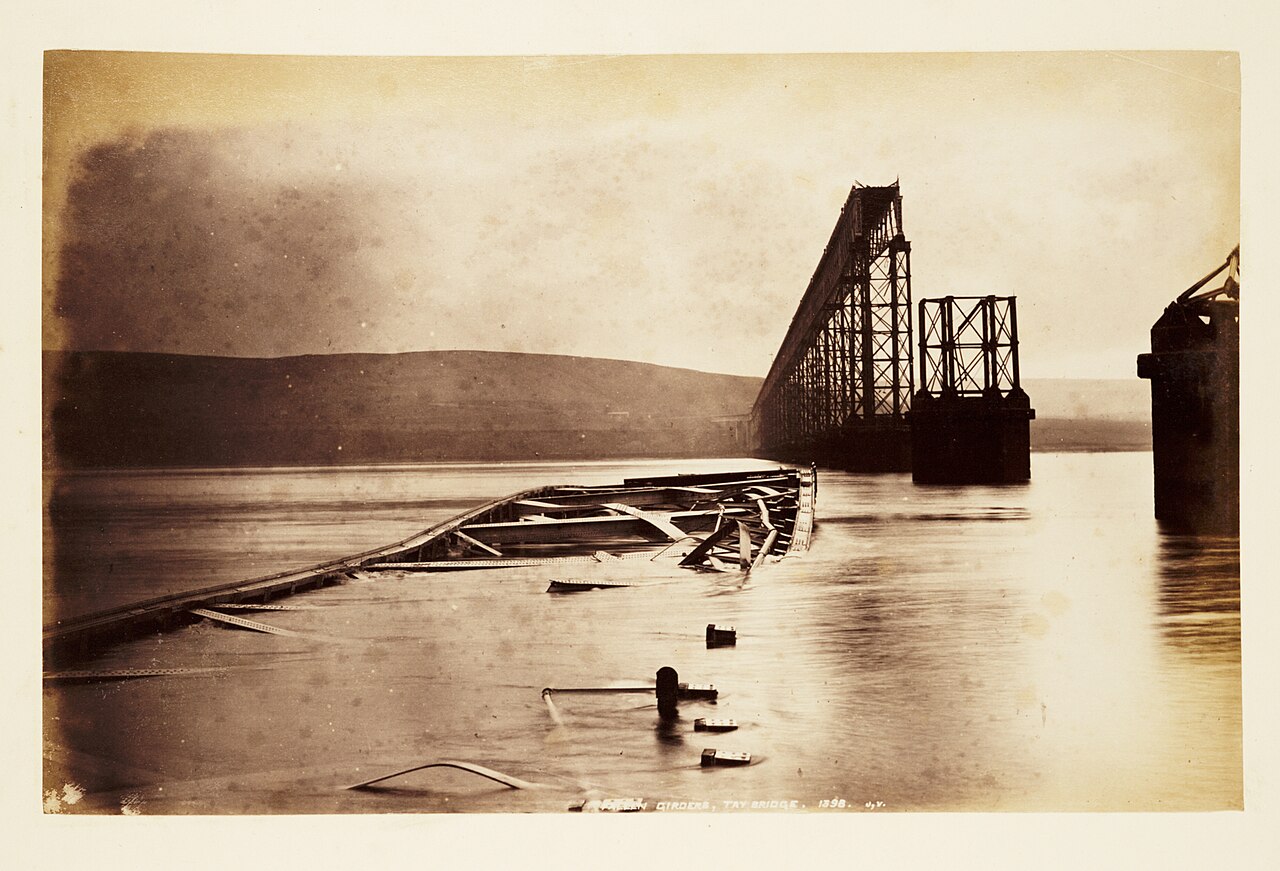
The Tay Bridge disaster is often remembered through weather: a winter gale, a night train, lights vanishing over the Firth of Tay. Weather matters, but it is not the full explanation. On December 28, 1879, the storm did not simply defeat an otherwise sound bridge. It found a structure whose design, workmanship, bracing, inspection, and maintenance left too little reserve when wind and railway loading arrived together.[1][2][3][4]
That distinction is the historical point. The first Tay Rail Bridge was a statement of Victorian reach: a long railway crossing over a broad Scottish estuary, designed by Thomas Bouch, opened in 1878, and quickly absorbed into the practical promise of faster rail movement between Fife and Dundee.[2][5] Less than two years later, its high-girder section collapsed while an Edinburgh-to-Aberdeen train was crossing. The Science Museum's collection account places the accident at about 7:15 p.m. and notes that everyone aboard, about 75 people, died.[2]
The clean moral would be "do not build in storms." The inquiry record and later engineering reappraisals make a harder argument. The mechanism was cumulative. A severe crosswind loaded the high girders and the train; slender piers and bracing had to carry forces for which they were not robustly prepared; defects in joints and cast-iron lugs reduced the structure's ability to behave as a stable frame; and the railway's normal confidence in an opened bridge delayed the institutional imagination of failure.[1][2][4]
Timeline anchors
- June 1878: the first Tay Rail Bridge opened, giving the region a single-track railway crossing over the estuary.[5]
- December 28, 1879: during a violent storm, the high-girder section collapsed as a passenger train crossed toward Dundee.[1][2][3]
- June 30, 1880: the Board of Trade inquiry report was published after examining the circumstances of the collapse.[1]
- 1887: a replacement Tay rail bridge opened, built as a more robust double-track structure upstream of the original remains.[5]
- 2002: a forensic-engineering reappraisal argued that the original inquiry was broadly right, but that fatigue and progressive failure in defective stabilizing elements help explain the final collapse sequence.[4]
Those dates show the shape of the episode. A bridge opened as progress in 1878, failed as disaster in 1879, became an inquiry problem in 1880, and returned as a redesigned crossing in 1887. The event is therefore not only a railway accident. It is a case study in how engineering confidence is disciplined after evidence arrives too late.
Wind Was The Trigger, Not The Whole Cause
The wind on the night of the disaster was real enough. The Science Museum account describes a gale across the Tay and signalmen watching the train's progress before a flash of light and darkness suggested that something had gone wrong.[2] The train, bridge, and storm were not separate actors. A train inside the high girders increased the exposed surface and dynamic demand at the very moment the wind was pressing laterally across the structure.[2][4]
But treating the storm as the cause by itself makes the bridge passive, almost innocent. That was not how the inquiry's afterlife developed. The National Galleries of Scotland summarizes the later conclusion in severe terms: the bridge was deemed "badly designed, badly built and badly maintained."[3] The phrase matters because it distributes causality across time. Design happened before the storm. Building quality happened before the storm. Maintenance and inspection happened before the storm. The gale was the final exam, not the whole curriculum.
This is the useful historical lesson. Catastrophes often become visible at the instant of collapse, but their causes can be stored quietly in assumptions: how much wind a designer expects, how much tolerance a joint is allowed, how faithfully contractors execute details, how much a railway treats vibration or movement as a warning rather than an annoyance.
The High Girders Made The Failure Concentrated
The central section mattered because the high girders lifted the railway line enough to clear navigation. That produced a more exposed and demanding structural zone than ordinary low spans. The Science Museum's description focuses on bracing ties and girders whose proportions were insufficient for the crosswind pressure when a train was passing.[2] ICE's account of the later replacement adds that the first bridge was a single-track lattice design, while the 1887 bridge was intended to be more robust and used many more pier pairs.[5]
The difference between those two bridges is not cosmetic. The replacement embodied a public admission that the old structure's reserve had been inadequate. A long estuary crossing is not one risk; it is many connected risks. Foundations, piers, bracing, metal quality, wind, rail alignment, train load, and inspection all have to cohere. If one weak point fails, adjacent members may be forced into loads they were never meant to carry.
That is why the fallen-girder photograph is so valuable.[6] It shows not a symbolic ruin but a physical argument: long metal members lying in water, separated from the continuous system that once made them useful. The bridge did not merely stop being a bridge. It became loose pieces again.
Small Defects Became System Behavior
The most interesting modern reading comes from Peter Lewis and Ken Reynolds's forensic-engineering reappraisal. Their abstract confirms the original inquiry's broad condemnation of design and material defects, then sharpens the collapse mechanism. They argue that trains passing over slight track misalignment induced lateral oscillations in the high-girder section; defective joints let the amplitude grow; fatigue cracks formed in cast-iron lugs; and on the night of the disaster, wind and train loading pushed already weakened stabilizing elements past the limit.[4]
This matters because it shifts the story from one overpowering gust to accumulated vulnerability. A lug is a small thing beside a bridge across the Tay. A joint detail is easy to miss beside a national railway project. But a bridge is not governed only by the grandeur of its span. It is governed by the behavior of load paths. If the components that stabilize the piers are weak, cracked, poorly fitted, or repeatedly stressed, the whole structure inherits their fragility.[4]
The reappraisal also clarifies why the disaster remained technically compelling long after 1880. The Board of Trade could identify gross fault and responsibility; later engineers could ask how the final sequence likely unfolded member by member.[1][4] Those are different historical tasks. One assigns blame inside a public inquiry. The other reconstructs failure as a dynamic process.
Inspection Failed As Imagination
The inquiry and later museum summaries both draw attention to responsibility. Bouch's reputation was destroyed; the Science Museum notes that the inquiry found him almost wholly to blame, while also criticizing General Hutchinson for not following up on concerns about crosswind capacity.[2] ICE's project history records that Bouch died within a year of the collapse, his professional standing in ruins.[5]
It would be too easy, though, to leave the story at one failed engineer. The Tay Bridge disaster is more disturbing as an institutional failure. The bridge had opened. Trains used it. Signals operated. Tickets were collected. The system behaved as if a working bridge had become proof of a safe bridge. That assumption is common and dangerous. Repeated service can reveal robustness, but it can also normalize warning signs if nobody has the authority or evidence discipline to convert those signs into action.
The court of inquiry was therefore a public technology as well as a legal event. Its work made the collapse discussable in the language of wind pressure, bracing, design responsibility, and maintenance, not only grief.[1][3] The public needed more than elegy. It needed a way to understand how a celebrated bridge could fail so completely.
What Changed
The 1887 Tay rail bridge did not erase the disaster; it built beside it. ICE notes that the replacement was a double-track iron-and-steel structure, about 2.75 miles long, using 73 pairs of piers, tubular wrought-iron caissons, and large quantities of iron, steel, concrete, and rivets.[5] The old remains stayed physically near the new crossing, turning the site itself into a comparison between confidence before inquiry and confidence after inquiry.
The broader lesson is not that Victorian engineers were foolish. It is that rapid infrastructure expansion can outpace the testing culture needed to keep it honest. The Tay Bridge was a railway achievement until the night it became evidence. Afterward, its meaning changed. It warned engineers that wind, fatigue, details, workmanship, and inspection were not secondary to heroic span length. They were the bridge.
That is why the disaster still has force. The storm was dramatic, but the enduring history lies in the quieter mechanism: small defects, light assumptions, weak follow-up, and one train entering a structure whose accumulated weaknesses had become one system.
Sources
- The Railways Archive, "Tay Bridge Disaster: Report Of The Court of Inquiry, and Report Of Mr. Rothery..." - Board of Trade inquiry report summary and scanned-document reference, published June 30, 1880.
- Science Museum Group Collection, "Tay Bridge" - object record for an 1879 disaster photograph, with summary of the collapse, casualty count, gale conditions, and design criticism.
- National Galleries of Scotland, "Tay Bridge, from the South (after Disaster), Dundee" - albumen-print record summarizing the collapse, investigation, and finding that faults in design, construction, and maintenance contributed.
- Peter M. R. Lewis and Ken Reynolds, "Forensic engineering: a reappraisal of the Tay Bridge disaster," Interdisciplinary Science Reviews 27, no. 4 (2002) - abstract on defective joints, cast-iron lug fatigue, oscillation, wind, and progressive collapse.
- Institution of Civil Engineers, "Tay Bridges: Engineering Scotland's Crossings" - engineering-history overview of the first bridge collapse, Bouch's ruined reputation, and the 1887 replacement bridge.
- Wikimedia Commons, "File:Fallen girders, Tay Bridge.jpg" - Board of Trade/National Library of Scotland archival photograph used as the article cover.