Edward W. Topping left Spokane for Seattle on 22 February 1910, a journey scheduled for twelve hours. His train stopped the next morning at the Cascade Tunnel's eastern entrance. On 24 February, it finally crossed west to Wellington.[1]
That movement looked like progress. But the tracks ahead remained blocked, and the route behind closed too.[1] Wellington became a place where a journey could continue only after someone else had cleared a way.
Before dawn on 1 March, an avalanche swept the passenger train and a mail train off the mountainside. Ninety-six people died.[6] To understand how they came to be there, the reconstruction has to begin with the days when the trains were still upright and inhabited—and departure still seemed possible.
A clearing that would not stay clear
Wellington was a working railway town. It had an engine house, a depot, a bunkhouse and a cookhouse. Crews added and removed the electric locomotives used to take trains through the tunnel. Rotary snowplows and teams of shovelers belonged to the same operation: crossing the Cascades required people who could continually recover the tracks from winter.[2]
A rotary plow could throw snow aside, but an avalanche might bring trees and other debris with it. Deep or timber-filled deposits required manual clearance. Geographer Karl Lillquist's account of the route describes these different kinds of work; the distinction explains why impressive machinery did not guarantee a passable railway.[2]
During the blockade, clearing one stretch did not secure the next. Jim Kershner's reconstruction, drawing on Gary Krist's history The White Cascade, describes fresh slides undoing the crews' progress.[4] The destination of their effort kept retreating. A locomotive needed a continuous line of usable track, while the storm could interrupt that line at any point.
This was the practical trap beneath the timetable. The passengers were waiting for a condition that no single successful shift of shoveling could establish. Meanwhile, the train continued to provide somewhere to sleep. Its usefulness as shelter helped prolong its occupation at a place chosen for a temporary halt.
The passengers ask for another journey
On 28 February, passengers petitioned the railroad superintendent to meet them aboard train No. 25. The document, reproduced in Kershner's account, asked for a means by which they could make their way to Skykomish. They had begun to imagine completing the journey without the train.[4]
That request matters because it gives the stranded passengers a voice before the disaster. They were discussing alternatives, rather than simply enduring a delay whose ending only the railroad could decide. But a demand for an exit did not supply the means to bring everyone out.
Some men had already walked away. Kershner recounts how a party including two Spokane lawyers struggled through deep snow toward Scenic. Their successful escape was hazardous enough that their attempted message back warned the others against following. With the telegraph lines down, the warning did not arrive.[4]
A handful of people reaching a hotel on foot therefore proved less than it might appear to prove afterward. A route negotiable by those men was not automatically an evacuation plan for a trainload of passengers. Nor could the people still aboard reliably learn what the journey had involved. The alternatives were being tested under conditions that also obstructed the exchange of information about them.
The slope joins the story
The avalanche came during the early hours of 1 March, amid a violent storm. Accounts differ on the exact minute; the later court opinion places it at about 1:30 a.m.[1] Precision beyond that would give a misleading impression of agreement.
Forest Service investigator Thornton T. Munger subsequently examined the landscape while evidence of the winter's slides remained fresh. His 1911 report describes a hillside whose forest had been killed by fire in 1893 and burned over twice more. By the disaster, little remained beyond logs, stubs and sparse brush. Wet, heavy snow broke loose across a broad area and descended over the siding.[5]
Munger distinguished this movement from an avalanche confined to an established gully. A broad slope could release snow where there was no familiar, repeatedly scoured channel. His account also preserved uncertainty: a smaller slide at one edge was reported as the possible immediate trigger. He did not establish it as an observed fact.[5]
That distinction separates two historical questions. Evidence about the snow, terrain and lost forest helps explain the hillside's vulnerability. It cannot by itself identify the first movement that released the avalanche. Thunder belongs to the recorded storm; making a particular clap of thunder the proven cause would go beyond this evidence.[2][5]
A railway becomes a rescue route
Wellington residents went down to the wreckage and began digging. Greg Lange's HistoryLink account records twenty-three people pulled out alive, many injured. The work took place below the railway, among crushed equipment and snow, rather than beside a train that could simply be boarded or unloaded.[6]
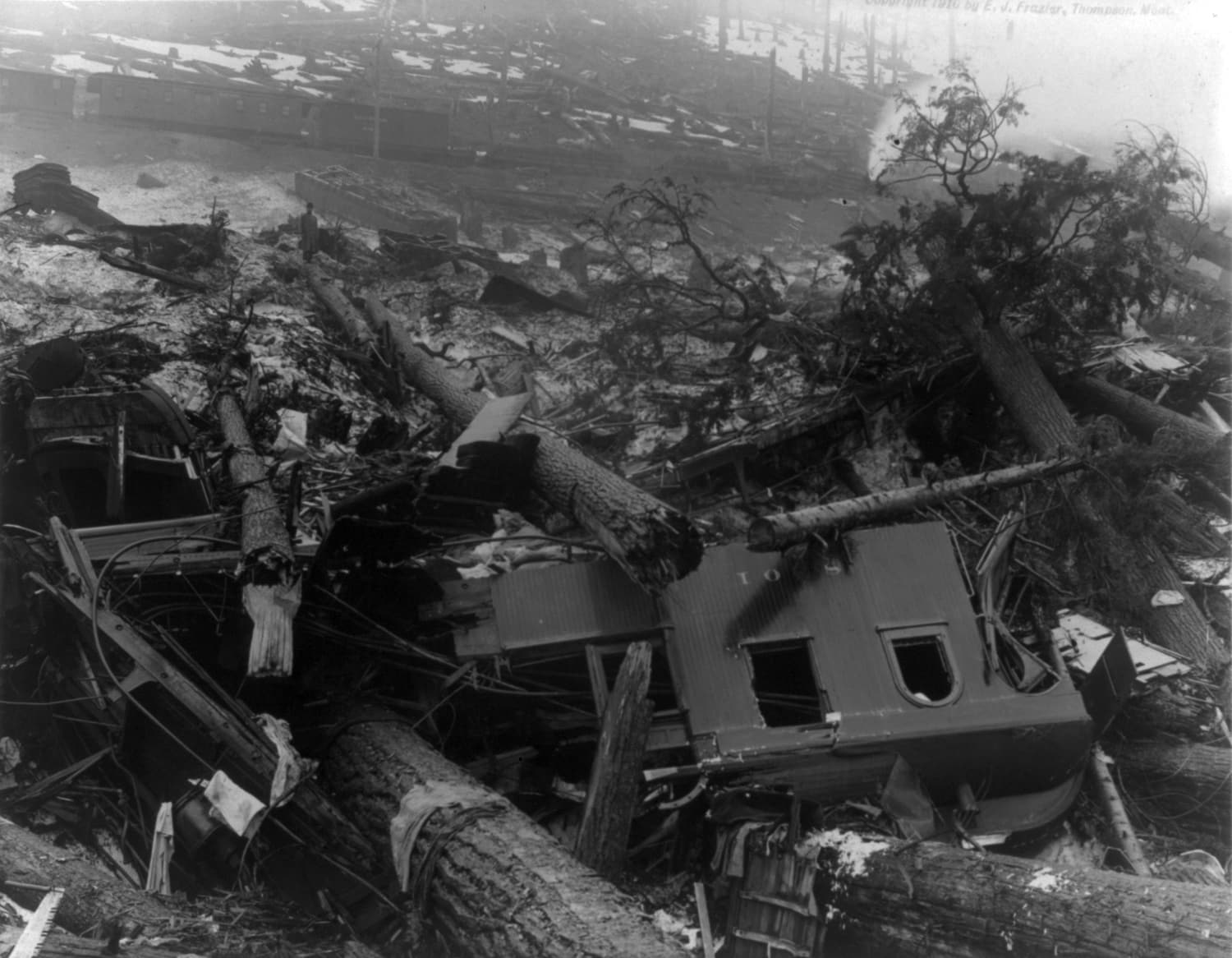
The photograph makes that change tangible. Recognizable pieces of railway equipment remain, but the orderly relationship between a vehicle and its track has disappeared. The image records an aftermath; it cannot show what the passengers knew before the slide or settle whether a different decision would have saved them.[3]
Even removing the dead required another form of transport. Bodies went down the western side of the mountains on toboggans before trains could carry them onward to Everett and Seattle. Lange's breakdown of the ninety-six deaths includes thirty-five passengers and sixty-one railway employees, three of the latter killed in cabins.[6] The disaster struck the community maintaining the route as well as the people traveling through it.
Outside Wellington, newspaper readers received changing estimates. The Library of Congress's collection of contemporary coverage preserves March 2 headlines reporting sixty lives lost in one paper and twenty-three dead in another. These were reports produced while the extent of the loss was still becoming known.[7] Reading them in sequence reveals how slowly a settled account could emerge from an isolated wreck site.
The place where trains could wait
Responsibility remained contested. A jury awarded damages to Topping's son, but in August 1914 the Washington Supreme Court reversed the judgment. It emphasized the exceptional storm and the absence of a previous known slide at that particular siding.[1] That was a ruling on the evidence of negligence, not a demonstration that the hillside could never have been made safer.
A verdict and a field survey answer different questions. The former assesses a claim about conduct; the latter investigates a landscape. To connect them more firmly, we would need evidence of what warnings officials possessed before the disaster and how those warnings shaped their choices.
The railroad's physical response was more visible. It built a long concrete snowshed at Wellington, designed to carry sliding snow over the tracks. Yet sheds themselves required maintenance, and the difficult upper route remained expensive to operate. In January 1929, a new tunnel opened at a lower elevation, allowing trains to bypass the old alignment.[8]
The concrete shelter and the replacement tunnel answered the predicament at different scales: one covered the place where trains had stood; the other changed where trains traveled. Both altered the geography that passengers in February 1910 had been unable to escape. Their petition had asked for a way through. By the time it was written, providing one involved far more than restarting an engine.
Sources
- Washington Supreme Court, Topping v. Great Northern Railway Co., 81 Wash. 166, 142 P. 425 (11 August 1914), Harvard Law School Caselaw Access Project — passenger chronology, evidence and reversal of the damages judgment.
- Karl Lillquist, Leavenworth to Wellington Field Trip (25 September 2016), Central Washington University / Ice Age Floods Institute, pp. 33–37 — railway operations, snow clearance and the limits of identifying the avalanche's trigger.
- E. J. Frazier, photograph of train wreckage after the Wellington avalanche (1910), Library of Congress digital ID cph.3b13980 — archival photograph and provenance, reproduced by Wikimedia Commons.
- Jim Kershner, “100 years ago avalanche wreaked havoc in the Cascades,” The Spokesman-Review (28 February 2010) — passenger petition and walking party, drawing on Gary Krist's The White Cascade.
- Thornton T. Munger, Avalanches and Forest Cover in the Northern Cascades, USDA Forest Service Circular 173 (24 November 1911), especially pp. 7–8 — contemporary field investigation of the Wellington slope.
- Greg Lange, “Train disaster at Wellington kills 96 on March 1, 1910,” HistoryLink (26 January 2003) — rescue, casualty breakdown and transport of the dead.
- Library of Congress, “Wellington, Washington Train Disaster: Search Strategies & Selected Articles” — dated contemporary newspaper headlines, including reports published on 2 March 1910.
- National Register of Historic Places, Stevens Pass Historic District nomination (1976), section 7 and continuation — concrete snowsheds and the lower tunnel opened in January 1929.