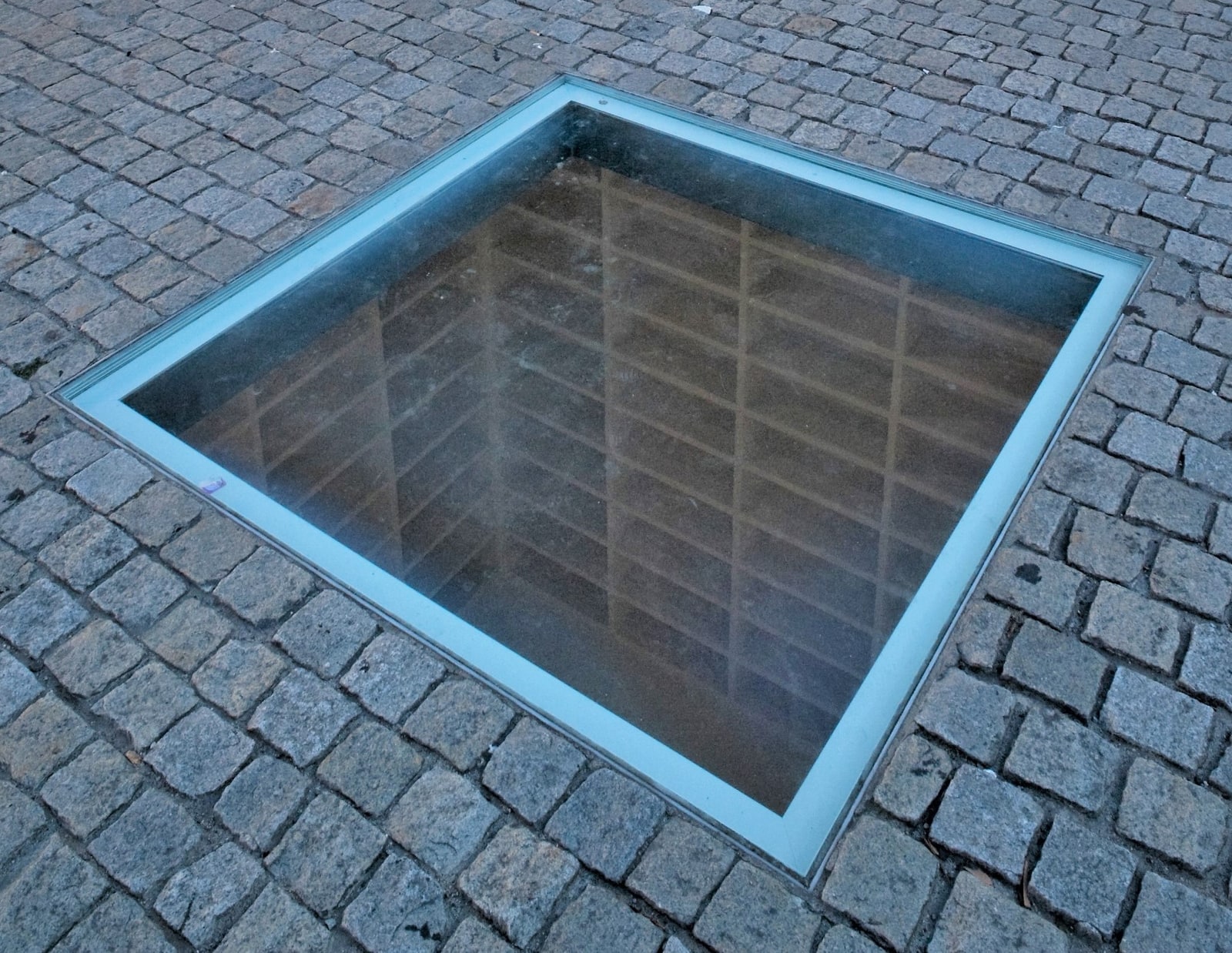
At Berlin's Bebelplatz, a library waits beneath the paving. Its white shelves have room for books, but every shelf is empty. Visitors can look into the sealed chamber through a window in the ground. Micha Ullman's memorial, inaugurated on 20 March 1995, gives the square a second space: one that can be seen but cannot be entered.[3][5]
That encounter depends on a surprisingly vulnerable object. The glass lies in a busy public square, where foot traffic and winter grit wear it down. In 2019, Berlin's Mitte district announced a new arrangement to pay for its regular replacement.[5] A memorial built around absence needs continuing work to make that absence visible.
Remembering who emptied the shelves
On 10 May 1933, the square, then called Opernplatz, hosted Berlin's Nazi book burning. About 20,000 volumes were destroyed. The United States Holocaust Memorial Museum places the event within a campaign organized by pro-Nazi university students and supported by the regime. Propaganda minister Joseph Goebbels spoke in Berlin; radio broadcasts and newsreel cameras carried the spectacle beyond the crowd.[1]
The selection of books was deliberate. Jewish authors, opponents of Nazism, pacifists and writers associated with the political left were among its targets. By collecting and burning the books, students helped enforce that exclusion from German public life. Education offered no automatic protection against that work of exclusion.[1]
Ullman's shelves can suggest a loss on an enormous scale, but empty shelves alone cannot identify its agents. The bronze inscriptions beside the window supply that historical specificity. One names the Nazi students and the authors, journalists, philosophers and scholars whose works they burned; another carries Heinrich Heine's warning about burning books and people.[6] Looking down and reading at ground level become connected acts. The room makes absence perceptible; the words keep responsibility attached to it.
Choosing a room beneath the square
The memorial emerged from an argument about what belonged on this particular ground. A plaque initiated by writer Heinz Knobloch had commemorated the burning since 1980.[3] After German reunification, another proposal involved placing a cast of Ernst Barlach's Geistkämpfer there. A Berlin Senate report dated 21 January 1994 records disagreement over whether that sculpture would adequately address the event at its historical location.[2]
A competition followed. Meeting on 23–24 September 1993, the jury chose Ullman's proposal from 23 submissions and unanimously recommended its realization. The Senate described an enclosed underground library with capacity corresponding to the 20,000 burned books. It praised the relationship between the subterranean room and the open expanse above it. The report also judged the square's existing parking spaces incompatible with the scheme.[2]
This last detail deserves attention. The memorial's effect depended on more than the object the artist would build. Space around it had to be considered too. An unobtrusive work could still make a substantial demand upon the city's use of land.
The library form gives that demand a particular force. Shelving is equipment for keeping things available: a book can be found, taken down and returned. Here, that familiar promise remains suspended. The vacant places invite a viewer to imagine what might occupy them, while the sealed room prevents the ordinary gestures that would make a library useful. This is a reading of the design, rather than a claim that every visitor experiences it in the same way.
The ground became contested again
The question of parking returned after the memorial opened. The Academy of Arts' written account accompanying a documentary by Ingo Kratisch and Konstanze Binder records that Berlin's Senate approved an underground garage in spring 2001. Ullman, a student action group, the Academy and more than 5,000 citizens protested. Construction nevertheless proceeded, turning the square into an excavation site.[4]
The Academy was itself an opponent, so its account should be read as a participant's record. It establishes the protest and explains the concern it shared with the artist; it does not provide a full account of the authorities' case for the garage. In its telling, Ullman's objection concerned the removal of the earth and the loss of quiet and respect around the memorial.[4]
The episode exposes a difficulty in preserving a work whose setting contributes to its meaning. Keeping the chamber physically intact could not, by itself, answer every objection about changing its surroundings. The ground was simultaneously part of an artist's conception, a place of remembrance and urban space over which other decisions could be made. Inauguration had settled none of those relationships permanently.
A window is part of the historical work
The later maintenance problem was smaller in scale and just as concrete. Mitte's 21 March 2019 announcement explained that heavy use required the glass to be replaced regularly, with winter grit causing particular wear. The district's replacement agreement with Wall AG had expired at the end of 2018. Businessman Hans Wall had offered to finance future replacements privately.[5]
The notice documents an arrangement at that moment; it does not establish who pays for the glass today. What it makes clear is the dependence built into the memorial. A visitor needs a usable view through the surface to encounter the carefully constructed space below.
There is an essential difference between the shelves' intended emptiness and a window that has become difficult to see through. The first gives loss a visible form. The second can prevent that form from being encountered at all. Maintenance therefore carries part of the commemorative task: it preserves the conditions in which looking can turn into understanding.
Bebelplatz's library asks people to notice what has been removed. Its own history asks them to notice what must continually be supplied—space, attention, money and care—so that a place of remembrance remains legible in an ordinary working city.
Sources
- United States Holocaust Memorial Museum, “Nazi Book Burnings” — student organization, targeted writers, the Berlin ceremony and its media coverage.
- Senate of Berlin, report to the Abgeordnetenhaus, Drucksache 12/3769, 21 January 1994, pp. 1–2 — the Barlach proposal, competition decision, underground design and parking provision.
- Federal Agency for Civic Education, “Denkmal Bücherverbrennung” — the earlier plaque, the memorial's enclosed room and empty shelving.
- Akademie der Künste, “Bibliothek. Mahnmal zur Bücherverbrennung von Micha Ullman” — written catalog account accompanying Ingo Kratisch and Konstanze Binder's documentary of 1995–2006; the Academy participated in the garage protests it describes.
- Bezirksamt Mitte, “Einladung zum Pressetermin auf dem Bebelplatz,” press release 135/2019, 21 March 2019 — inauguration date, glass wear, the expired replacement contract and Hans Wall's offer of support.
- visitBerlin, “Book burning memorial at Bebelplatz” — the viewing window and transcriptions of the bronze inscriptions.
- Stefan Kemmerling, photograph of the Bebelplatz book-burning memorial, 19 August 2009; cropped by Beyond My Ken in 2020, Wikimedia Commons — source of the article image.