On the night of 18 February 1952, four Coast Guardsmen brought 32 survivors of the tanker Pendleton back to Chatham, Massachusetts, in a wooden lifeboat just 36 feet long. Bernard Webber, Andrew Fitzgerald, Richard Livesey and Ervin Maske had crossed a dangerous harbor bar during a nor’easter to reach the ship’s broken stern.[7]
The most revealing part of their achievement is the repeated approach. Reaching the tanker did not provide a stable place to work. The lifeboat and the wreck rose and fell separately; a ladder hanging between them could become a weapon. Every man brought aboard changed the little boat’s load. Understanding the rescue means following how the crew kept making another approach possible.
A ship could stay afloat and still be unreachable
At about 5:50 a.m., Pendleton broke in two off Cape Cod. Captain John Fitzgerald and seven others were lost with the bow. Chief engineer Raymond Sybert took charge of the 33 men in the stern, where machinery and lighting remained operational. No distress call had gone out.[1]
That separation divided the ship’s capabilities as well as its hull. John Ullman’s account, preserved by the Orleans Historical Society, describes men in the stern listening to radio coverage of another tanker’s distress. They could receive information about the rescue of Fort Mercer, which had also broken apart, without being able to announce their own predicament.[2]
The two wrecks had a material connection. Maritime historian Jay E. Moore explains that these welded T2 tankers carried substantial cargo amidships. When waves supported their ends, the middle was subjected to enormous bending stress. Cold-sensitive steel could fracture instead of deforming enough to absorb the strain. His account places the losses within a wider history of brittle fractures in ships, including vessels that had split without a storm.[3]
The weather was therefore doing several kinds of damage at once. It loaded the hull, exposed weaknesses in its material and made the resulting wreck difficult to find. The storm alone is an incomplete explanation: the ship’s construction and loading helped determine what happened when it met those seas.[3]
Chatham’s radar detected two objects at 2:55 p.m. An aircraft identified Pendleton’s separated sections after 4 p.m., according to Coast Guard historian W. Russell Webster’s reconstruction. Rescuers now had to distinguish two damaged tankers and four floating sections.[1]
The hull could recover; the crew still had to work
CG 36500 had been built at the Coast Guard’s Curtis Bay yard in 1946. It belonged to a developed family of rescue boats, rather than being a convenient small vessel pressed into emergency service.[7]
Its National Register nomination describes a self-righting lifeboat lineage and the 36-foot TRS design’s capacity to operate in conditions that would disable other small boats. It also makes an essential qualification: the Pendleton mission exceeded the conditions for which CG 36500 was designed. The boat’s original power plant was a 90-horsepower gasoline engine; the diesel now associated with its preserved form was a later replacement.[4]
A boat designed to recover from violent motion still needed someone to keep it moving. In Webster’s later account for the National Coast Guard Museum, the crossing smashed the windshield and tore the compass from its mounting. Fitzgerald repeatedly entered the cramped engine compartment to restart the motor after it stopped, suffering burns and bruises.[5]
This is where the language of an indestructible rescue boat becomes misleading. The hull’s ability to survive a blow preserved an opportunity for its crew to act. It could not supply propulsion, steering or a position once those functions were interrupted. Fitzgerald’s work and Webber’s handling made the surviving hull useful again.
A ladder was a moving meeting point
At the tanker, the survivors lowered a Jacob’s ladder. Ullman describes the lifeboat withdrawing and returning as men came down, timing each approach to the motion of the sea. The rescuers had to bring a man from one moving object to another without letting either object strike him.[2]
In the museum account, Webber recalls working the steering and throttle continuously. A mistimed approach could bring the lifeboat up underneath a descending survivor. The boat sometimes needed several passes to collect one person. Repetition was the method by which the rescue progressed.[5]
Each withdrawal created room to try again. Staying close was not automatically safer: proximity exposed both the man on the ladder and the rescuers below to the next surge. The useful distance changed with the movement of the wreck. A successful pass required judgment about the next few seconds, not merely a correct course toward the ship.
Thirty-two of the 33 men in the stern reached CG 36500. One died during the transfer. Ullman’s account does not let the successful total erase that loss; the same ladder-and-boat encounter that saved the others remained lethal.[2]
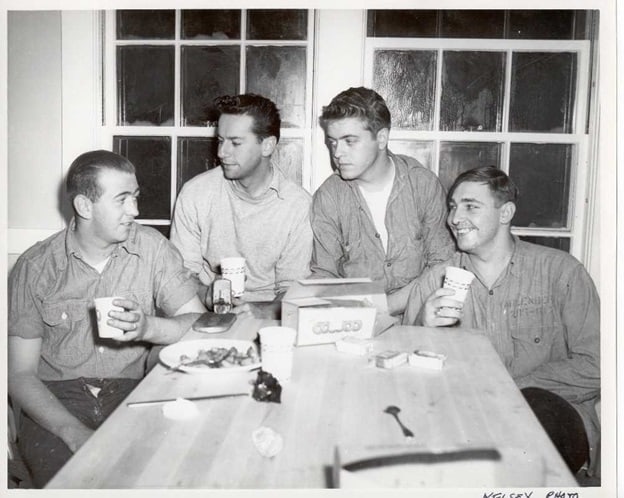
Bringing them aboard created another emergency
The National Register nomination records a rating of twelve passengers and crew. CG 36500 returned with 36 people aboard. Whatever margin its designers had provided, the rescue had consumed far more than its normal carrying allowance.[4]
The transfer thus moved the danger. The men were clear of the tanker, but now shared an overcrowded boat whose compass was gone. More survivors aboard meant a greater obligation to reach land, without making the route there any easier.
Webster recounts discussion over the radio about transferring the survivors to the cutter McCulloch. Webber instead headed shoreward, prepared to beach the lifeboat. A red flashing buoy revealed the entrance to Old Harbor, allowing him to reach the fish pier.[1]
The possibility of another transfer shows why reaching a larger ship was not a complete answer. It would require another hazardous movement of exhausted people between vessels. Heading toward shore carried its own uncertainty. The outcome establishes that Webber found a way home; it does not turn the choices available offshore into safe ones.
On 14 May 1952, the Coast Guard’s awards announcement named all four rescuers among the recipients of the Gold Lifesaving Medal. The release, later reproduced in the Congressional Record, placed their achievement within operations that saved seventy men from the two tankers. It listed aircraft, cutters, radar, liferafts and other equipment alongside the motor lifeboats.[6]
That contemporary inventory widens the familiar picture of four men alone at sea. Their immediate work at the ladder depended on abilities concentrated in one small crew, while finding the wreck and responding across the coast involved many others. The rescue was personal at the point of contact and collective in its reach.[6]
CG 36500 retired in 1968 and passed to the Orleans Historical Society in 1981, when volunteers began restoring it.[7] Its survival leaves a tangible measure of that night: a hull small enough for the repeated approaches, carrying far more people home than its ordinary duty allowed. The achievement lies in those approaches, made one after another while the opportunity lasted.
Sources
- W. Russell Webster, “The Pendleton Rescue,” 2002 retrospective, Orleans Historical Society — chronology, investigation references and return journey.
- John A. Ullman, “Rescue 36500,” reprinted from the Cape Codder by the Orleans Historical Society — radio isolation and repeated transfers.
- Jay E. Moore, “Brittle Fracture: When Ships Split in Two,” The Mariners’ Museum and Park, 28 January 2021.
- National Register nomination, “Coast Guard Motor Lifeboat CG 36500,” April 2005, sections 7–8; NRIS 05000467 — design, engine and rescue loading.
- W. Russell Webster, “Bernard ‘Bernie’ Webber and the greatest smallboat rescue in Coast Guard history,” National Coast Guard Museum, 20 March 2024 — recollections and crew photograph.
- U.S. Coast Guard, news release of 14 May 1952, reproduced in “Tribute to Gil Carmichael,” Congressional Record, 28 January 2016, pp. S340–S341.
- Orleans Historical Society, “About the CG36500 Lifeboat” — crew, construction, retirement and restoration.