
By the time the Senate Watergate hearings opened on 17 May 1973, the scandal already had a chronology, but it did not yet have a civic form. The break-in at the Democratic National Committee headquarters had happened on 17 June 1972. The burglary trial had begun on 10 January 1973. The Senate had voted on 7 February 1973 to establish the Select Committee on Presidential Campaign Activities under Sam Ervin.[2] Those dates mattered, but they did not by themselves explain why Watergate became a national discipline in democratic accountability rather than a Washington scandal with a few spectacular headlines attached.
The strongest answer is television. The Senate Historical Office's own reconstruction of the committee emphasizes that television outlets carried the proceedings live for two weeks in May 1973, while PBS rebroadcast them in prime time across more than 150 affiliates.[2] That change in scale altered the political object itself. Americans were no longer hearing that investigators were asking questions somewhere inside government. They could watch the questions happen. The hearing room became a machine for converting rumor into sequence: who asked, who answered, who evaded, who insisted, what the committee could compel, and what the White House would resist.
That is why the archival footage below matters as more than a commemorative clip.[1][2] Watergate did not become historically decisive only because it uncovered wrongdoing. It became decisive because the hearings taught viewers how institutional scrutiny actually looks when it is working under pressure. Procedure was not background. Procedure was the drama. The nation saw bipartisan members arranged at one table, counsel moving the record forward, microphones capturing hesitation, and a constitutional vocabulary slowly displacing the language of mere campaign dirt.[2][5]
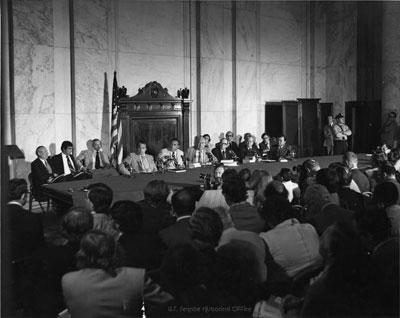
Image context: the cover uses the U.S. Senate Historical Office's hearing photograph. It fits this article because the point is spatial as well as legal. Watergate's public authority came from room choreography: senators on the dais, witnesses before microphones, staff passing paper, cameras fixing attention on the act of examination itself. A hearing room became one of the central visual sets of American constitutional life.[3][4]
Historical context: a burglary became a public test of institutional sequence
The committee did not begin with total clarity. In June 1972 five men were caught inside the DNC offices at the Watergate complex with cash and surveillance gear.[2] Subsequent reporting and federal investigation widened the story, but it was still possible in late 1972 to describe Watergate as a dirty political operation that would remain partly hidden behind campaign denial and criminal-law procedure. Nixon won reelection in November anyway.[2] The issue was not whether facts existed. The issue was whether those facts could be arranged into a form the public could follow.
The Senate committee supplied that form. Senate Resolution 60 created a seven-member body with subpoena power, a defined budget, and a mandate not only to examine the break-in but also the broader universe of illegal, improper, or unethical campaign conduct surrounding the 1972 election.[2] Sam Ervin was a particularly consequential chair for that assignment. He was old enough, formal enough, and constitutionally minded enough to present the inquiry as something larger than partisan improvisation.[2] Howard Baker's presence as Republican vice chairman mattered for the same reason. The committee's architecture told viewers that oversight was supposed to involve contest, but not collapse into factional screaming.
The public-relations strategy mattered too. The Senate Historical Office notes that chief counsel Samuel Dash coordinated an aggressive media plan and that the result was extraordinary public penetration: within a month, 97 percent of Americans had heard of Watergate, and among those people 67 percent believed Nixon had participated in the cover-up.[2] Those numbers are not just polling trivia. They show that the hearings created a national common object. Millions of people were now watching the same room, hearing the same questions, and learning the same institutional grammar.
The room itself carried historical weight. The Kennedy Caucus Room had already hosted major Senate investigations before Watergate, and that continuity matters.[4] The setting made the hearings feel less like improvised television and more like an inherited chamber of inquiry. Watergate did not invent congressional investigation, but it restored mass attention to it after the legitimacy damage left by earlier inquiry cultures such as the McCarthy era.[2][4] The hearings felt modern because they were televised, but they also felt authoritative because the architecture signaled precedent.
Video provenance
The embedded clip is "May 17, 1973: Watergate Hearings Begin," published by NBCUniversal Archives on YouTube.[1] That provenance is useful for an archival spotlight. This is not a retrospective explainer talking over stills. It is broadcast-era footage preserved through a major network archive and centered on the opening day of the Senate hearings themselves. The clip compresses what television made legible: exterior establishing shots, senators behind microphones, name captions, and the insistence that official process could be made watchable without ceasing to be formal.
Close reading: what the footage shows about procedure as television
The first useful thing in the clip is its refusal to treat Watergate as invisible conspiracy alone.[1] It begins outside, in the ordinary urban exterior of the Senate office world, and then moves inward toward the room where the state will have to explain itself. That motion matters. Scandal begins in secret, but accountability begins when secrecy is dragged into a place with a timetable, a witness chair, and cameras. The footage makes that threshold visible.
Once inside, the visual logic is repetitive in exactly the right way.[1] The camera cuts to identified senators at microphones rather than racing for sensation. Howard Baker appears as a named institutional actor, not as decorative bipartisan cover. Sam Ervin appears not as a prosecutor in a criminal courtroom but as a constitutional steward inside a legislative one. The distinction matters historically. Watergate eventually produced criminal consequences, but the hearings first taught the public that Congress had its own evidentiary role: assembling record, testing claims, and pressing the executive branch in open view.[2][5]
The microphones, lower-third captions, and close-ups do more than humanize the committee. They break procedure into graspable units.[1] A viewer does not have to understand every rule of committee practice to recognize cadence: question, answer, pause, follow-up, objection, return. That cadence is part of why Watergate became sustainable television. The scandal's public meaning expanded because the hearings found a visual rhythm that ordinary viewers could read. Evidence stopped looking like a sealed file and started looking like human beings speaking under institutional pressure.
The footage also clarifies why Watergate damaged the White House so deeply even before the tape crisis reached its climax.[1][2] Television does not merely transmit information; it redistributes confidence. Every calm question by a senator, every careful line by counsel, every visible hesitation by a witness shifted trust toward the committee room and away from blanket executive denial. This is the piece that can be lost when Watergate is reduced to the burglary, the tapes, or the resignation helicopter alone. The hearings changed the center of gravity first. They made Congress, briefly, the nation's primary stage for sorting truth from managed narrative.
There is a deeper constitutional point here as well. The Senate page notes that Nixon resisted access to information, refused to allow aides to testify, and later fought subpoenas for the tapes.[2] Those later confrontations mattered because the hearings had already created a public audience capable of understanding them. By the time Alexander Butterfield revealed the existence of the taping system on 16 July 1973, millions had already been trained by weeks of televised procedure to see why records, testimony, and executive privilege were not abstractions.[2] The hearings had educated their own audience in advance.
Legacy: why this footage still matters now
Watergate is often remembered through endings: the Saturday Night Massacre, the Supreme Court's ruling in United States v. Nixon on 24 July 1974, and Nixon's resignation on 9 August 1974.[2][5] Those endings deserve their place, but the archival force of this clip lies elsewhere. It catches the moment when accountability stopped being merely retrospective and became publicly procedural. You can watch a republic teaching itself, in real time, how a committee builds legitimacy.
That is why the clip still holds in 2026.[1][2] The footage preserves something more durable than scandal atmosphere. It shows how institutions gain credibility when they make their method visible. The Senate Historical Office argues that the Watergate Committee helped revive public confidence in congressional investigations, and the legislative afterlife was real: campaign-finance reform, the Ethics in Government Act, stronger Freedom of Information rules, and a broader expectation that oversight could be both adversarial and structured.[2] The National Archives page on the Watergate Special Prosecution Force extends the story by showing how large the documentary trail became once the inquiry crossed into prosecution and records management.[5]
In that sense, the hearing footage is not only an artifact of Watergate. It is an artifact of democratic tempo. It reminds viewers that constitutional crisis does not become legible all at once. First it has to be slowed down, named, organized, and shown. Watergate entered American memory not just because cameras caught a downfall, but because cameras first made procedure compelling enough for millions of people to stay with the case.
Sources
- NBCUniversal Archives, "May 17, 1973: Watergate Hearings Begin," YouTube video.
- U.S. Senate Historical Office, "Select Committee on Presidential Campaign Activities (The Watergate Committee)."
- U.S. Senate Historical Office, "Watergate Committee Hearing" image page.
- U.S. Senate Historical Office, "Kennedy Caucus Room" - historical note on the room that hosted major investigations including Watergate.
- National Archives, "Records of the Watergate Special Prosecution Force."