
By the last forty-eight hours of April 1975, the fall of Saigon already had the shape of a final scene: helicopters rising above walls, Marines controlling gates, families climbing toward roofs, and North Vietnamese forces closing from the edges of the city.[1][3][4] Yet the archival record gives the ending a different structure. Once shelling at Tan Son Nhut Air Base halted the fixed-wing exit on 29 April, the city could no longer evacuate outward through an airport. It had to evacuate upward and then seaward: stairwells, ladders, rooftops, helicopter pads, and finally carrier decks offshore.[3][4][5]
That distinction matters because public memory tends to compress the whole event into one photograph and one building. The famous Hubert van Es rooftop image is still commonly described as the roof of the U.S. Embassy, even though both a corrected AP Archive note and the surviving site record point instead to 22 Gia Long Street, the Pittman Apartments used by the CIA, roughly half a mile away.[2][6] The mistake is revealing. It shows how quickly a dispersed evacuation network hardened into one symbolic address. A staircase became "the embassy roof"; a chain of departure points became one emblem of defeat.
The footage below is valuable because it restores movement between those nodes.[1] In ITN Archive's compilation, the last days of Saigon are not framed as a single dramatic lift-off alone. They are a sequence of thresholds: embassy walls, rooftop waiting areas, helicopters that can take only a fraction of the people pressing upward, and then the city itself shifting from evacuation tempo to takeover tempo. The event becomes legible not as one exit, but as a system under terminal pressure.
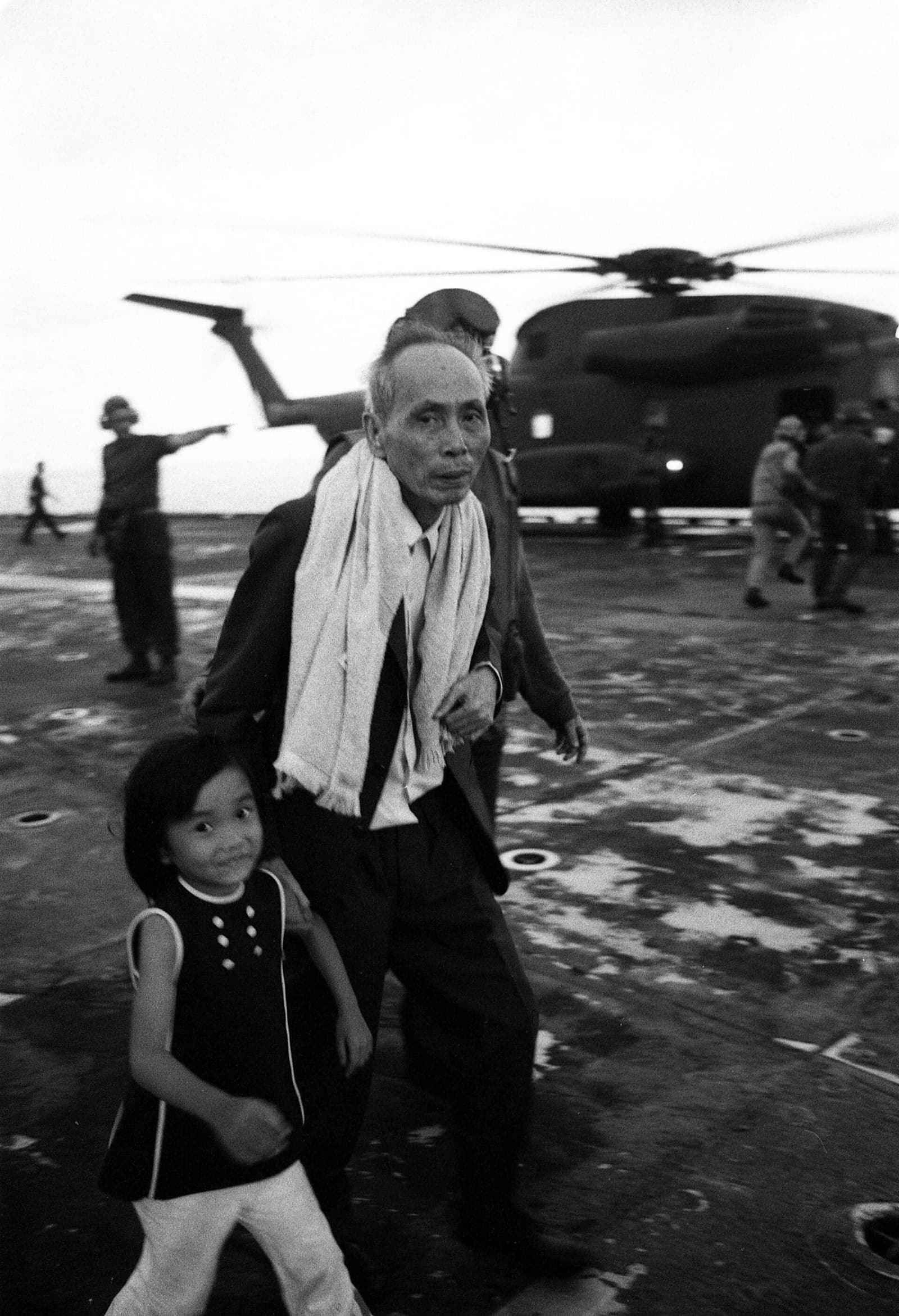
Image context: the cover uses a real 29 April 1975 National Archives photograph of South Vietnamese evacuees walking across the flight deck of the USS Hancock after helicopter extraction from Saigon.[5] It fits this article because the key historical point is logistical. The fall of Saigon became iconic in the city, but it was completed offshore, where carriers received civilians, searched baggage, processed arrivals, and made room for yet more helicopters.
Historical context: once the runway closed, the city had to evacuate upward
The background to the final evacuation was already months in the making. The National Museum of American Diplomacy notes that after the Paris Peace Accords and the withdrawal of U.S. combat forces, about 5,000 Americans still remained in South Vietnam in 1975, including diplomats and embassy staff in Saigon.[4] Through March and April 1975, North Vietnamese forces took city after city, refugee flows accelerated, and lines outside the American embassy lengthened as South Vietnamese civilians and dependents tried to secure a path out.[4] By the final week of April, evacuation was no longer a contingency on paper. It was the only remaining administrative task with any political meaning.
The decisive break came on 29 April 1975. According to both the National Archives and the State Department museum account, shelling at Tan Son Nhut ended the possibility of evacuation by plane.[3][4] The signal to begin Operation Frequent Wind was then broadcast through the now-famous playing of "White Christmas" over radio.[3][4] That detail has become part of the folklore, but its practical meaning is more important than its romance. It marked the moment when normal departure infrastructure had failed and the city had to be reorganized around helicopter rhythm.
The museum account captures the scale of that reorganization clearly.[4] After attacks on the defense attaché compound, the U.S. embassy became the sole departure point for helicopters. Ambassador Graham Martin insisted that the departing pool include not only Americans but also South Vietnamese officials and local staff whose association with the United States placed them in danger.[4] The result was a crisis of vertical sorting. Roughly 10,000 South Vietnamese gathered at the embassy gates hoping to reach flights; helicopters came in at roughly 10-minute intervals; some pilots flew for 19 hours; and more than 7,000 people, including about 5,500 Vietnamese, were evacuated in less than 24 hours.[4]
Seen this way, the fall of Saigon was not simply a military collapse observed from the outside. It was also an emergency architecture. Gates had to be held, names checked, walls climbed, people prioritized, helicopters packed, and arrival decks cleared for the next cycle.[3][4][5] That is why the event so often feels simultaneously intimate and impersonal in archival material. The smallest unit is a family on a staircase. The largest unit is an evacuation conveyor that does not stop because no other exit remains.
Video provenance
The embedded clip is "Fall of Saigon | Rare Footage of US Embassy Airlift and NVA Takeover (1975)," published by ITN Archive on YouTube.[1] The archive description identifies the journalists and crew who documented the chaos in Saigon and notes that one team escaped by American helicopter while another remained to film the communist takeover.[1] That provenance matters for an archival spotlight. This is not a modern explainer summarizing the event with maps and retrospective narration. It is archive-managed period footage shaped by the visual pressures of the evacuation itself: cramped spaces, hurried movement, overcrowded thresholds, and the abrupt shift from extraction to occupation.
Close reading: what the footage shows about collapse as a stacked sequence
The first thing the clip restores is verticality.[1] The people in these frames are rarely shown moving through open civic space as though departure were orderly or horizontal. They are pressed against walls, waiting in upper stories, climbing stairs, leaning toward ladders, and gathering at rooftop edges. That matters historically because it reveals how the city's last exit points had narrowed. A runway can process crowds as lanes. A roof can only process them as batches. Every ascent into the frame therefore also records exclusion: many more people have reached the building than can reach the helicopter.
The second thing the footage clarifies is that the famous "one roof" memory is too neat for the actual event.[1][2][6] The evacuation moved across several linked sites, and public memory later fused them together. AP Archive's 2025 correction note on its own anniversary compilation explicitly states that the widely circulated rooftop helicopter shot was not the U.S. Embassy roof but the Pittman building at 22 Gia Long Street nearby.[2] The surviving Commons page for the rooftop site says the same.[6] That correction is more than a caption dispute. It forces the viewer to understand the last hours of Saigon as a network rather than a stage set. The embassy mattered enormously, but it did not monopolize the event's imagery or its mechanics.
The third thing the footage needs, though it cannot entirely contain by itself, is the offshore continuation of the same sequence.[3][5] The city images end in helicopter lift-offs, but those lift-offs were only a midpoint. National Archives records of Operation Frequent Wind show what followed on carriers such as the USS Midway, USS Hancock, and USS Vancouver: evacuees stepping out onto decks, baggage checks, crowded reception zones, and helicopters being pushed overboard to make room for the next arrivals.[3] The cover photograph from the USS Hancock belongs to that second half of the story.[5] It shows the fall of Saigon after the famous lift-off, when flight turned into intake, sorting, and uncertain temporary safety.
The clip's final value lies in its change of tempo.[1] Evacuation footage is full of compression, urgency, and repeated upward motion. Takeover footage works differently. Once North Vietnamese forces enter the city, the rhythm flattens. The question is no longer who can still get out in the next ten minutes. It is who now governs the streets, buildings, and symbols that had moments earlier been departure points. The event therefore records two different endings at once: the end of an evacuation corridor and the end of a state.
Legacy: why this footage still matters now
The fall of Saigon remains easy to remember as an image of abandonment. The archival record asks for a harder, more exact memory.[1][3][4] What ended in April 1975 was not only American prestige or South Vietnamese sovereignty in the abstract. What ended was an entire transport and paperwork regime that had to keep functioning even while the state around it gave way. The National Museum of American Diplomacy puts the point well when it says the visa and evacuation logistics were "not glamorous" but essential, with diplomats behind every detail.[4] The footage makes those details visible again.
That is why this clip still matters in 2026.[1][3][5] It restores sequence where memory prefers symbol. The famous roof remains part of the story, but so do the stairwells below it, the helicopter cadence above it, and the carrier decks beyond it. Once those pieces are seen together, the fall of Saigon becomes less a single snapshot of panic and more a historical lesson in how states end in layers: first the runway, then the queue, then the roof, then the shipboard ledger that receives whoever made it out.
Sources
- ITN Archive, "Fall of Saigon | Rare Footage of US Embassy Airlift and NVA Takeover (1975)," YouTube video.
- AP Archive, "A look back at coverage of the fall of Saigon 50 years ago," YouTube video, including the corrected note that the famous rooftop evacuation shot was the Pittman building rather than the U.S. Embassy roof.
- National Archives, "Haste: Operation Frequent Wind and the Fall of Saigon" - The Unwritten Record.
- National Museum of American Diplomacy, "The Fall of Saigon (1975): The Bravery of American Diplomats and Refugees."
- Wikimedia Commons, "File:South Vietnamese evacuees walk across the flight deck of the USS Hancock.jpg" - source page for the cover photograph.
- Wikimedia Commons, "File:Rooftop, 22 Gia Long Street, Saigon.jpg" - source page identifying the famous evacuation rooftop site as 22 Gia Long Street rather than the embassy roof.