
The Apollo 11 moonwalk on 20 July 1969 survives in public memory as a paradoxical picture: everyone knows it, and almost everyone remembers it as murky.[1][2] That ghostly look was not an accident added by later nostalgia. It was built into the way the event reached Earth. NASA's own mission overview still frames the scale of the moment in the clearest possible terms: an estimated 650 million people watched Neil Armstrong's televised image and heard the first-step line on 20 July 1969.[2] Yet the image that carried that line around the world was already a compromised version of a better picture.
That is what makes the archival footage below historically valuable. The moonwalk mattered as an act of exploration, but it also mattered as a transmission event.[1][3][4] Apollo 11 did not merely place a man on the lunar surface. It placed a non-standard television signal into a fragile international chain of antennas, scan converters, microwave relays, satellites, landlines, and broadcast rooms. The result was a world-historical image produced under severe bandwidth limits and visible engineering sacrifice. The event was modern not only because it happened on the Moon, but because hundreds of millions encountered it through a picture that had to be translated before it could be shared.
The strongest way to read the first step, then, is not as a simple triumph of presence. It is a case study in selective visibility.[3][4][5] The people in the tracking chain could see more than the public could. The raw slow-scan signal received at Goldstone, Honeysuckle Creek, and Parkes preserved sharper detail than the official worldwide broadcast. The public got history in time, but not at full fidelity.[3][4] That gap between local clarity and global memory is precisely why the footage still matters.
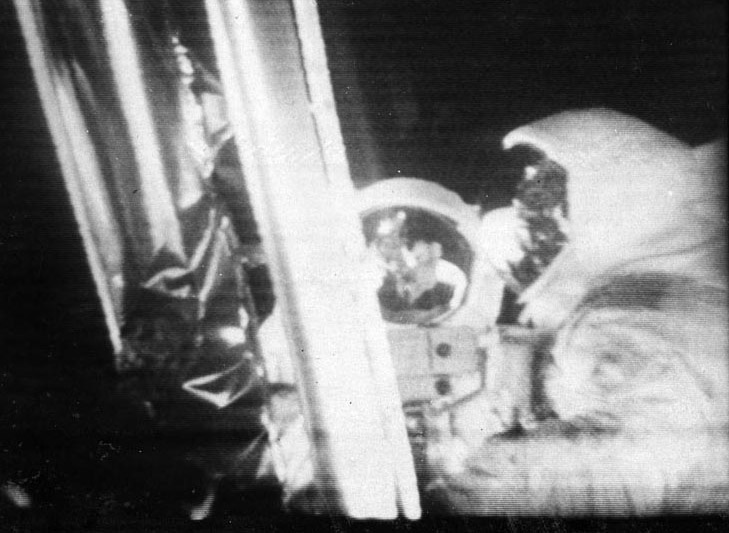
Image context: the cover uses the archival file Apollo11A.jpg from Wikimedia Commons, sourced to a Polaroid photograph taken at Sydney Video of a Fairchild 320-line slow-scan monitor showing the Parkes feed on 21 July 1969 UTC.[6] It fits this article because it captures the essential historical distinction: the clearer picture existed inside the receiving system before it was softened, cropped, and standardized for mass television.
Historical context: the moonwalk had to fit inside a narrow communications budget
Apollo 11's lunar television was constrained long before Armstrong climbed down the ladder. The Honeysuckle Creek tape-search flyer, drawing on the technical history of the tracking network, explains that Apollo planners expected very limited bandwidth from the Moon.[3] Voice, telemetry, biomedical data, and television all had to share the same lunar link. NASA therefore budgeted only 500 kHz for television from the lunar surface, far below the 4.5 MHz bandwidth of commercial broadcast TV.[3] That single constraint shaped everything that followed.
The camera solution was ingenious and costly at the same time. According to the same technical account, NASA called for a non-standard slow-scan format of 320 lines at 10 frames per second, rather than the American television standard of 525 lines at 30 frames per second.[3] Westinghouse spent years building a lunar camera that could survive temperature extremes, glare, and the practical violence of being handled on the Moon.[3] Inside the mission boundary, that camera did its job well. The problem began when the signal had to leave the mission boundary and become ordinary television.
Three receiving points mattered during the EVA: Goldstone in California, Honeysuckle Creek in Australia, and the Parkes radio telescope in Australia.[4] The comparison document from Honeysuckle Creek lays out the path plainly. Goldstone sent video to Houston by landline, while the Australian pictures were routed through Sydney, then to the OTC Moree earth station, and then onward by Intelsat to the United States.[4] This was not redundant scenery around the moonwalk. It was the physical system that turned a local engineering image into a global civic event.
That system also helps explain why public memory and source memory diverged. The tape-search flyer states that the highest-quality television was recorded on telemetry tapes at the receiving stations and that the pictures seen by the world were substantially degraded by the time they reached Houston.[3] The comparison document makes the same point visually and verbally: as Armstrong came down the ladder, the international television audience saw very little compared with the clearer slow-scan monitor image available at Goldstone.[4] The moonwalk entered history as a global achievement, but it entered television history as a tradeoff.
Video provenance
The embedded video is "Apollo 11 TV Broadcast - Neil Armstrong First Step on Moon," published on the official YouTube channel of the Smithsonian National Air and Space Museum.[1] For an archival spotlight, that provenance matters. This is not a modern explainer or a commemorative montage. It is an institutional preservation upload of the broadcast event itself, centered on the interval in which Armstrong descends the ladder and steps onto the lunar surface. The value of the clip lies in the fact that it preserves the historical problem along with the historical act: you do not just see the first step, you see what the first global moonwalk looked like after translation into standard television.
Close reading: the broadcast makes the Moon feel both immediate and far away
The first thing to notice in the footage is how unstable "presence" really is.[1][3][4] Viewers are watching a human being become visible on another world, but the image resists smooth legibility. Edges bloom. Contrast shifts. Motion feels hesitant. The picture seems to arrive with effort. That is not just a defect to be corrected by restoration culture. It is historical evidence. The image tells you, in real time, how much work it took to move lunar experience into the format of terrestrial television.
This is why the phrase "damaged miracle" is a useful description. The miracle is obvious enough: Armstrong appears, the ladder becomes a threshold, and the Moon stops being only telescopic or imagined space.[1][2] The damage is equally important. NASA's restoration note explains that the original lunar camera produced a non-standard scan format that commercial television could not broadcast directly.[5] NASA therefore used scan converters to adapt the picture into standard U.S. television, and that adaptation imposed loss before the signal ever reached the living room.[5] When the footage looks thin or ghostly, it is showing the strain of its own circulation.
The Australian part of the chain deepens that reading. The Honeysuckle Creek technical flyer says most of the broadcast came through the Australian stations and was then further degraded by long-distance analog transmission to Houston, covering almost 50,000 miles / 80,000 km from the tracking stations to Mission Control.[3] That distance is worth holding in mind while watching the clip. The image is not weak because history failed. It is weak because the picture has been converted, relayed, standardized, and recorded across an immense path in order to arrive on time.
The footage also clarifies a subtler historical point: the public did not witness the moonwalk in exactly the same visual world occupied by the tracking stations.[3][4][6] The people working with the raw slow-scan pictures had access to a sharper version of the event than the one that became global memory. The Commons image used here preserves that distinction with unusual force. It shows the clearer slow-scan monitor view from Sydney Video, including detail in the visor reflection that the official broadcast softened.[6] In other words, the most famous live image of the twentieth century is also an image of information loss.
That does not diminish the event. It explains its actual texture. The moonwalk's public authority came partly from the fact that it was visibly difficult to deliver.[1][3][5] This was not a polished studio picture pretending to be live. It looked hard-won because it was hard-won. The signal had to survive the lunar camera, the downlink, the tracking stations, the scan converters, the microwave and satellite hops, the Houston switching chain, and finally the telerecording and rebroadcast processes that fixed it in memory.[3][4][5] The blur is part of the document.
Legacy: why this footage still matters now
Apollo 11 is often described as the moment humanity first looked back at itself from another world. That is true, but it misses the more precise media history inside the event. What millions encountered on 20 July 1969 was not direct lunar vision in any simple sense. It was a carefully managed conversion from mission-specific engineering into global television.[2][3][5] The moonwalk became universal by becoming poorer in the very act of distribution.
That is why this archival clip still matters in 2026. It keeps the first step attached to the infrastructure that made it public.[1][3][4] The video does not merely commemorate Armstrong's movement from ladder to surface. It preserves the threshold between two systems: a lunar camera designed for extreme constraints and a global broadcast culture demanding immediate legibility. The history lives in that threshold. Apollo 11 reached the world not as perfect sight, but as a signal struggling successfully across distance.
Sources
- Smithsonian National Air and Space Museum, "Apollo 11 TV Broadcast - Neil Armstrong First Step on Moon," YouTube video.
- NASA, "Apollo 11 Mission Overview" - mission summary noting that an estimated 650 million people watched Armstrong's televised image on July 20, 1969.
- Honeysuckle Creek Tracking Station, The Search for the original Apollo 11 Moonwalk TV tapes - technical flyer on the 500 kHz bandwidth constraint, 320-line/10 fps slow-scan format, scan conversion losses, and the Australia-to-Houston relay chain.
- Honeysuckle Creek Tracking Station, Comparison photographs of the Apollo 11 Lunar Television - visual and technical comparison of slow-scan monitor images at Goldstone, Honeysuckle Creek, Parkes, and the scan-converted broadcast seen in Houston and worldwide.
- NASA, "NASA Releases Restored Apollo 11 Moonwalk Video" - on the non-standard lunar TV format, scan conversion, restoration sources, and why the broadcast image degraded before worldwide transmission.
- Wikimedia Commons, "File:Apollo11A.jpg" - source page for the archival slow-scan monitor image used as the article's lead image.