The Women Airforce Service Pilots, usually remembered as the WASP, are often introduced through overdue recognition: women flew Army aircraft in World War II, were treated as civilians, and had to wait until 1977 for veteran status.[1][5] That memory is true, but it can make the wartime program sound like a symbolic injustice first and an operating system second. The sharper historical question is mechanical: how did a group without military status become useful enough to fly Army aircraft, ferry fighters, tow targets, test repaired planes, and keep male pilots available for combat?
The answer is that WASP turned military flying into a home-front labor-allocation system. It did not put women into combat units. It put trained civilian women into the domestic aviation tasks that made combat aviation possible: moving aircraft from factories to bases, preparing pilots through target practice, checking aircraft after repair, instructing trainees, and absorbing danger inside U.S. airspace.[1][3][4] The contradiction was built into the design. The Army needed the labor to behave like military labor, but Congress and the service establishment were not yet willing to make the women full members of the military.
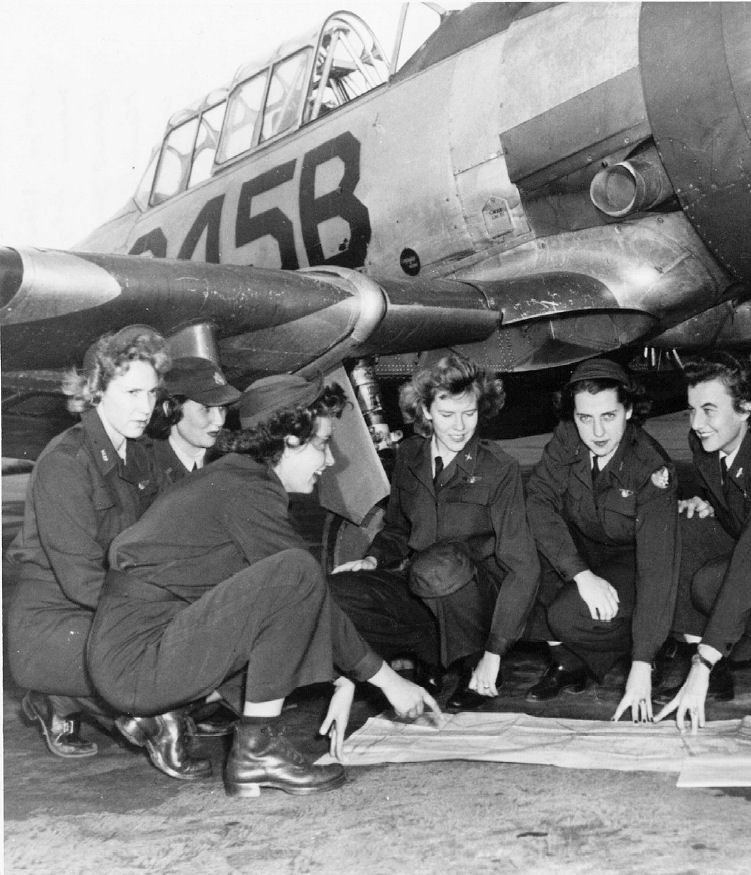
That is why the photograph matters. Four trainees at Avenger Field study a flight plan beside a T-6 Texan, neither posed as novelty celebrities nor hidden inside a sentimental home-front tableau.[6] They are doing the work before the work has received the category it deserved.
The pilot shortage created the opening
The chain begins after U.S. entry into World War II in December 1941. The Army Air Forces needed more pilots, and two experienced aviators, Jacqueline Cochran and Nancy Harkness Love, separately pressed the case that women could take over noncombat flying on the home front so men could be sent to combat assignments.[1][4] The National Park Service summarizes the early structure clearly: the Army first created the Women’s Auxiliary Ferrying Squadron and the Women’s Flying Training Detachment, then merged them into WASP in 1943.[1]
That merger matters because the program fused two different needs. Love’s ferrying idea used experienced pilots who could move aircraft quickly. Cochran’s training program created a pipeline that could produce more women pilots who had been retrained “the Army way.”[1][4] The Eisenhower Presidential Library’s Cochran document page preserves the administrative paper trail around this transformation: ferry-pilot requirements in September 1942, hiring civilian women pilots, a June 1943 memo about incorporating women civilian pilots and trainees into the Army Air Force, and a final report after the program ended.[3] The WASP were never an informal club beside the war effort. They were a formal answer to a personnel bottleneck.
The first mechanism, then, was substitution. If a qualified woman could ferry an aircraft from factory to base, tow a target, or test a repaired trainer, a male pilot could be used elsewhere. The National WWII Museum states the wartime scale in hard terms: nearly 1,100 women tested, flew, and ferried 12,650 aircraft over 60 million miles.[4] Those numbers should not be read as tribute decorations. They are evidence that the program solved a logistics problem at scale.
Civilian status made the system cheaper and more fragile
The second mechanism was legal ambiguity. Officially, WASP was a civilian organization cooperating with the Army; its members did not have military status.[1] That status made the program administratively possible before political acceptance existed, but it also placed the women in a strange category. They wore uniforms, followed Army discipline, trained at military facilities, flew military aircraft, and took military risks, yet they lacked the protections, pay, funeral support, and postwar standing attached to military service.[1][4]
The training regime exposes the contradiction. NPS says more than 25,000 women applied, about a thousand completed rigorous training, and trainees at Avenger Field studied navigation, meteorology, Morse code, and airplane mechanics while marching, drilling, and undergoing inspections.[1] The National WWII Museum adds that 1,830 were accepted and 1,074 earned their wings after four months of training, including 560 hours of ground school and 210 hours of flight training.[4] The Army needed discipline and standardization, not amateur enthusiasm.
Yet the same system stopped short of full obligation in the other direction. The women were held to a military-like standard while the government retained civilian treatment. When a WASP died, federal military funeral support did not automatically follow; NPS notes that colleagues had to pool money to send bodies home.[1] The National WWII Museum likewise records that women in the training program had minimal medical care, no life insurance, and had to fund funeral expenses for pilots who died during training.[4] In mechanism terms, the program extracted military utility without granting military reciprocity.
Domestic flying was not safe simply because it was domestic
The third mechanism was risk transfer. The WASP did not fly combat missions, but their work was not decorative or safe by definition. NPS lists ferrying, target towing for gunnery practice, instructing male trainee pilots, and testing aircraft that were new or had been damaged and repaired.[1] The Smithsonian National Air and Space Museum’s digitized photo essay emphasizes the same operating field: WASP pilots flew 60 million miles during World War II on domestic missions and often carried out ferrying work, moving aircraft for the war effort.[2]
That domestic geography can mislead. Factory-to-base ferrying sounds routine only if one ignores the machines, weather, navigation limits, mechanical uncertainty, and wartime tempo. The National WWII Museum’s account is blunt about variety: WASP pilots flew about 80 percent of U.S. military ferrying missions, delivered aircraft of 78 kinds, towed targets for simulated strafing and antiaircraft artillery training, and flew repaired or difficult planes that some male pilots refused.[4] The cockpit did not become safe because the destination was inside the United States.
Thirty-eight WASP pilots died in service.[1][4] That number is central because it breaks the soft version of the story. The program’s purpose was not morale messaging. It inserted women into dangerous aviation work precisely because the Army needed skilled labor in places that did not fit the combat/noncombat moral shortcut. A target tow over a training field, a test hop in a repaired aircraft, or a delivery flight in bad conditions could still kill a pilot.
The same labor that proved the case threatened the category
The fourth mechanism was backlash. WASP pilots did not enter a neutral labor market. They entered one of the most prestigious masculine identities in the wartime military: the pilot. NPS notes that WASP members faced sexism and hostility, were paid less than male counterparts for comparable work, and encountered commanders who questioned their judgment and fitness.[1] The National WWII Museum makes the status threat explicit: pilots were elite, and the WASP served in a role many men wanted and admired.[4]
This helps explain why evidence of competence did not automatically produce permanence. A program can prove operational value and still lose a political fight if its success unsettles the group that controls the category. In 1944, WASP and allies pressed for military status; other women’s branches such as the WAC and WAVES were already part of the armed forces, but Congress refused to militarize the WASP, and the program was deactivated in December.[1] The National WWII Museum gives the legislative hinge: a House bill to militarize the civilian WASP failed narrowly in July 1944, and as more male pilots became available for stateside roles, the stated need for WASP decreased.[4]
That sequence is important because it keeps the story from becoming a simple “women were useful, therefore recognition followed” narrative. Recognition did not follow. Usefulness and exclusion coexisted. General H. H. Arnold’s October 1944 deactivation memo is preserved in the Cochran papers listed by the Eisenhower Library, and the paper trail around militarization and disbandment shows the program being closed administratively after its work had already demonstrated what women pilots could do.[3]
The WASP thus exposed a wartime boundary problem. Were they civilian contractors, temporary auxiliaries, military trainees, or service members in everything but legal name? The answer changed depending on who was asking and what cost was attached.
Delayed recognition was part of the mechanism, not just the epilogue
The postwar story is often told as correction: the country forgot, then corrected the record. The mechanism is sharper. The original civilian category continued to govern what benefits, honors, burial practices, archives, and public memory could do. NPS states that it took thirty years for official recognition and veteran status to arrive in 1977.[1] The National WWII Museum makes the same point: the WASP were the only women’s branch not granted military status during World War II, and recognition came only in 1977.[4]
The later Congressional Gold Medal extended that correction into public commemoration. The Smithsonian object record says Congress recognized and awarded the WASP the medal for their service, record, and “revolutionary reform” in the Armed Forces during World War II; the medal was presented on March 10, 2010, under Public Law 111-40, signed on July 1, 2009.[5] That medal did more than honor a group. It marked the belated conversion of a disputed labor category into national military memory.
The delay matters historically because it proves the original category had consequences. If the WASP had simply been treated as service members from the beginning, the later fight for veteran status would not have been necessary. The long recognition campaign was not only about pride. It was about forcing the state to admit that military service can be hidden by administrative labels when institutions benefit from the work but resist the status.
What the WASP actually changed
The cleanest causal chain is this: wartime pilot demand created a labor gap; Cochran and Love supplied two women-pilot models; the Army converted those models into a civilian training-and-ferrying system; WASP pilots performed domestic military aviation work at scale; civilian status kept the program politically containable but denied reciprocity; backlash and returning male pilots made militarization fail; postwar recognition had to repair the category after the work was already done.[1][3][4][5]
That is why the WASP should not be remembered only as pioneers, though they were. Pioneer language can make them sound like inspiring exceptions. Their history is more structural. They showed that access to military aviation was not only about physical capacity or technical skill. It was about whether institutions were willing to let demonstrated work alter status.
The 1943 Avenger Field photograph preserves that point better than a medal image would. The women are not asking for symbolic inclusion. They are reading a flight plan beside an aircraft, preparing to do a job the Army needed done.[6] The historical injustice was not that the country failed to applaud them quickly enough. It was that the country knew how to use their competence before it knew how to name their service.
Sources
- National Park Service, "Women Airforce Service Pilots (WASP)" - official overview of program origins, civilian status, training, missions, deaths, discrimination, deactivation, and 1977/2010 recognition.
- National Air and Space Museum, "Explore Newly Digitized Photos of WWII Women Pilots" - Smithsonian photo-archive essay on WASP founding, domestic missions, ferrying work, aircraft types, and NARA Record Group 342 image context.
- Eisenhower Presidential Library, "Jacqueline Cochran and the Women's Airforce Service Pilots (WASPs)" - archival document guide listing Cochran papers on ferry-pilot requirements, hiring civilian women pilots, militarization, appointment, deactivation, and final reporting.
- The National WWII Museum, "WASP: Women Airforce Service Pilots" - institutional history with application, training, aircraft-delivery, mileage, mission, casualty, militarization, deactivation, and recognition details.
- National Air and Space Museum, "Congressional Gold Medal, Women Airforce Service Pilots" - Smithsonian object record for the medal presented in 2010 under Public Law 111-40.
- Wikimedia Commons, "File:Avenger Field - WASP trainees with T-6 Texan.jpg" - source page for the 1943 U.S. Air Force photograph used as this article's image.