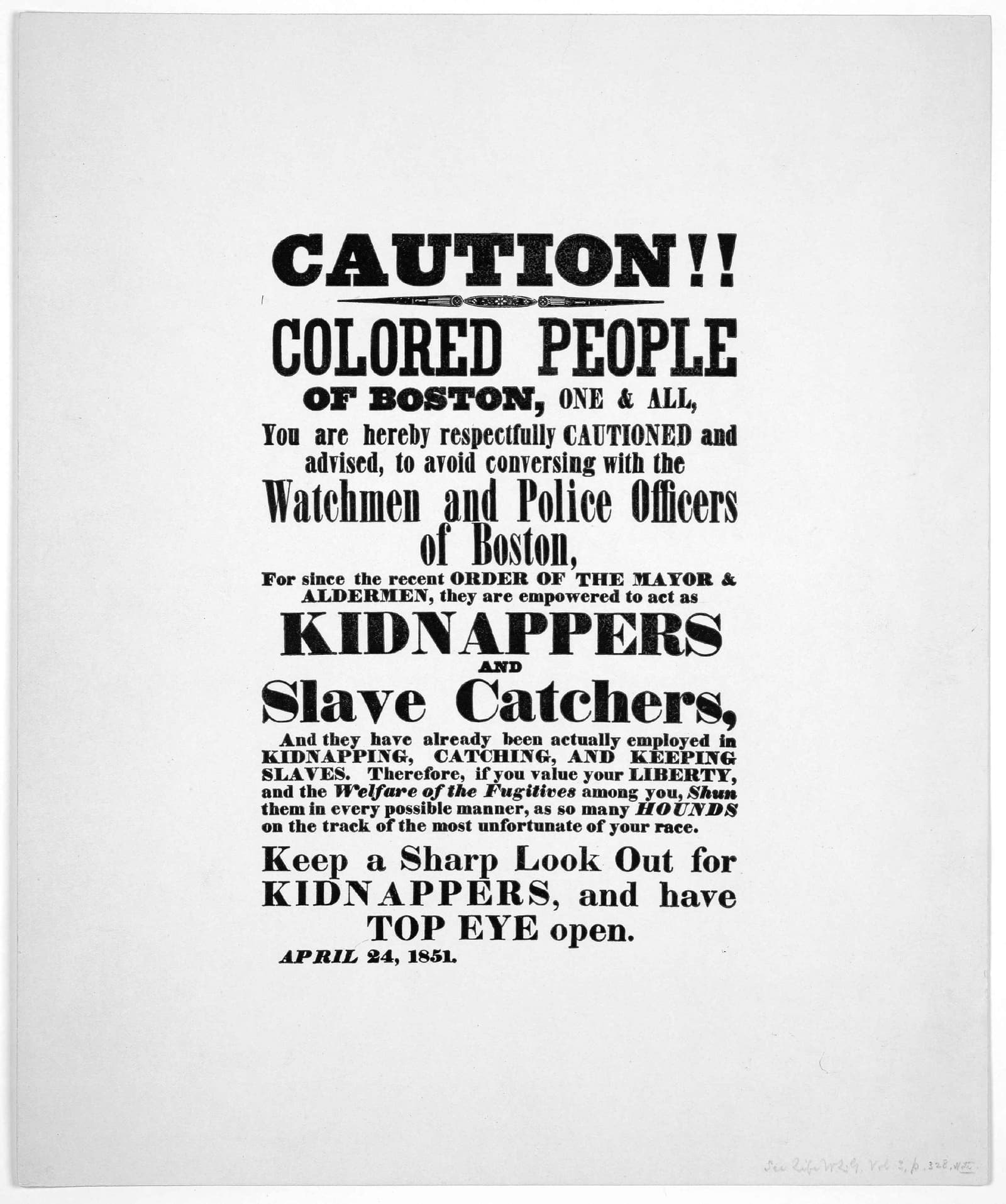
The broadside begins as a public notice, but it behaves like a survival instrument. Caution!! Colored people of Boston, one & all was printed in Boston in 1851, not as a distant antislavery argument but as a street-level warning about whom to speak to, whom to avoid, and how quickly legal categories could turn a sidewalk conversation into a seizure.[1] Its central historical question is narrow: how did one sheet of paper make the danger of the Fugitive Slave Act visible before an arrest happened?
The answer is that the broadside moved the crisis from Washington lawmaking into ordinary urban contact. It did not ask readers to study sectional compromise, constitutional doctrine, or congressional procedure first. It told Black Bostonians that the men they might otherwise encounter as watchmen or police officers had been empowered to act as "Kidnappers and Slave Catchers."[1] The phrase was not legal analysis in neutral dress. It was a deliberate reclassification of local authority.
That is what makes the document worth reading closely. It was not only protesting slavery. It was mapping the practical interface between federal rendition law and municipal policing. The broadside's evidence is the everyday scene it assumes: a Black resident on a Boston street, a uniformed officer asking questions, and a legal regime in which conversation itself could become exposure.
The law turned free-state space into enforcement space
The immediate legal background was the Fugitive Slave Act of 1850, enacted as part of the Compromise of 1850. The National Archives describes the compromise as a set of slavery-related measures, including a stricter fugitive slave act, passed after western territorial disputes strained the balance between free and slave states.[2] The new law required both federal and local law enforcement in free and slave states to assist in arresting suspected fugitives, and it penalized anyone who helped an enslaved person escape.[2]
The National Constitution Center's summary sharpens the machinery. A person could be arrested on a claimant's sworn testimony, commissioners received $10 if they ruled for rendition and $5 if they did not, and people who aided fugitives faced six months in prison and a $1,000 fine.[3] These details matter because the broadside is responding to incentives and procedures, not just attitudes. It appeared in a city where the law had changed the risk attached to recognition, questioning, shelter, and delay.
Boston's self-image made the change especially volatile. The city had antislavery networks, Black mutual aid, abolitionist lawyers, and public meeting spaces that could mobilize quickly. But the Fugitive Slave Act made free-state institutions part of the claimant's path. The broadside reads like a compressed operating manual for that new world: do not treat civic uniforms as protection; do not give casual information; do not assume that Boston's antislavery reputation will interrupt federal power before it reaches the body.
The Sims case gave the warning a recent wound
The broadside's force depended on timing. In February 1851, Thomas Sims escaped slavery in Georgia by boarding the brig M. and J.C. Gilmore; near Boston Light in March 1851, a mate discovered him, and Sims eventually reached the city.[4] Federal and local authorities arrested him in Boston in early April 1851 under the Fugitive Slave Law.[4][6]
The National Park Service reconstruction of the Sims case shows why a street warning made sense. Authorities placed chains around the courthouse, stationed guards, and kept a militia nearby after abolitionists tried to prevent Sims's return to slavery.[4] On April 12, 1851, Sims was marched to Long Wharf inside a formation of armed police, city watch, and other authorities, then sent back to Savannah aboard the brig Acorn.[4] Tufts' exhibit on Sims likewise emphasizes the courthouse confinement, barred windows, chains, dramatic trial, and return to slavery.[6]
This was not an abstract constitutional controversy. It was a recent public spectacle in which local and federal force had worked together. The broadside's warning about police and watchmen therefore had a specific memory behind it: the sight of Boston's own public order infrastructure becoming the route by which a man was carried out of Massachusetts and back into bondage.
The document does not need to name Sims to live in the aftermath of his case. Its phrase "recent Order of the Mayor & Aldermen" points to municipal action; its accusation that officers had already been used in slave-catching turns a legal event into a pattern.[1] The inference is clear but bounded: the broadside is not a full case record. It is a public alarm written by people who believed the Sims rendition had shown how quickly city authority could be enlisted.
The typography makes emergency public
The broadside's design is plain, but the plainness is tactical. The largest word is not "law" or "slavery." It is Caution. That choice makes the document less like a manifesto than a posted hazard sign. It addresses "Colored people of Boston" directly, creating an audience defined by vulnerability under the new enforcement regime.[1] The public is not everyone. The first audience is the group most likely to pay the cost of an officer's question.
Then the sheet narrows the conduct. It warns readers to avoid conversation with watchmen and police officers.[1] This is the document's most practical insight. The danger did not always begin with a warrant visibly produced or a courtroom formally convened. It might begin with talk: a name, an address, an origin story, a hesitation, a clue about someone else. The broadside treats speech as a risk surface.
Its most charged move is renaming. Watchmen and police officers are not described as mistaken, compromised, or politically unfortunate. They are made legible as slave-catching actors.[1] That rhetorical escalation did two things at once. It stripped civic office of automatic trust, and it placed municipal policing inside the long history of kidnapping into slavery. For a reader in Boston, the warning was not merely "be careful of Southerners." It was "be careful of the local men whose office lets them approach you."
The final imperative is visual as well as verbal: keep watch. The sheet's typography uses capitals and emphatic spacing to make attention itself feel like a civic discipline. It imagines Black survival as collective vigilance: one person warning another, one household reading the street, one community refusing to let the categories of law conceal the mechanics of seizure.
Boston resistance had to become logistical
The National Park Service's broader account of the Fugitive Slave Laws in Boston explains the organized setting. In October 1850, Black Bostonians met at the African Meeting House and called white allies to Faneuil Hall; together they formed the third Boston Vigilance Committee to assist freedom seekers.[5] In February 1851, local abolitionists helped rescue Shadrach Minkins. Later that spring, Sims was returned to slavery despite resistance. In 1854, Anthony Burns became Boston's last major Fugitive Slave Law case, and the public reaction helped produce another Massachusetts Personal Liberty Law.[5]
Those episodes show why the broadside is a primary source for operations, not just opinion. Resistance was not only a speech, sermon, or petition. It was also warning networks, legal defense, lookout habits, household decisions, crowd movement, ferrying, concealment, and fast communication. The broadside belongs to that logistical world. It compresses policy into a behavioral instruction because the enforcement system itself operated through behavior: officers asked, witnesses answered, claimants identified, commissioners ruled, marshals moved the captive.
The document also reveals a hard boundary in antislavery Boston. The city could mobilize lawyers and crowds, but it could not assume that local institutions would remain neutral. Once the Fugitive Slave Act made compliance enforceable and noncompliance punishable, the front line shifted toward everyday interactions. To avoid a police conversation was not paranoia. It was a rational adjustment to a regime in which legal capture could start before the community knew whom to defend.
What the sheet lets us see
The broadside's lasting value is that it records the fugitive-slave crisis from below the level of statute and above the level of private fear. It is public, printed, and confrontational, yet it is built around the intimate problem of how to move through a city. That middle scale is easy to miss if the story is told only through Congress, courts, and famous abolitionist speeches.
The document also resists a comforting geography. Boston was not the South. Massachusetts was not Georgia. But after September 18, 1850, the federal law made northern space available for slave-catching, and after the Sims rendition in April 1851, Black Bostonians had fresh proof that local streets, courts, wharves, and officers could participate.[2][4][5] The broadside makes that transformation legible in one sheet.
Its argument is not subtle, and that is part of its historical intelligence. Subtlety would have failed the moment. The broadside had to warn quickly, name the danger plainly, and make official authority suspect when official authority had become an enforcement channel. It turned a national law into a local practice question: when a police officer speaks to you, what kind of state is speaking?
Read this way, Caution!! is not simply an abolitionist poster. It is a map of forced vulnerability in a free city. It shows how law travels through uniforms, streets, conversation, money, fear, and memory. Most of all, it shows that Black Boston's vigilance was not an abstract moral posture. It was a necessary method for staying free.
Sources
- Library of Congress, Caution!! Colored people of Boston, one & all... Boston, 1851 - catalog record and scan for the broadside, Printed Ephemera Collection, Portfolio 60, Folder 22.
- National Archives, "Compromise of 1850 (1850)" - milestone document overview and transcript context for the compromise and the strengthened Fugitive Slave Act.
- National Constitution Center, "The Fugitive Slave Act (1850)" - document summary and excerpt explaining arrest procedure, commissioner incentives, and penalties for aiding fugitives.
- National Park Service, "'The Whole Land is Full of Blood': The Thomas Sims Case" - reconstruction of Sims's escape, arrest, courthouse confinement, rendition procession, and return to Savannah.
- National Park Service, "The Fugitive Slave Laws and Boston" - overview of Boston's Vigilance Committee, Black and white abolitionist response, Shadrach Minkins, Thomas Sims, Anthony Burns, and the law's local impact.
- Tufts University, "Thomas Sims" in The Magnet and the Iron: John Brown and George L. Stearns - exhibit note on Sims's arrest, trial, failed rescue efforts, and return to slavery.