Rosenwald Schools are often introduced through scale: thousands of school buildings, fifteen southern states, hundreds of thousands of Black students. The numbers are necessary, but they can make the story too smooth. The sharper memory problem is smaller and more physical. A one- or two-teacher schoolhouse, with large windows, light-painted walls, a stove to feed, a yard to clean, and no guarantee that public authorities would have built anything comparable without pressure, asks a hard question about commemoration: when a building survives, what exactly is being remembered?[1]
The answer is not only philanthropy. Julius Rosenwald's money mattered, and Booker T. Washington's Tuskegee Institute mattered, but the schoolhouses were not gifts dropped whole into passive communities. They were bargaining devices. The National Park Service teaching history describes the early program after Washington and Rosenwald met in 1912, the first six Alabama schools, and the later spread into a building program that used grants, plans, local donations, labor, and public-school participation to make Black rural education visible in places where children had sometimes learned in churches, fields, front yards, or improvised rooms.[1]
That is why a preserved Rosenwald School carries two memories at once. It remembers educational deprivation under Jim Crow. It also remembers organized local agency inside that deprivation. The building says: this was what segregation withheld, and this was what a community helped force into being.
The schoolhouse as a public bargain
The Rosenwald model worked because it made an unequal public system reveal itself. A private grant alone could not build a durable school network. Local Black communities had to raise money, contribute materials or labor, and press white-controlled school districts to participate. That matching structure was morally complicated. It asked communities already taxed and underfunded to pay again for basic education. Yet it also created paper trails, buildings, and expectations that public officials could no longer pretend did not exist.[1][4]
The physical plans were part of the argument. NPS notes that Rosenwald designs used large windows, orientation, and light interior paint because most rural schools lacked electricity and needed daylight to work.[1] The architecture was plain, but not careless. It treated a classroom as a tool: sunlight, ventilation, movable partitions in some larger schools, a teacherage where needed, shop buildings where industrial training was part of the curriculum.[1] Memory here is not sentimental. It is operational. The building remembers the daily mechanics of making school possible.
The annual "Rosenwald School Day" in 1927 makes that point especially clear. NPS describes it as a moment when students, teachers, and community members cleaned yards, painted buildings, heard student programs, and reported progress to state agents.[1] That ritual turned maintenance into public performance. A school did not remain a school simply because it had been built. It remained one because a community kept appearing for it.
Why survival became the next argument
The original building program ended in 1932, the year Rosenwald died, and many schools continued operating into the desegregation era of the 1950s and 1960s.[1] Then the commemorative problem changed. Some buildings were abandoned, sold, adapted, or forgotten. Others became churches, community centers, museums, senior centers, or local-history sites. Preservation did not mean freezing one classroom day from the 1920s. It meant deciding whether the building could keep serving a public memory after its original school function had passed.[1][4]
The National Trust's preservation account gives the stakes in modern terms: between 1917 and 1932, nearly 5,000 Rosenwald schoolhouses were built, while research estimates that fewer than 500 structures survive.[4] That survival ratio matters because the remaining buildings now have to stand for both a vast network and thousands of losses. One schoolhouse cannot carry the whole story, but it can keep the story from floating away into abstraction.
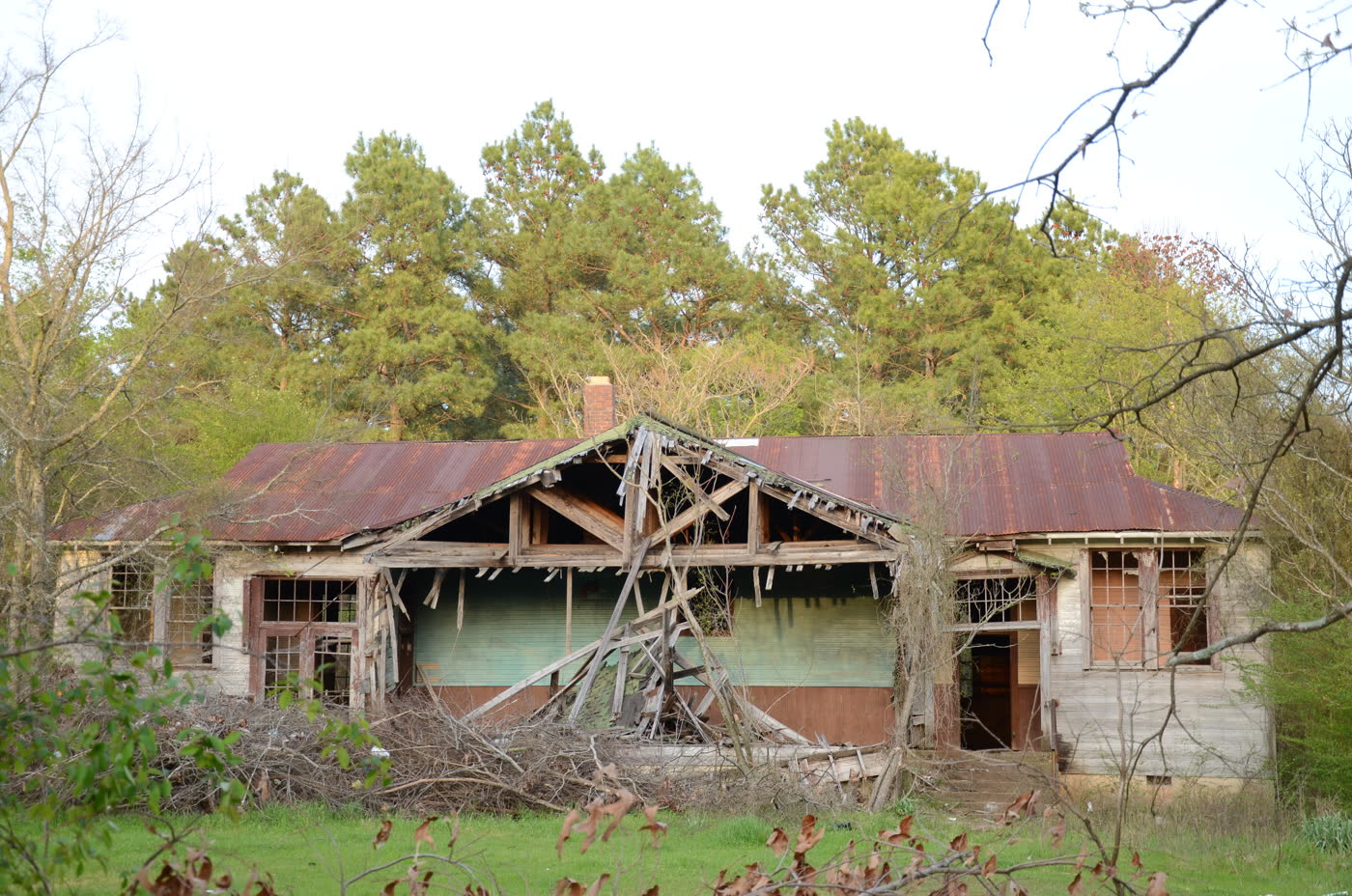
This is where the image of the Oak Grove Rosenwald School earns its place. It is not an archival classroom scene full of children. It is a later photograph of a surviving building, listed on the National Register of Historic Places, with the plain front elevation still legible.[6] The absence is part of the force. A viewer is asked to imagine not only who sat there, but who raised money, who cut wood, who argued with school boards, who cleaned the room, and who later decided the building was worth saving.
The proposed national network changes the scale again
In 2020, Congress directed the Secretary of the Interior to study sites associated with Julius Rosenwald and the Rosenwald Schools.[2][3] The National Park Service completed and transmitted that special resource study on June 13, 2024.[2][3] Its conclusion is revealing: NPS identified the San Domingo School in Wicomico County, Maryland, as the analyzed site that met the criteria for a possible new national historic site, and it also recommended a Rosenwald School Network Program with grant-making authority to support groups already preserving and interpreting schools across the country.[3]
That two-part recommendation matters because Rosenwald memory does not fit neatly into one monument. A single national site can give the story visibility, staff, interpretation, and permanence. But the history itself was distributed. It happened through thousands of local bargains, each with a different county, church, parent group, teacher, carpenter, and student body. A network program acknowledges that structure. It says the national story is real precisely because local sites remain specific.[2][3]
The NPS news release makes the same point in public language, describing a proposed site and network as a way to preserve the legacies of Rosenwald and the schools, while also interpreting Booker T. Washington, Tuskegee, and the role of more than 5,000 Black communities in creating them.[2] That last phrase is essential. Without it, commemoration risks repeating the old imbalance by making the philanthropist easy to see and the communities harder to name.
What a restored school should remember
The best Rosenwald commemoration keeps all the tensions visible. It should remember Rosenwald's philanthropy without turning him into the whole cause. It should remember Tuskegee's design and administrative role without losing the students and teachers who made the buildings live. It should remember the pride of new classrooms without romanticizing the segregated system that made Black families pay extra for ordinary public goods. It should celebrate preservation without pretending that reuse is simple when roofs leak, records are scattered, and alumni memories are aging.[1][4][5]
That is why the surviving schoolhouses are strongest when they become local civic rooms again: museums, meeting places, history classrooms, archives, and reunion sites. They do not need to imitate the old school day perfectly. They need to keep the original bargain intelligible. A Rosenwald School was never just lumber and windows. It was a public claim in building form: Black children deserved permanent classrooms, and Black communities were willing to organize, pay, build, clean, and remember until that claim became too visible to ignore.[1][2][4]
In that sense, preservation is not an afterword to the Rosenwald story. It is the story's latest chapter. The first generation built schools against educational exclusion. The current generation saves the buildings against historical erasure. Both acts answer the same problem in different materials: how to make a public system see children and communities it had been trained to overlook.
Sources
- National Park Service, "The Rosenwald Schools: Progressive Era Philanthropy in the Segregated South" - Teaching with Historic Places lesson on the 1912 origins, school plans, community matching model, teacherages, Rosenwald School Day, program end, and preservation afterlife.
- National Park Service Office of Communications, "National Park Service Recommends Historic Designation for Rosenwald Schools," June 13, 2024 - news release on the transmitted study, San Domingo School, and proposed national site plus network.
- National Park Service ParkPlanning, "Julius Rosenwald and Rosenwald Schools Special Resource Study" - project page summarizing the 2020 congressional direction, evaluated sites, June 13, 2024 completion, San Domingo recommendation, and network-program recommendation.
- National Trust for Historic Preservation, "Rosenwald Schools Updates" - preservation overview including the 1917-1932 building period, fewer-than-500 survival estimate, 2002 endangered listing, and modern grassroots reuse.
- Library of Congress, "Rosenwald Schools: Guide to Library of Congress Resources" - research guide to manuscript, print, and pictorial resources for Rosenwald School history.
- Wikimedia Commons, "File:Oak Grove Rosenwald School.JPG" - source page for the Oak Grove Rosenwald School photograph used as this article's image.