The Washington Naval Conference is often remembered as an unusually civilized interwar scene: statesmen in Washington, lofty speeches about peace, and a treaty that supposedly slowed the naval race until the 1930s. That memory catches the atmosphere but misses the mechanism. The conference worked, for a time, because it did not ask the major powers to trust one another in any deep sense. It asked them to accept a system that made rivalry easier to calculate.[1][3][4]
That distinction matters. By November 12, 1921, the United States, Britain, and Japan were already measuring each other through expensive building programs, Pacific possessions, and worst-case planning. A generic appeal to disarmament would have collapsed under that weight. Charles Evans Hughes therefore opened with something harder than moral exhortation. He proposed that capital-ship construction be stopped, older battleships be scrapped, and existing strength be translated into a concrete tonnage order.[1] The proposal had force because it named hulls, money, and losses already incurred. Negotiation began from visible sacrifice.
The conference's durable contribution lies there. It turned a spiraling competition over future possibilities into a narrower bargain over present inventory and geography. The 5:5:3 ratio did not settle every dispute, and Article XIX did not remove Pacific insecurity.[3][4][5] What they did do was bind prestige, budgets, and strategic fear into one legible package. The naval race became governable precisely because the treaty stopped trying to solve everything at once.
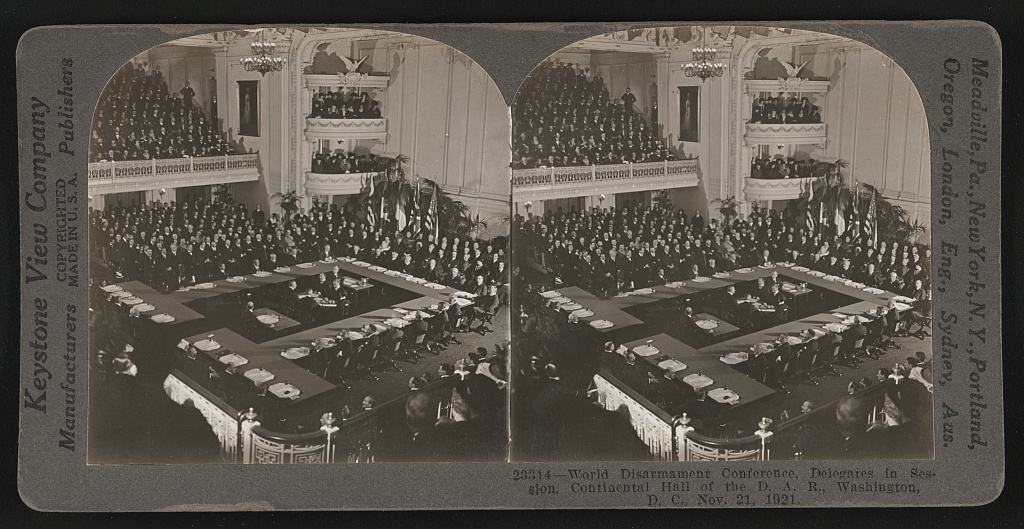
Image context: the cover image uses the Library of Congress photograph of delegates in session at Continental Hall on November 21, 1921. It suits this article because the argument is about conference politics as staged visibility. The mechanism worked only once ship counts, rank order, and Pacific restraint were made public enough to be bargained over together.[6]
1) Hughes made disarmament credible by putting sunk costs on the table
The opening move of the conference was theatrical in the best strategic sense. In the proposal Hughes presented at the first plenary session on November 12, 1921, the United States did not merely endorse naval limitation as a principle. It offered a detailed plan built around four ideas: eliminate current and projected capital-ship building programs, scrap older ships, measure strength through capital-ship tonnage, and preserve the interests of the powers involved.[1]
The practical detail is what changed the room. Hughes's text specified that the United States would scrap 15 new capital ships under construction, representing 618,000 tons and $332 million already spent, while also disposing of 15 older battleships.[1] This was not soft language about future restraint. It was a public willingness to burn political and fiscal capital in front of the other delegations. Once that happened, bargaining could no longer hide inside vague promises. Every side had to answer a list.
That is why the conference did not begin as a conventional moral summit. It began as an accounting exercise with geopolitical implications. The more precisely Hughes named the ships, the harder it became for other governments to defend purely aspirational positions. Negotiation narrowed from "what kind of navy should a great power want?" to "what can each power keep, what must it scrap, and what order will everyone recognize as tolerable?"[1]
In mechanism terms, Hughes changed the unit of argument. Instead of debating intentions, the conference debated inventories. That shift favored agreement because inventories can be compared and intentions cannot. States still distrusted one another, but distrust became bounded by lists, tonnage, and replacement rules.[1][4]
2) The 5:5:3 ratio worked because it made hierarchy explicit rather than pretending hierarchy away
The central political difficulty was Japan. In the Japanese naval experts' memorandum of November 30, 1921, they stated that a 70 percent ratio was "absolutely necessary" for national security and rejected the American way of counting "existing strength," especially when uncompleted ships were included in the calculation.[2] That memo is valuable because it shows the real disagreement clearly. The argument was not over whether hierarchy existed. The argument was over what degree of inferiority Japan could accept without feeling strategically trapped.
This is where many retrospective accounts become too sentimental. The conference did not succeed by discovering equality. It succeeded by fixing inequality in a form that all sides could price. The United States and Britain wanted the 5:5:3 structure because it preserved their larger global naval position.[3][4][5] Japan pushed for more because its leaders read security in regional rather than worldwide terms.[2][5] The eventual deal did not erase that conflict. It froze it at a level the conference could administer.
The December 15, 1921 press statement shows the point. It announced that the American proposal on naval ratio had been accepted, that the ratio would stand at 5:5:3, and that related adjustments would be made to preserve that relative balance while handling specific prestige problems such as Japan's desire to retain the Mutsu.[3] The statement allowed Japan to keep Mutsu, let the United States complete Colorado and Washington, and let Britain build two new ships, all in the name of maintaining the agreed relationship.[3] This was not elegant equality. It was managed rank.
That explicitness was the source of temporary stability. A hidden hierarchy invites constant revisionist probing because no one is sure where the line truly sits. A declared hierarchy can be politically painful, but it also creates a visible threshold. The conference drew one. Japan did not get the 10:10:7 outcome its experts had demanded.[2][5] Yet it received a settlement in which relative place, replacement rules, and Pacific geography were all negotiated in one package.[3][4]
3) Article XIX mattered because tonnage alone would not have been enough
Ship ratios by themselves would not have closed the deal. Naval power is never only a matter of total tonnage. It is also a matter of where fleets can be repaired, supplied, and reinforced. That is why the conference's second mechanism sat in the Pacific.
The same December 15, 1921 statement that confirmed 5:5:3 also said that, in the Pacific region, the "status quo" on fortifications and naval bases would be maintained.[3] The final treaty, signed on February 6, 1922, codified that principle in Article XIX. The United States, the British Empire, and Japan agreed not to establish new fortifications or naval bases in a defined set of Pacific possessions, with specific exceptions for places such as Hawaii, Australia, New Zealand, and the Japanese home islands.[4] In practice, that meant no free hand to harden every forward island outpost.
This is the part of the bargain that made lower Japanese tonnage more bearable. If Washington and London had kept the right to expand every exposed Pacific base indefinitely, then a 5:5:3 ratio would have looked from Tokyo like inferiority plus encirclement. Article XIX changed that calculation. It did not give Japan parity, and it did not eliminate U.S. or British advantages.[4][5] It did something more precise: it limited how fully those advantages could be projected from the western Pacific perimeter.
The Office of the Historian summary captures the tradeoff well. Article XIX became controversial in the United States because naval officers worried that restricting base expansion in the Pacific could endanger American holdings, especially Guam and the Philippines.[5] That criticism reveals why the clause mattered. A clause is strategically meaningful only when someone important hates the constraint it creates. Article XIX constrained all three Pacific powers by tying naval ceilings to geography rather than leaving geography open-ended.
The conference therefore worked as a linked bargain. Tonnage established rank; base restraint softened the strategic implications of rank; each term made the other more tolerable. Without ratios, Article XIX would have looked like an arbitrary freeze. Without Article XIX, the ratios would have looked like a simple verdict on relative worth. Together they formed a package.
4) Why the system held for a while and then frayed
The treaty's formal language shows both its strength and its boundary. Article III required the contracting powers to abandon capital-ship building programs except within tightly prescribed replacement rules, while Article IV fixed capital-ship ceilings at 525,000 tons each for the United States and the British Empire, 315,000 for Japan, and 175,000 each for France and Italy.[4] That was a real achievement. It transformed the most expensive prestige category in naval rivalry into a monitored ceiling.
But the mechanism had edges. As the State Department milestone notes, some classes of ships remained unrestricted, and a new competition in cruisers followed after 1922, pushing the powers back to negotiation in 1927 and 1930 to close loopholes.[5] The conference had solved one problem well: runaway competition in capital ships. It had not solved rivalry as such, and it had not changed the political conflicts in East Asia that gave naval planning its urgency.
That is the right scale on which to judge the conference. It was not a moral conversion experience and not a permanent peace architecture. It was a workable interwar control system built around a specific causal insight: arms races can sometimes be slowed when the category that matters most is made countable, when the ranking is admitted rather than denied, and when geography is folded into the settlement instead of left outside it.[1][2][3][4][5]
In that sense the Washington Naval Conference succeeded by being narrower than its legend. It did not abolish great-power suspicion. It made suspicion easier to budget, easier to compare, and harder to escalate immediately. For a decade, that was enough.
Sources
- U.S. Department of State, Office of the Historian, "Proposal for a Limitation of Naval Armament, Presented by the Secretary of State at the First Plenary Session of the Conference, November 12, 1921" (Foreign Relations of the United States, 1922, vol. I, doc. 34).
- U.S. Department of State, Office of the Historian, "Memorandum by the Japanese Naval Experts" (November 30, 1921, Foreign Relations of the United States, 1922, vol. I, doc. 43).
- U.S. Department of State, Office of the Historian, "Statement Issued to the Press by the Conference on the Limitation of Armament, December 15, 1921" (Foreign Relations of the United States, 1922, vol. I, doc. 57).
- U.S. Department of State, Office of the Historian, "Treaty between the United States of America, the British Empire, France, Italy, and Japan, Signed at Washington February 6, 1922" (Foreign Relations of the United States, 1922, vol. I, doc. 77).
- U.S. Department of State, Office of the Historian, "The Washington Naval Conference, 1921-1922" - milestone overview of the conference, the Five-Power Treaty, Article XIX controversy, and later loopholes.
- Library of Congress Prints and Photographs Division, "World Disarmament Conference, delegates in session, Continental Hall of the D.A.R., Washington, D.C., Nov. 21, 1921" - item page for the archival lead image used in this article.