The Japanese American "loyalty questionnaire" is often remembered through its most famous afterlife category: the "no-no boy."[1][2] That memory captures one consequence, but it can blur the document itself. A primary-source close reading starts with a simpler question: what did the state actually ask, and under what conditions did it ask it? Once that question is put back into sequence, the form looks less like a neutral measurement of patriotism and more like a compressed administrative demand about military service, leave clearance, family unity, and legal belonging.[1][2][3][4]
The timeline matters. By the time the questionnaire arrived in 1943, the federal government had already expelled Japanese Americans from the West Coast under Executive Order 9066, pushed them through assembly centers, and placed about 112,000 people into War Relocation Authority camps, nearly 70,000 of them American citizens.[1] The Smithsonian's summary is blunt: ordinary civilians had already been treated as security threats before they were asked to prove loyalty.[4] That sequence is the document's hidden core. The form did not begin a relationship of trust with the government. It arrived after dispossession, confinement, and months of administrative coercion.[1][3][4]
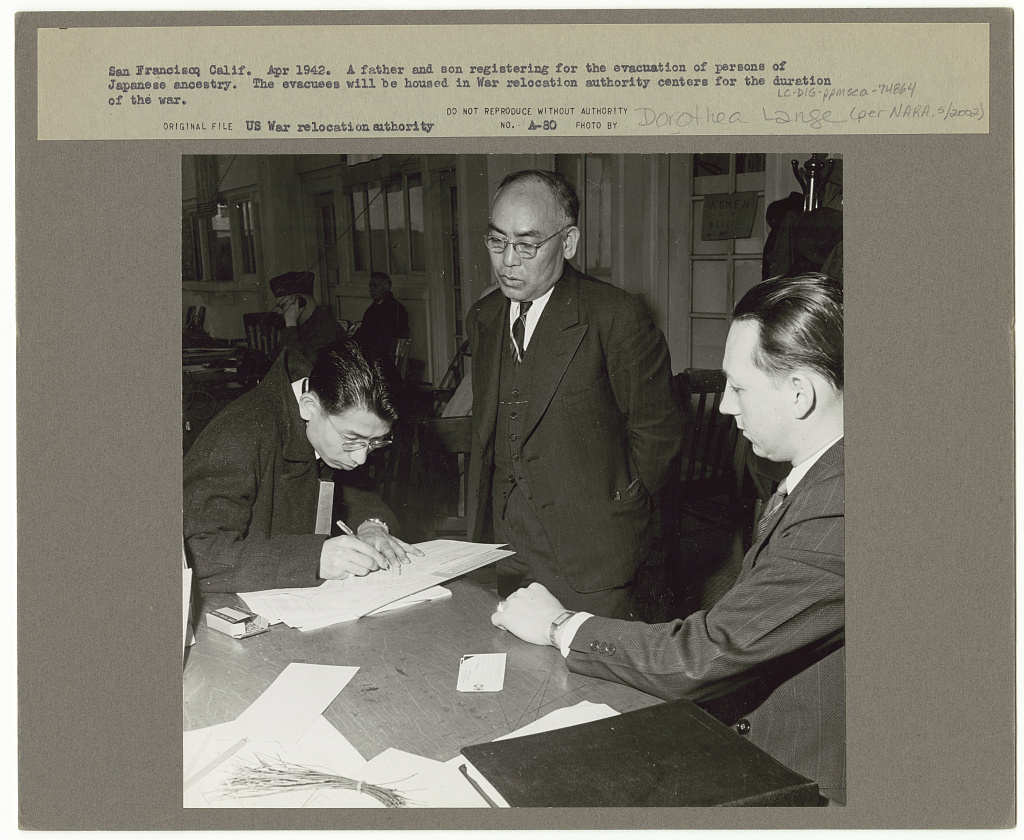
Image context: the cover photograph shows a father and son registering at a San Francisco control station in April 1942, before confinement in War Relocation Authority camps. It belongs here because the later questionnaire grew out of exactly this bureaucratic scene: ordinary family life narrowed into lines, desks, forms, and official classification.[5]
Timeline anchors
- February 19, 1942: Executive Order 9066 authorizes military exclusion from designated areas, creating the legal frame for mass removal.[1]
- March 29, 1942: forced evacuation from the West Coast begins in earnest under military proclamations and supporting legislation.[1]
- January 29, 1943: the War Department announces a new registration program tied to military service and leave clearance.[3]
- February 3, 1943: the War Relocation Authority begins administering the questionnaire to incarcerated Japanese Americans aged seventeen and older.[3]
- 1943-1944: controversy over answers, revisions, segregation, and the category later called "no-no" hardens into a long political and family wound.[2][3][4]
Those dates already show why the phrase "loyalty questionnaire" is too clean. The document was not handed to free citizens in an ordinary civic setting. It was administered inside camps to people whose homes, jobs, and movement had already been taken.[1][3]
The form was an instrument of classification, not a detached opinion poll
The Smithsonian page is useful here because it names the two bureaucratic forms and their audiences. The government used the "Application for Leave Clearance" and the "Statement of United States Citizenship of Japanese Ancestry," created jointly by the War Relocation Authority and the Army, and circulated them while the military also began recruiting from the camps.[4] That bureaucratic pairing matters. The form was doing more than one job at once. It was screening for military service, identifying who could leave camp, and sorting households into new suspicion categories.[3][4]
That is why the article's core claim is narrow but important: the questionnaire measured compliance under unequal conditions more than it measured inner belief. When one document decides whether a person may leave confinement, whether a family will stay together, and whether the government will view dissent as disloyalty, the answers cannot be read as simple opinion data.[2][3][4]
Question 27 asked for service after rights had already been suspended
The federal retrospective Personal Justice Denied explains the first half of the trap clearly. Question 27 asked draft-age males whether they were willing to serve in the armed forces on combat duty wherever ordered; parallel versions for women and Issei asked about service in the WACs or Army Nurse Corps.[2] In abstract form, that might sound like an ordinary wartime obligation. Inside camp, it read differently. The people being asked had already been deprived of ordinary constitutional protection, ordinary freedom of movement, and the practical ability to defend their property or community standing.[1][2][3]
The NPS Tule Lake material shows how quickly rumor, fear, and administrative opacity filled that gap. Residents did not know how answers would be used. They heard conflicting stories about conscription, forced labor, relocation to unfamiliar places, and penalties for interfering with registration.[3] In that setting, a yes answer could look like cooperation with a government that had already confined you; a no answer could mark you for lasting suspicion. The question therefore acted less as a pure call to service than as a demand to re-enter the state on the state's own terms.
Question 28 trapped Issei in a legal contradiction
Question 28 is where the document's logic becomes impossible to miss. Personal Justice Denied quotes it as a request for "unqualified allegiance" to the United States and forswearing allegiance to the Japanese emperor or any other foreign power.[2] The Commission's summary then makes the problem explicit: for the Issei, the question was "unfair and unanswerable" because U.S. law had barred them from naturalized citizenship, so an affirmative answer could render them, in their own argument, "men without a country."[2]
This is the point where a close reading becomes more useful than moral shorthand. The issue was not simply whether a person "liked America." The issue was that the state had written a question whose legal meaning differed radically by citizenship status. For Nisei citizens, answering no could invite charges of disloyalty. For Issei immigrants, answering yes could feel like a coerced renunciation into statelessness, while answering no could still trigger suspicion, family fracture, or transfer into harsher administrative categories.[2][3]
The government recognized part of this contradiction quickly enough to revise question 28, and the Smithsonian page even preserves an announcement of that revision.[4] But the revision did not erase the underlying fact that the first version had already shown how carelessly the state understood the people it was governing. Once that distrust existed, a technical wording change could not restore confidence.
"No-no" was an administrative outcome, not one single ideology
This is where public memory often goes flat. The later phrase "no-no boy" can imply a single coherent political camp. The sources show something messier. Some people answered negatively out of anger at confinement. Some refused because they would not bear arms while parents remained behind barbed wire. Some feared statelessness. Some distrusted the Army and WRA because the government had already lied or withheld basic information. Some answered differently inside the same household because each person faced different legal risks.[2][3][4]
The NPS testimony from Tule Lake is especially clarifying because it restores atmosphere. The anonymous writer describes fear, rumor, military intimidation, and the bitterness produced when registration was introduced under conditions already saturated with coercion.[3] Whether one agrees with every claim in that testimony is not the point. The point is evidentiary: the questionnaire circulated inside a dense field of distrust that shaped what any answer could mean.
Why the document still matters
The questionnaire remains historically important because it shows how states can mistake forced declaration for proof. A government that has already removed people from their homes, confined them, and blurred the boundary between military necessity and racial administration should not expect a clean readout from a form. The document did not simply discover loyalty. It helped produce new categories of loyalty and disloyalty through its own wording, timing, and coercive setting.[1][2][3][4]
That is the sharper lesson to carry forward. Questions 27 and 28 were not trivial because they asked too much of language under conditions where language had lost ordinary freedom. One question asked for service from people already denied equal treatment; the other asked some families to translate belonging into a legal renunciation that the government itself had made structurally impossible. Read that way, the questionnaire measured the strain between state power and civic membership more than it measured private patriotism.
Sources
- U.S. National Archives, "Japanese-American Incarceration During World War II" - Executive Order 9066, March 1942 removal timeline, camp population totals, and the legal setting of incarceration.
- Commission on Wartime Relocation and Internment of Civilians, Personal Justice Denied, Chapter 7 - question 27 and question 28 wording, the Issei citizenship contradiction, and the government's own retrospective analysis of the questionnaire's flaws.
- National Park Service, "Why I Refused to Register" - January 29, 1943 announcement, February 3 rollout, Tule Lake registration conditions, and the atmosphere of rumor, coercion, and refusal around the questionnaire.
- Smithsonian National Museum of American History, "Challenging Patriotism" - 120,000 removed, about 70,000 citizens, the WRA and Army forms, the poorly worded questions, and the later revision notice for question 28.
- Library of Congress, "San Francisco, Calif. Apr. 1942. A father and son registering for the evacuation of persons of Japanese ancestry" - photographic source and catalog record for the cover image by Dorothea Lange.