The Voting Rights Act of 1965 is often remembered through one just summary: after Selma, Congress finally outlawed literacy tests and protected Black voting rights.[1][2] That memory points in the right direction, yet the document itself is sharper and more suspicious than the summary suggests. Read closely, the Act does not simply announce a national principle and hope local officials will comply. It assumes that delay, paperwork, and last-minute rule changes have already become instruments of exclusion, and it builds federal machinery to interrupt them.[1][3][4]
That is the historical question worth following in the text. Why did this statute matter so much more than another general promise of equality? The answer sits in its structure. Section 2 states a nationwide rule against racial denial or abridgment of voting rights.[1][4] Section 4 identifies the places Congress believed had turned discriminatory procedure into a system.[3][4] Section 5 freezes new voting changes in those covered jurisdictions until federal review says they can go forward.[1][3][4] And the Act also authorizes federal examiners who can register qualified voters where local registrars had treated obstruction itself as administration.[1][4] Put together, these provisions show a law that did not trust local discretion to cure local abuse.
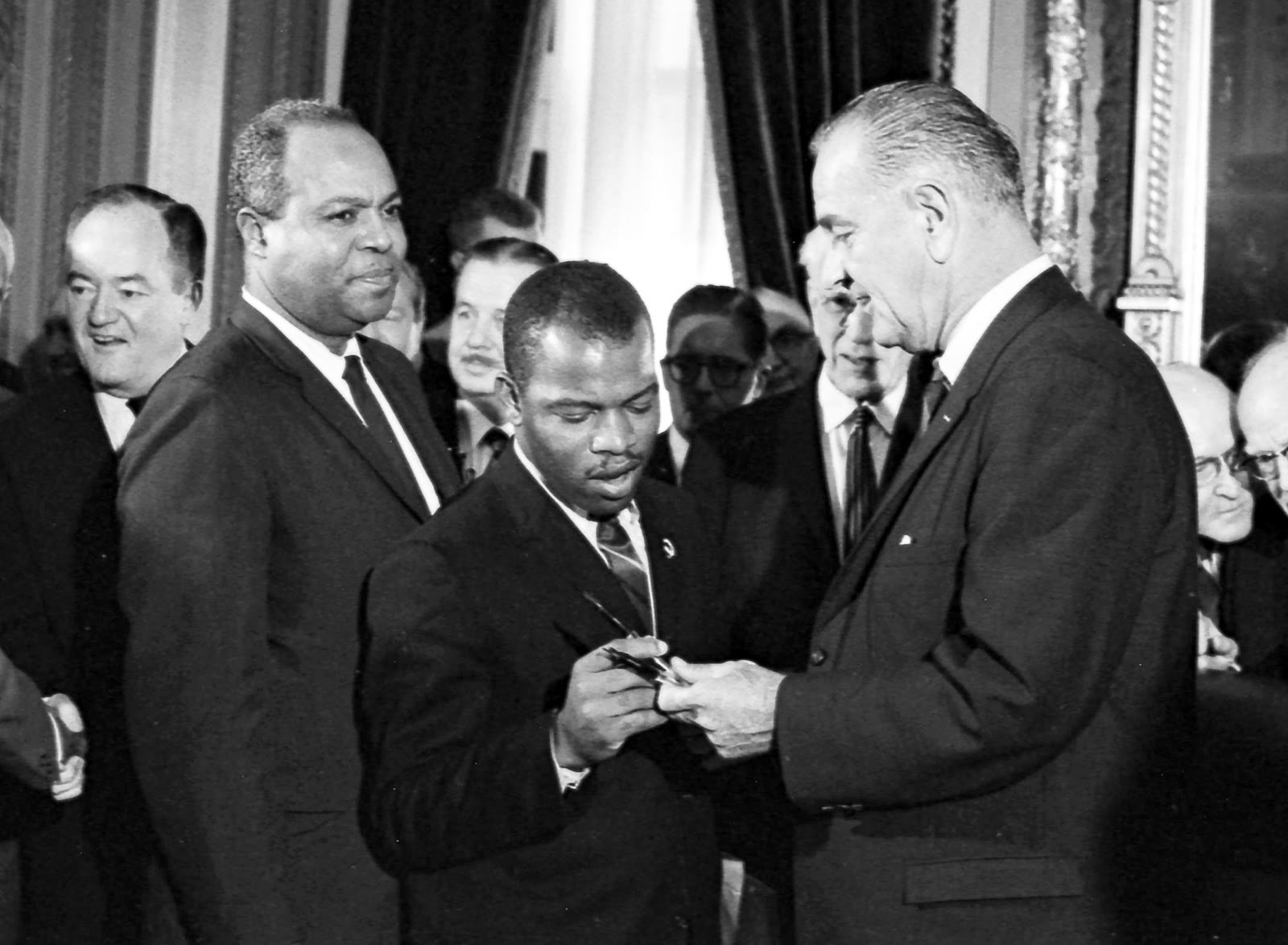
The cover image fits that reading exactly. The photograph from the LBJ Library shows Lyndon B. Johnson handing a signing pen to John Lewis on August 6, 1965.[6] It is easy to read such a scene as the end of a story. In fact it marks the beginning of a harder one. The Act's power lived in what followed the ceremony: who counted as covered, what had to be submitted for review, who could register voters, and how quickly local officials could no longer move the goalposts.
Timeline anchors
- March 15, 1965: Johnson's speech to Congress, "The American Promise," urges immediate voting-rights legislation and frames the issue as a national democratic duty rather than a sectional complaint.[2][5]
- August 6, 1965: Johnson signs the Voting Rights Act into law, ninety-five years after ratification of the Fifteenth Amendment.[1][6]
- End of 1965: the Act has already registered a quarter of a million new Black voters, about one-third of them through federal examiners.[1]
- End of 1966: only four of the thirteen southern states have fewer than 50 percent of African Americans registered to vote, showing that the law's administrative design had immediate effect.[1]
These dates matter because they keep the statute connected to tempo. The Voting Rights Act was not only a moral declaration after March 1965. It was a fast federal intervention whose early effects were visible before a full year had passed.[1][2]
Section 2 named the rule, but Congress did not stop at naming
The Act opens with a broad national command. In the National Archives transcript, Section 2 bars any voting qualification, prerequisite, standard, practice, or procedure imposed to deny or abridge the right to vote on account of race or color.[1] The current GovInfo compilation preserves the same basic architecture in federal law.[4] This matters because Congress wanted a rule that reached beyond one county, one registrar, or one state's preferred trick. The prohibition is national.
Yet Johnson's March 15 speech helps explain why Congress did not treat a national rule as sufficient by itself.[2][5] In that address he told Congress the country could not keep waiting and called for clear federal legislation because the ordinary promises of citizenship had remained unkept for more than a century.[2] The National Archives teaching page makes the same constitutional point from another angle: the bill authorized the federal government to set eligibility rules in an area long dominated by the states.[5] The law therefore starts from a principle, but it is written by people who have already concluded that principle alone has been too easy to evade.
That is the first reason this statute reads differently from a mere restatement of the Fifteenth Amendment. It does not assume that local officials need only a better reminder. It assumes they need to be overruled.[1][2][5]
Sections 4 and 5 turned suspicion into a map and a brake
The Act's deeper invention appears once the text stops speaking in nationwide abstractions and starts identifying where ordinary state discretion could no longer be trusted. The Justice Department's explanation of Section 5 says the provision was enacted to freeze changes in voting practices or procedures in covered jurisdictions until federal review determined that the new rule had neither discriminatory purpose nor discriminatory effect.[3] That one sentence is the law's operating logic in miniature. Congress was not waiting to punish exclusion after the fact. It was trying to stop a new obstacle before it could go live.
The coverage formula mattered because it told the federal government where to look first. The Justice Department page explains that the original 1965 formula asked two questions keyed to November 1, 1964 and the 1964 presidential election: did the state or political subdivision maintain a "test or device" restricting registration or voting, and did fewer than 50 percent of voting-age persons register or vote?[3] Where both conditions were met, the jurisdiction became covered. Entire states including Alabama, Georgia, Louisiana, Mississippi, South Carolina, and Virginia, among others, fell under that regime, along with certain political subdivisions in additional states.[3]
This is what makes the Act a historical break in federal-state relations. Congress did not say only that discrimination was wrong. It wrote a formula that translated a history of obstruction into a jurisdictional map.[1][3][5] In those places, any new voting rule had to survive preclearance before it could be enforced.[1][3] That meant covered officials could no longer react to one successful registration drive by inventing a fresh paperwork hurdle, a new polling-place arrangement, or a revised election procedure and then forcing disenfranchised voters to start a new lawsuit from scratch. The brake came first.
The text's structure shows how deliberate that move was. Section 5 did not abolish local election law. It placed certain jurisdictions under advance review because Congress believed the normal sequence of abuse followed by delayed litigation had already failed.[1][3][4] Preclearance was therefore a timing device as much as a constitutional device. It shifted initiative away from the discriminator and toward the federal reviewer.
Federal examiners mattered because local delay had become policy
The Act's second practical weapon was less famous than preclearance and just as revealing. The National Archives summary notes that the law provided for appointment of federal examiners with the power to register qualified citizens in covered jurisdictions.[1] The original text, preserved in the Act transcript and the federal compilation, ties that authority to enforcement of the Fifteenth Amendment and to places where tests or devices had been used to deny or abridge voting rights.[1][4]
This matters because one of the South's most durable techniques had been administrative slowness. Exclusion did not always require a spectacular legal barrier. It could live in office hours, hostile questioning, arbitrary rejections, missing forms, or endless deferral. A statute that only banned bad rules would still leave those local choke points intact. Federal examiners changed the situation by creating a way around them.[1][4] Qualified citizens no longer had to rely exclusively on the local registrar whose office had become the obstacle.
The early numbers show why Congress paired the brake with this bypass. By the end of 1965, a quarter of a million new Black voters had been registered, and about one-third of them were registered by federal examiners.[1] That is not an ornamental statistic. It shows that the law did more than declare a right. It supplied personnel who could operationalize the right where local administration had become a barrier to it.
In this sense, the Act worked through two different federal postures at once. Preclearance restrained hostile local innovation before implementation. Federal examiners supplied direct capacity where the existing local gatekeepers could not be trusted.[1][3][4] The law's force came from the pairing.
The bounded conclusion
The Voting Rights Act mattered because it refused to let local procedure hide behind the language of ordinary administration.[1][3][5] Section 2 announced a national rule. Sections 4 and 5 took the stronger step of identifying covered jurisdictions and freezing new voting changes until they had been reviewed. The examiner provisions then supplied a direct federal route into registration where local offices had converted discretion into exclusion.[1][3][4]
That is why the law's strongest historical claim is narrower and more durable than the usual summary. The Act did outlaw literacy tests and other discriminatory devices.[1] It also did something harder. It treated time, paperwork, and local improvisation as part of the problem and rewired the sequence by which voting rules could take effect. The statute worked because it did not trust a hostile system to reform itself first. It imposed review, supplied federal capacity, and made delay answer to national power.[1][2][3]
Sources
- National Archives, "Voting Rights Act (1965)" - milestone document page with the original act transcript, summary of literacy-test abolition, federal examiners, preclearance, and early registration impact.
- LBJ Library, "Special Message to the Congress: The American Promise," March 15, 1965 - Johnson's voting-rights speech calling for immediate federal legislation.
- U.S. Department of Justice, Civil Rights Division, "About Section 5 Of The Voting Rights Act" - official explanation of the original coverage formula, covered jurisdictions, preclearance, and administrative review.
- GovInfo, Voting Rights Act of 1965 - federal text compilation preserving the statute's section structure and operative language.
- National Archives, "Congress Protects the Right to Vote: The Voting Rights Act of 1965" - legislative-education overview on the federalism shift and congressional debate around federal voting enforcement.
- LBJ Library, "Signing of the Voting Rights Act" - public-domain photograph source page for the article image showing Johnson handing a pen to John Lewis on August 6, 1965.