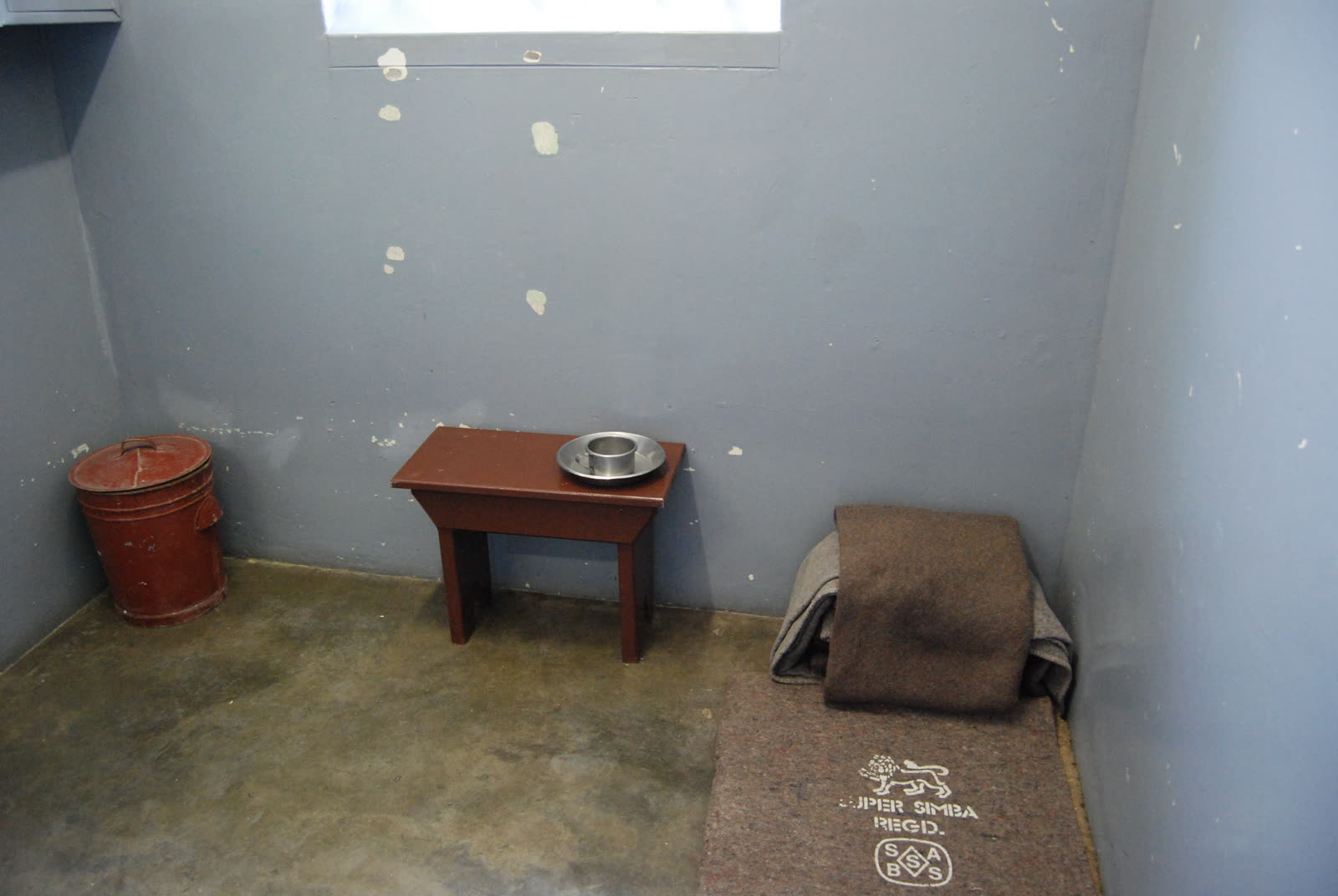
Robben Island is often compressed into one room. The global image is Nelson Mandela's cell: a narrow interior, a mat on the floor, a bucket, a small table, a barred window.[7] That room deserves its place, but by itself it can make the island easier to sentimentalize than to understand. Robben Island's historical force does not come from one preserved object alone. It comes from a preserved route of coercion that still holds together: the ferry threshold, the intake point, the labor landscape, the prison yard, and the cell block.[1][2][3][4][5]
That is the practical historical question worth asking. How did a site built to isolate, classify, and punish become a museum without losing the logic of the punishment? The answer sits in the curatorial choice to preserve sequence rather than monument alone. UNESCO's World Heritage description already hints at the larger frame by treating Robben Island not as a single prison chamber but as a layered landscape whose buildings and institutional traces testify to a long history of banishment, segregation, and political imprisonment from the seventeenth to the twentieth century.[1] The island matters because memory there still moves through space the way power once did.
The image of Mandela's cell belongs in that argument for a reason.[7] A preserved cell can easily become devotional. On Robben Island, it does not stand alone. The museum route keeps forcing the visitor back into logistics: where prisoners landed, where they were processed, where they worked, and how they were cut off from the mainland. Taken together, those preserved stages make the site harder to flatten into a saint's relic or a general anti-apartheid symbol.
First layer: the museum begins at the threshold, not at the cell
Robben Island Museum states that the institution was established in 1997 by the Department of Arts, Culture, Science and Technology, and that the island opened as a museum in the same post-apartheid decade that converted it from prison space into public history.[2] That timing matters. The site did not pass through a long neutral interval before being interpreted. The transition from coercive institution to commemorative institution happened close to living memory, with former political prisoners, warders, families, and visitors all still inside the historical frame.[2][6]
Jetty 1 is the clearest expression of that choice.[3] Robben Island Museum's Jetty 1 page notes that the first museum ferries departed from there when the museum opened in 1997, and that the building now holds exhibitions including visitor registration records from the prison era.[3] One of those records is a form signed by Winnie Mandela when she arrived to visit Nelson Mandela.[3] That detail does more than add pathos. It preserves the island as an administrative gate. Before Robben Island was a memory site, it was a place of controlled entry, surveillance, and permission. The museum keeps that bureaucratic threshold visible.
My inference from these source details is straightforward: the ferry is part of the interpretation, not just transportation. The crossing recreates separation. Jetty 1 ensures that visitors do not encounter Robben Island first as a moral abstraction. They encounter it as an island that had to be reached under authority and from which prisoners could not simply leave.[2][3]
Second layer: the limestone quarry keeps labor and collective memory in the frame
If the ferry preserves separation, the limestone quarry preserves work. Robben Island Museum's account of the prison years explains that from 1963 many political prisoners were sent to the quarry for hard labor, and that the quarry later became one of the most important remembered spaces on the island.[4] This is crucial because prison memory can easily drift toward the solitude of famous leaders. The quarry resists that drift. It restores the island as a labor regime.
The museum page also records what happened there after apartheid began to fall. In 1995, former political prisoners returned and created an isisivane, a memorial cairn, at the quarry.[4] That is a powerful commemorative gesture because it did not replace labor history with a cleaner symbolic object. It marked the labor site itself. The place where the apartheid state extracted work, damaged eyesight, and enforced routine became the place where former prisoners reinscribed fellowship and witness.[4]
That change in use matters historically. It shows memory not as removal from the site of pain, but as a deliberate staying with it. A quarry is not an elegant monument. It is a harsh work landscape. By keeping it central, Robben Island's commemorative logic refuses the easier museum habit of concentrating all meaning in the prison cell of the most famous inmate.[4]
Third layer: B-Section keeps imprisonment specific instead of generic
Robben Island Museum's prison-history page frames the years 1961 to 1991 as the island's high-security prison period and notes that the last political prisoners were released in May 1991.[5] South African History Online extends the sequence one step further by noting that the prison closed in 1996 and the island was then turned into a museum, with tours that included former political prisoners as guides.[6] Those dates matter because they show how little interpretive distance existed between incarceration and exhibition. Robben Island became a museum while the experience of confinement was still carried in living bodies and voices.[5][6]
B-Section, and Mandela's cell within it, therefore work best when read as the compressed architecture of a larger prison order.[5][7] The cell is austere enough to command attention, but its historical value lies in specificity. It was part of a graded regime of surveillance, discipline, restricted movement, and racialized authority. UNESCO's World Heritage framing helps here by emphasizing not only one prisoner or one story, but the ensemble of buildings and uses that make the island a record of systems: colonial banishment, segregation, military use, hospital use, and apartheid imprisonment.[1]
That wider framing is what keeps Robben Island from collapsing into biography tourism. Mandela's cell matters intensely, but it matters inside a chain of places that makes imprisonment legible as a system. If you keep only the cell, the island risks becoming a shrine to endurance. If you keep Jetty 1, the quarry, the yards, and the layered island landscape, it remains a history of how the state organized exclusion.[1][3][4][5]
Why UNESCO inscription did not finish the story
UNESCO inscribed Robben Island on the World Heritage List in 1999, only two years after the museum opened.[1][2] That move stabilized the site's global standing, but it did not settle the interpretive question. The risk after inscription is always that a place becomes too polished by recognition. Robben Island's strongest defense against that risk is that its key spaces are stubbornly procedural. Jetty 1 is about registration and passage.[3] The quarry is about labor and return.[4] The prison section is about confinement and controlled routine.[5][7]
Taken together, the sources support a clear conclusion. Robben Island became a durable memory site because it did not try to escape the infrastructure of punishment. It preserved it, redirected it, and made visitors move through it.[1][2][3][4][5][6] That is why the island still lands so hard. Its memory does not begin with inspiration. It begins with arrival under guard.
Sources
- UNESCO World Heritage Centre, "Robben Island" - World Heritage overview of the island's layered history from the 17th to the 20th century and its inscription significance.
- Robben Island Museum, "About us" - official museum history, institutional mandate, and 1997 establishment.
- Robben Island Museum, "Jetty 1" - on the first museum ferries in 1997, exhibitions in the gateway building, and preserved visitor-registration records from the prison era.
- Robben Island Museum, "Banishment, 1963-1995" - on political prisoners' quarry labor and the 1995 isisivane memorial at the limestone quarry.
- Robben Island Museum, "Imprisonment, 1961-1991" - official overview of the maximum-security prison years and the release of the last political prisoners in May 1991.
- South African History Online, "The Robben Island Museum" - on the prison's 1996 closure, the museum transition, and former political prisoners serving as guides.
- Wikimedia Commons, "File:Nelson Mandela's prison cell, Robben Island, South Africa.jpg" - source page for the article image.