Claudette Colvin entered the Montgomery bus story twice.[1][2][3] The first entry came on March 2, 1955, when the 15-year-old student refused to surrender her seat on a segregated city bus and was arrested.[1][2] The second came almost a year later, when civil rights lawyers put her name into Browder v. Gayle, the federal case that broke bus segregation in Montgomery.[2][3][5] Public memory usually keeps the second entry faint and the first one faintly mythic: Colvin is remembered as "the girl who came before Rosa Parks," then pushed to the margins of the story. That shorthand misses the more revealing history. Colvin matters because her path shows that movements do not use every courageous act in the same way.
The sharp question is not whether Colvin was brave. The record on that is settled.[1][2][3] The sharper question is why her arrest did not become the boycott's public hinge, yet still became part of the legal chain that ended bus segregation.[2][3][4][5] The answer sits in the difference between two kinds of work. A mass protest needs a public figure around whom adults, churches, printers, cab drivers, and cautious neighbors can align in one readable symbol. A federal lawsuit needs injured plaintiffs, constitutional clarity, and a factual pattern that can survive judicial scrutiny.[2][3][4] Colvin fit those two roles differently, and Montgomery's Black leadership knew it.
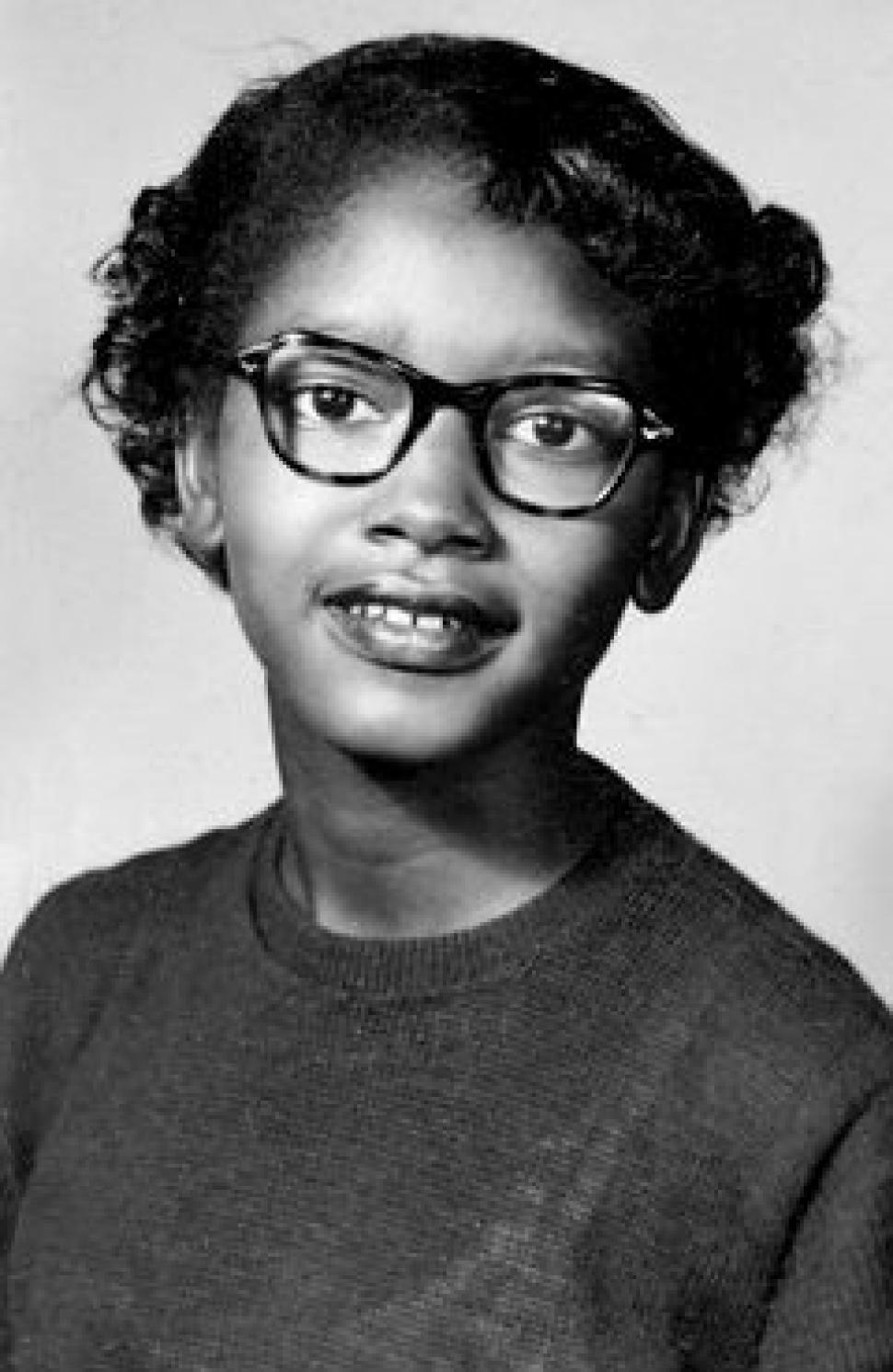
The cover image catches that tension before it became history.[6] The portrait shows Colvin at age 13 in 1953, two years before the arrest that made her politically useful and, at the same time, politically difficult.[6] It belongs with this essay because the conflict around her was never only about legal principle. It was also about how age, gender, sexuality, respectability, and movement timing shaped who could become a public emblem in Montgomery in 1955.[2][4]
Timeline anchors
- 1955-03-02: Claudette Colvin is arrested in Montgomery after refusing to move on a segregated bus.[1][2]
- 1955-12-01: Rosa Parks is arrested on a Montgomery bus, nine months after Colvin.[1][2][4]
- 1955-12-05: the Montgomery bus boycott begins after Parks's case triggers a unified citywide response.[2][4]
- 1956-02-01: Fred Gray and Charles Langford file the federal suit that becomes Browder v. Gayle on behalf of Aurelia Browder, Susie McDonald, Claudette Colvin, Mary Louise Smith, and initially Jeanatta Reese.[2][3]
- 1956-06-05: a three-judge federal district court rules bus segregation unconstitutional in Montgomery.[2][5]
- 1956-11-13 to 1956-12-20: the Supreme Court affirms the ruling, rehearing is denied, and Montgomery ends bus segregation as the boycott closes.[2][5]
1. Colvin's arrest showed that the bus issue was already live before Rosa Parks
The National Park Service page for Dexter Avenue Baptist Church is useful because it strips away the schoolbook sequence in which bus resistance appears suddenly in December.[1] The page places Colvin inside a longer local tradition of confrontation, noting that Vernon Johns had challenged bus segregation before her and that Colvin's arrest came nine months before Parks's.[1] That chronology matters. By the time Parks stayed seated, the grievance was old, the anger was organized, and the possibility of boycott had already been imagined in Montgomery's Black political world.[1][2][4]
Colvin's own arrest also clarifies how humiliating the bus system was in practice. The Supreme Court Historical Society's overview of Browder v. Gayle explains that Montgomery ordinances and Alabama statutes required segregation and empowered bus employees to enforce it.[2] Colvin was not dragged from a symbolic "whites only" front seat chosen for theatrical effect. According to the National Park Service continuation sheet for Cleveland Court Apartments, she was forced off after refusing to surrender a seat near the rear when more white passengers boarded and Black riders were expected to keep compressing their own section to preserve white comfort.[4] That detail restores the ordinary cruelty of the system. The law did not only divide space. It gave drivers the power to keep moving the line.
This is one reason Colvin belongs in a microhistory rather than in a decorative prelude to Parks.[1][2][4] Her case reveals that the Montgomery bus struggle was already a daily negotiation over who had to stand, who could sit, and who had to perform deference on command. When she refused, she did not invent the issue. She made it impossible to pretend the issue was minor.
2. The reason Colvin was set aside was strategic, social, and painfully specific
The hardest part of the story is also the most historically revealing. Movement leaders did not turn Colvin into the boycott's public face, even though her arrest offered the same basic legal grievance that Parks's later case would dramatize.[2][4] The Supreme Court Historical Society summary says the Women's Political Council initially saw her arrest as a possible opening, then decided against using it because adults in the community were unlikely to rally around someone they saw as an "emotional" teenager; soon after, her pregnancy made leaders fear public attention would drift away from segregation and toward moral policing of the girl herself.[2]
The National Park Service continuation sheet is even blunter. It records that Colvin was dropped as a potential test case because of her youth, because she had physically resisted the officers who arrested her, and because she was pregnant and unmarried.[4] Those reasons are historically ugly, but they should not be blurred away. They show that the movement's public strategy moved through the respectability standards of the Black middle class as well as through constitutional principle. Organizers were not only asking, "Who suffered a legal wrong?" They were asking, "Whom can we ask the whole city to defend without losing disciplined unity?"[2][4]
That distinction helps explain why Rosa Parks became the hinge without requiring any diminishment of Colvin.[1][2][4] The same continuation sheet quotes Parks's later recollection that the ideal plaintiff would be a woman who could draw sympathy and be seen as "above reproach."[4] In that framework, Parks looked publicly legible in a way Colvin did not. She was older, already established in local movement networks, and easier for ministers, teachers, and cautious householders to defend in one shared language.[2][4]
This does not make Colvin historically secondary. It makes her historically diagnostic. Her exclusion shows the terms on which mass protest had to assemble in 1955 Montgomery. The movement wanted justice, but it also needed a symbol capable of surviving the hostile scrutiny of white courts, white newspapers, and its own internal anxieties about classed and gendered respectability.[2][4]
3. The legal story changed once the movement shifted from symbol to plaintiff
Colvin's role changed once the center of gravity moved from public ignition to federal litigation. The Stanford King Institute account of Browder v. Gayle explains that Fred Gray and Charles Langford filed the case on February 1, 1956 on behalf of women mistreated on Montgomery buses, including Colvin.[3] The same page notes that Gray deliberately left Rosa Parks out of the federal suit because he did not want the case entangled with claims that the movement was trying to short-circuit her separate prosecution.[3] That decision is crucial. It meant the legal challenge could proceed on the cleaner constitutional question: whether the segregation laws themselves were valid.[2][3]
In court, Colvin no longer had to carry the entire burden of movement iconography.[2][3] She needed to be what she had always already been: a person against whom the bus system had enforced racial hierarchy. The plaintiff role was narrower, but in some ways sturdier. Federal judges did not need a saint. They needed a justiciable injury, a record, and a statute to test against the Fourteenth Amendment.[2][3][5]
The National Archives lesson on Rosa Parks's arrest records helps make that procedural shift visible.[5] The page notes that the Parks arrest documents later appeared as evidence in Browder v. Gayle, and that the three-judge federal panel ruled on June 4, 1956 that bus segregation was unconstitutional, with the Supreme Court affirming on November 13.[5] Colvin's first arrest therefore did not vanish when Parks entered the story. It reappeared inside a larger evidentiary and constitutional file.
That sequence is why Colvin's historical significance cannot be reduced to the melancholy phrase "before Rosa Parks."[2][3][5] She was not simply an earlier version of the more famous case. She occupied a different operational slot. Parks triggered the boycott's durable public coalition. Colvin helped supply the plaintiff structure for the federal case that ended the legal regime the boycott was targeting.[2][3]
4. What Colvin's microhistory reveals about civil rights history
Colvin's two-stage role helps correct a broader mistake in how civil rights history is often narrated. Public memory likes one hero, one seat, one date, one turning point. Actual movement history is usually more distributed.[1][2][3][4] Different people do different kinds of irreplaceable work. Some make a crisis publicly legible. Some endure the long logistics of boycott. Some provide organizational infrastructure. Some, like Colvin, expose the gap between whom a movement can celebrate in public and whom it still needs inside the constitutional machinery of change.[2][3][4]
That is why the story retains force even after the court victory. On June 5, 1956, the district court ruled against bus segregation; on November 13, the Supreme Court affirmed; on December 20, Montgomery was forced to comply and the boycott ended.[2][5] Those dates usually enter textbook history as the culmination of one unified campaign. Colvin's life inside the sequence shows that the campaign was unified only after being socially sorted. The movement did not stop needing her because it hesitated to center her. It found another lane in which her experience was indispensable.
This is also why the archival portrait matters.[6] Looking at the young face in that 1953 photograph, the temptation is to turn Colvin into a symbol of innocence belatedly recognized. The history is more demanding than that. She should be read as a participant whose youth sharpened both her vulnerability and the movement's ambivalence. Her importance lies in that friction.
The bounded conclusion
Claudette Colvin reached the courthouse by being passed over first because Montgomery's bus struggle required different human forms at different stages.[1][2][3][4][5] In March 1955, her arrest proved that the city was already sitting on a combustible injustice and that Black riders had begun refusing its rules before the boycott became famous.[1][2][4] In the months that followed, local leaders judged that she could not carry the public symbolic load they needed for a mass campaign.[2][4] In February 1956, once the fight turned toward a federal constitutional challenge, that same teenager became useful again in a different, decisive register: as a plaintiff in Browder v. Gayle.[2][3][5]
That is the durable lesson in her microhistory. Civil rights victories were not built only by the people who fit the movement's preferred public image. They were also built by people whose lives made organizers uneasy, whose stories were harder to discipline, and whose names still entered the legal record anyway. Colvin's place in history lives in that exact seam.
Sources
- U.S. National Park Service, "Alabama: Dexter Avenue Baptist Church Montgomery" - on Claudette Colvin's March 2, 1955 arrest, the older bus-resistance context, and the boycott's later emergence.
- Supreme Court Historical Society, "Browder v. Gayle (1956)" - on Colvin's arrest, the Women's Political Council's hesitation, the reasons her case was not used to launch the boycott, the filing of Browder v. Gayle, and the ruling sequence.
- The Martin Luther King, Jr. Research and Education Institute at Stanford University, "Browder v. Gayle, 352 U.S. 903" - on the plaintiffs, Fred Gray's litigation strategy, and the district court and Supreme Court chronology.
- U.S. National Park Service, National Register continuation sheet for Cleveland Court Apartments - on the details of Colvin's March 1955 bus arrest, why she was dropped as a potential test case, and how local leaders thought about a plaintiff who would draw broad sympathy.
- National Archives, "An Act of Courage, The Arrest Records of Rosa Parks" - on Browder v. Gayle as the federal case that invalidated Montgomery bus segregation and on the Parks arrest documents preserved in that case file.
- Wikimedia Commons, "File:Claudette Colvin.jpg" - source page for the 1953 photographic portrait used as this article's cover image.