
Douglas Engelbart's Mother of All Demos is often remembered as the public debut of the computer mouse. That is true, but it is too small. On December 9, 1968, Engelbart and the Augmentation Research Center team at Stanford Research Institute presented the oN-Line System, or NLS, at the Fall Joint Computer Conference in San Francisco.[2][3] The mouse was the most memorable object because it gave the future a shape that could fit in one hand. The deeper event was that Engelbart made computing look less like calculation and more like shared intellectual work.
The historical setting matters. Engelbart's group had been working on NLS since 1962, and the 1968 public session brought together a system rather than a single invention: screen text, hierarchical files, links, graphics, view control, a keyboard, a chord keyset, a mouse, remote collaborators, and live audio-video connection.[2][3] The Doug Engelbart Institute describes the demonstration as a 90-minute live public presentation by Engelbart and 17 researchers, attended by roughly 1,000 computer professionals.[2] SRI's retrospective emphasizes that the audience saw not only the first public look at the mouse but also the debut of personal and interactive computing.[3]
That distinction is why the archival video below still has force. A later screenshot can show the device. A museum label can name the innovations. The moving record shows the argument being performed: a person at a console can navigate, rearrange, link, retrieve, collaborate, and think through a screen in real time.[1][2] This was not a consumer product launch. It was a staged proof that a computer could become a medium for augmenting human work.
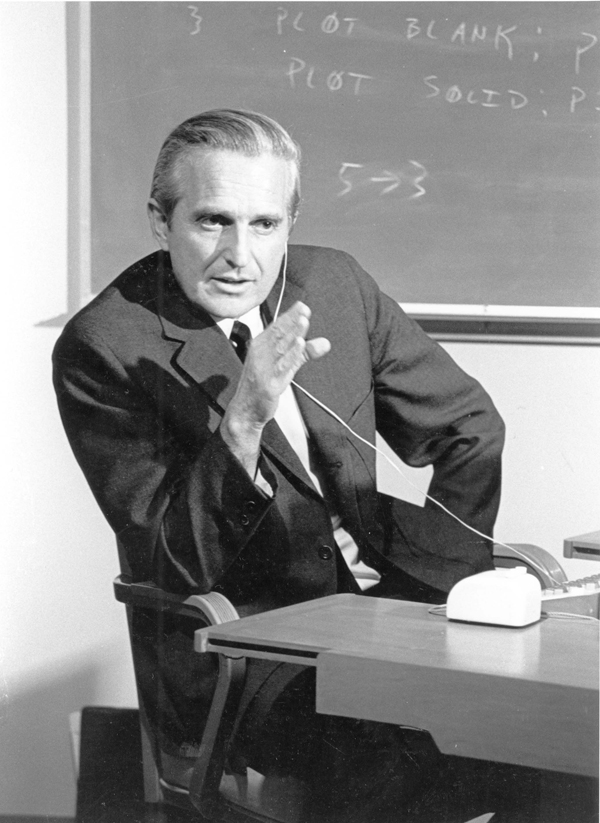
Image context: the cover image is an archival SRI photograph of Engelbart practicing in December 1968, preserved through Wikimedia Commons.[6] It is not a diagram or generated visual. It is useful because the demo was also a media operation: Engelbart's body, console, pointing device, screen feed, and camera all had to be composed so an auditorium could understand a new way of working.
The Archival Video
The embedded video is Part 1 of the Doug Engelbart Institute's remastered YouTube upload of the 1968 demonstration.[1] The Institute's own demo page notes that the original 90-minute video is part of the Engelbart Collection in Stanford University Special Collections and that the presentation was later segmented and reformatted for online access.[2] That provenance matters for an archival spotlight. We are not watching a modern explainer that summarizes the event from the outside. We are watching the demonstration's own performance grammar: Engelbart talks, manipulates text, shifts views, and teaches the audience how to see interactive computing before the audience has a normal vocabulary for it.
The first useful thing to notice is the calmness. Engelbart does not sell NLS as spectacle in the modern product-demo sense. He behaves more like a researcher opening a workbench. The point is not that one feature dazzles. The point is that many small operations can be chained into a different intellectual tempo. He enters and edits text, changes structure, invokes views, and moves between levels of information.[1][2] The demonstration asks the audience to imagine a professional day in which the computer is always available, responsive, and tied to the user's working memory.
That made the mouse important, but not self-sufficient. The Lemelson Center's account places the mouse prototype in the Engelbart and Bill English collaboration at SRI, while the Institute's segment guide makes clear that the device appears alongside keyboard input, the chord keyset, the tracking spot on the screen, and broader control systems.[2][4] The mouse matters historically because it made screen attention movable. It turned pointing into a continuous act. Yet the demo's real claim was that pointing, typing, linking, and viewing could form one environment.
Why The Demo Needed An Audience
The Mother of All Demos was not only a technical demonstration. It was a translation event. Engelbart had to make a room of computer professionals understand something that did not yet fit the dominant image of computing. In 1968, many machines were still encountered through batch processing, terminals, institutional time-sharing, or specialized engineering environments. Engelbart's stage showed a different relationship: a knowledge worker seated in front of an interactive display, shaping live information as though the screen were a thinking surface.[2][3][5]
That is why the live staging matters as much as the software list. The demo connected the conference site to SRI in Menlo Park and brought remote collaborators into the presentation.[2] In later vocabulary, we might call parts of this video conferencing, collaborative editing, hypertext, or interactive document work. Those labels are useful, but they can make the event sound like a checklist of features waiting to be commercialized. The archival footage shows something more integrated. The system is valuable because the pieces reinforce each other. A link is more powerful when it sits inside a structured document. A remote collaborator is more useful when both users can work inside a shared information space. A pointing device matters more when the screen is no longer just output but a navigable workspace.
The Computer History Museum's Engelbart profile frames the 1968 demonstration as the moment when he brought together strands of research from the Augmentation Research Center, founded in 1959, into an event that anticipated computing paradigms people would use decades later.[5] That later influence is real, but it can obscure the historical oddity of the moment. Engelbart was not simply predicting the desktop computer. He was arguing for augmentation: computers as tools for improving how people organize knowledge, coordinate work, and attack complex problems.[2][5]
What The Footage Shows That A Feature List Misses
One reason the demo survives is that it lets us see confidence before consensus. Engelbart moves through NLS as though the audience should expect computers to behave this way. That assurance is historically revealing. It suggests the system was not a speculative slide deck; it was a working research culture with habits, commands, documents, and collaborators already built around it.[2] When he changes views or follows relationships inside information, the action feels practiced. The future is not announced. It is operated.
The footage also preserves the awkwardness of the future arriving early. The camera angle, scan quality, verbal pacing, and hardware bulk all belong to the late 1960s.[1] Nothing looks sleek. That is precisely why the video is valuable. It separates conceptual modernity from aesthetic modernity. The interface ideas feel contemporary, while the physical apparatus looks archival. The viewer is forced to notice that modern computing did not begin as polished consumer minimalism. It began as research infrastructure, projection logistics, custom input devices, long cables, institutional funding, and a presenter patiently teaching the room what a cursor could mean.
This is where the phrase "Mother of All Demos" can mislead. It sounds as if the event birthed later computing in one clean line. History was messier. Engelbart's ideas traveled through SRI, ARPA networks, Xerox PARC, universities, hardware labs, and commercial systems that often adopted pieces while leaving behind his larger philosophy of collective augmentation.[3][5] The mouse, windows, links, and collaborative editing became easier to recognize than the social ambition that tied them together.
The archival video keeps that ambition visible. Engelbart is not merely showing faster document production. He is showing an environment in which a person can manage complexity by moving through structure. Text is not a static page. It is something that can be rearranged, expanded, collapsed, linked, annotated, and shared.[1][2] That is the historical breakthrough: computing becomes an active relationship with information rather than a distant service that returns answers.
The Legacy: Not Just The Mouse
The most durable lesson of the Mother of All Demos is that interface history is also organizational history. A mouse is an object. NLS was a working system. The demo's real subject was the possibility that groups could improve their thinking by improving their tools, then use those improved tools to improve the next generation of work.[2][5] That recursive idea is less famous than the pointing device, but it is closer to Engelbart's historical importance.
In 2026, the footage remains useful because so many modern tools still chase the same promise under different names: collaborative documents, shared screens, links, search, version control, video calls, networked teams, and constantly reconfigurable workspaces. The difference is that Engelbart's demo makes the promise strange again. It reminds us that these habits were not inevitable. They had to be imagined, funded, built, rehearsed, filmed, and explained to a room that did not yet live inside them.
That is why the archival record matters. The video is not just evidence that the mouse appeared in public in 1968.[1][4] It is evidence of a larger historical pivot: a computer could be presented as a partner in structured thought and shared work. The demo's power lies in the fact that it made that claim visible before the world had caught up with it.
Sources
- Doug Engelbart Institute, "1968 "Mother of All Demos" with Doug Engelbart & Team (1/3) [re-mastered]," YouTube archival video.
- Doug Engelbart Institute, "Doug Engelbart 1968 Demo" - overview of the 90-minute Fall Joint Computer Conference demonstration, NLS, team context, original video, and segment guide.
- SRI, "1968 'Mother of All Demos' Forecasted Much of the Technology We Use Every Day" - SRI retrospective on the December 9, 1968 demo, interactive computing, mouse, hypertext, editing, windows, and teleconferencing.
- Smithsonian Lemelson Center, "The Mother of All Demos" - museum account of Engelbart, Bill English, the early mouse prototype, and the demonstration's place in invention history.
- Computer History Museum, "Douglas C. Engelbart" - biographical profile on the Augmentation Research Center, the 1968 demo, and Engelbart's long-term influence on computing paradigms.
- Wikimedia Commons, "File:SRI Douglas Engelbart 1968.jpg" - source page for the archival SRI photograph used as the article image.