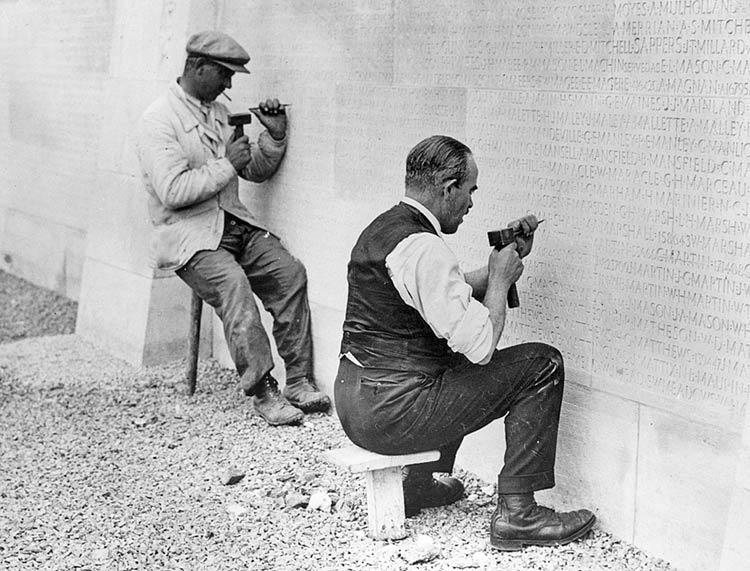
At the Canadian National Vimy Memorial, a name could continue across the joint between two blocks of limestone. That small decision made remembrance unusually demanding to repair. Replacing a damaged block meant matching letters that belonged to a larger inscription, rather than starting again on a self-contained tablet. Veterans Affairs Canada's 2005–2006 performance report described precisely this difficulty as new stone arrived for the restoration.[5]
The problem reaches beyond masonry. What should remain unchanged when a memorial deteriorates: its original material, its appearance, or the ability to read the people it commemorates? At Vimy, keeping faith with the names required accepting that some of the stone carrying them would have to go.
A monument larger than one battle
The ridge in northern France was the site of the Canadian Corps' victory in April 1917. But Walter Seymour Allward's memorial, built between 1925 and 1936, commemorated a wider loss. Its walls carried the names of 11,285 Canadian soldiers who died in France during the First World War and had no known grave. The geography of the battle provided a place for people whose individual burial places could not provide one.[1]
On 26 July 1936, Edward VIII unveiled the monument before a vast gathering that included veterans who had crossed the Atlantic. Its twin pylons represented Canada and France; the solitary figure known as Canada Bereft gave mourning a human posture. The ceremony was also broadcast to listeners in Canada. A distant battlefield could enter a household through sound, even when a family could not make the journey.[2]
The memorial therefore had to work at different distances. Its silhouette could gather attention from across the landscape. Close to the wall, its promise became more particular: someone could find a name.
The stone had a history before Vimy
Allward selected limestone from Seget, in present-day Croatia. According to the Vimy Foundation's account, the survival of Diocletian's Palace at Split helped persuade him that the material offered durability as well as beauty. Obtaining and transporting the large blocks took time; the first shipment did not reach France until 1927.[2]
The choice became part of the monument's identity. Parks Canada's heritage description specifically includes Seget stone and its uniform colour among the features that give the site its significance. It also includes the sculptures, engraved names, battlefield traces and views. The protected object is consequently more complicated than a quantity of old masonry: it is an arrangement of material, landscape and acts of recognition.[1]
That distinction matters when repairs become necessary. Replacing everything with any convenient pale stone might preserve a distant outline while changing the work people encounter up close. Equally, leaving every original surface untouched could allow the lettering to become unreadable. Conservation had to negotiate between those losses.
Water reached the names
At a parliamentary hearing on 21 March 2002, restoration project director André Smith explained why patching had become inadequate. Water entered through walls and the platform, moved through the concrete, and carried dissolved material outward. Calcite deposits emerged at joints and obscured inscriptions; saturated stone, freezing and thawing, and corroding reinforcement compounded the damage.[3]
Smith's testimony also described a visual ambition: the monument was supposed to appear as a continuous mass of stone. Repairs that made individual blocks conspicuous could weaken that effect. He assured the committee that the names had been recorded, so damaged lettering could be reinscribed. The immediate danger was therefore to their legibility on the monument, rather than the disappearance of the underlying records.[3]
A March 2005 government announcement shows how the response joined practical repair to commemorative purpose. It described work on walls, stairs, terraces and platforms, attention to thermal expansion and contraction, and the restoration of damaged names. Visitors temporarily lost access to the monument itself, although other parts of the battlefield park remained open.[4]
The closure exposes an easily overlooked cost of preservation. A place maintained for public remembrance sometimes has to interrupt the very encounter it exists to make possible.
Matching the next letter
The 2005–2006 performance report brings the story back to the hand and the eye. Replacement material was again Seget stone. Because inscriptions ran across joints, newly carved letters had to agree with the surviving work in what the report called “spirit and detail.” The task was to continue an inscription convincingly across a repaired surface.[5]
Visitors could follow the work through interpretive panels and viewing areas outside the stone-carving workshop. For a time, making the memorial readable was itself something the public could watch. That arrangement acknowledged the labour behind a monument whose finished appearance might otherwise suggest effortless permanence.[5]
Veterans Affairs Canada's subsequent brochure records completion in 2007. The programme included dismantling and rebuilding parts of the platform and vertical walls, replacing and re-engraving damaged stone, renewing mortar joints in the pylons, cleaning the sculptures, and improving drainage and lighting. Repair extended from what a visitor saw to the routes by which water moved through the structure.[6]
This was a particular conservation response, not proof that replacement is always the right answer for an ageing monument. At Vimy, however, the names supplied a demanding test. Keeping an old block had limited commemorative value if the person inscribed upon it could no longer be read. The restoration treated legibility as part of the inheritance. Its care would be encountered in the quiet moment when a visitor leaned toward the wall and found the next letter.
Sources
- Parks Canada, “Vimy Ridge National Historic Site of Canada” — official heritage record, construction dates, commemorative scope and character-defining elements.
- The Vimy Foundation, “The Canadian National Vimy Memorial” — stone selection and delivery, sculpture, and the 26 July 1936 unveiling.
- House of Commons of Canada, Sub-Committee on Veterans Affairs, Evidence, 21 March 2002 — André Smith's testimony on water damage, inscriptions and the aims of restoration.
- Veterans Affairs Canada, “Media Invited to Witness Vimy Memorial Restoration,” 7 March 2005 — contemporary description of the works and temporary access restrictions.
- Veterans Affairs, 2005–2006 Performance Report, printed p. 29 (PDF p. 33) — Seget stone procurement, names crossing masonry joints, replacement lettering and workshop viewing areas.
- Veterans Affairs Canada, “Vimy Ridge National Historic Site of Canada,” 2008 brochure, “The Restoration” (PDF p. 3) — completed work and its 2007 completion date.
- Wikimedia Commons, “Vimy Memorial – carving of names” — archival photograph sourced to Veterans Affairs Canada, catalogued 1925–1939; photographer unidentified.