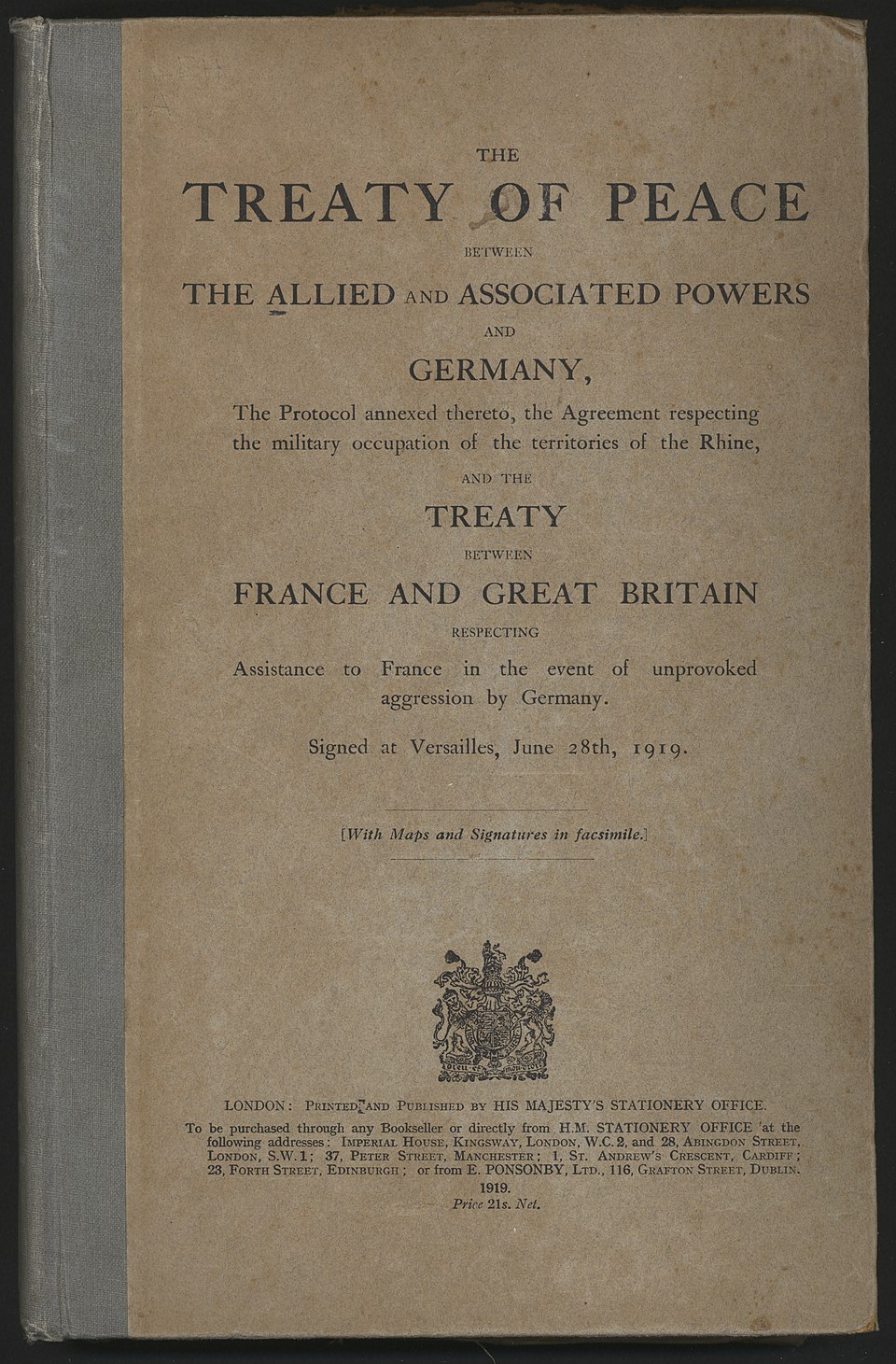
Article 231 is usually remembered by its nickname, the “war guilt clause,” but that label hides the sentence-level mechanics that made the clause consequential. Read inside Part VIII of the treaty, Article 231 functions less as a standalone moral verdict and more as a legal hinge: it establishes responsibility language that the following reparations articles immediately operationalize.
The historical question is therefore narrow and useful: did Article 231 primarily sentence Germany to symbolic guilt, or did it primarily create a legal basis for a compensation regime that was then politically received as humiliation?
Timeline anchors: when text became policy
- 5 November 1918: the Lansing note formula already tied settlement to compensation for civilian damage caused by aggression.[2]
- 11 November 1918: the armistice framework accepted reparations in principle for wartime damage.[3]
- 28 June 1919: Treaty of Versailles signed, including Article 231 in Part VIII (Reparation).[1]
- 1 May 1921: treaty deadline for the Reparation Commission’s quantified obligation notice.[1]
- 1921 (London Schedule): total headline liability fixed at 132 billion gold marks, with payment structure differentiated across bond categories.[2][4]
Close reading: what Article 231 says, and what Article 232 does with it
Article 231 states that the Allied and Associated Governments affirm, and Germany accepts, responsibility for “all the loss and damage” suffered as a consequence of a war imposed by German aggression.[1] On first reading, the phrasing sounds absolute. The crucial interpretive move is to read one article further.
Article 232 immediately introduces a capacity boundary: it recognizes that Germany’s resources are not adequate for complete reparation, then narrows compensation practice toward defined civilian damage categories and commission procedures.[1] In legal design terms, the sequence works as a two-step structure:
- responsibility language in Article 231;
- compensable-scope and payment machinery in Articles 232–235.
That sequence matters because it separates legal foundation from collection instrument. The treaty text does not stop at accusation; it quickly moves to administrative questions: who assesses claims, by when, on what schedule, with what possibility of timetable modification.[1]
Why political reception diverged so sharply from legal architecture
From the Allied drafting perspective, the clause provided a juridical predicate for transferring civilian-war-damage claims into an enforceable reparations framework.[1][2] From the German domestic perspective, the language was read as an all-encompassing confession of war causation and national dishonor, then amplified in public rhetoric as proof of punitive peace.[4][5]
This is the core interpretation gap:
- Drafting logic: liability language to support claims processing and payment law.
- Reception logic: moral condemnation text standing for national humiliation.
Both readings were politically real at the same time, and the gap itself became policy-relevant. Once “responsibility” was domesticated as “sole guilt,” each later fiscal number looked less like negotiated burden-sharing and more like sentence enforcement.
Numeric anchors that structured the post-1919 dispute
Three numbers organized the argument ecology:
- 20 billion gold marks: interim payment target for 1919–early 1921 under Article 235 pending full assessment.[1]
- 132 billion gold marks: 1921 headline London Schedule figure.[2][4]
- 30 years: Article 233 horizon for discharge scheduling from May 1921, with commission discretion to extend timing.[1]
The mechanism-level point is that these numbers sat on top of prior wording choices. Article 231 did not itself compute the bill, but it made the bill legally attachable.
Competing interpretations and evidence weight
Interpretation A: Article 231 was essentially a legal precondition for reparations
Evidence for this view comes from textual adjacency in Part VIII and from diplomatic summaries emphasizing compensation architecture, commission authority, and civilian-damage framing.[1][2]
Interpretation B: Article 231 functioned as punitive moral inscription and destabilized settlement legitimacy
Evidence for this view comes from immediate German political reaction, long-tail propaganda use, and the way clause rhetoric became a mobilizing symbol beyond technical legal scope.[4][5]
The strongest historical reading is layered rather than binary: Article 231 was drafted as legal infrastructure and received as moral indictment; the settlement crisis emerged from that mismatch, not from one side’s reading alone.
Invalidation boundary
This interpretation would weaken if draft records and implementation practice showed that Allied negotiators treated Article 231 as purely symbolic while deriving reparations authority from an independent legal route, or if German elite/private records showed no meaningful humiliation effect from 231-language framing. Current documentary synthesis points in the opposite direction, but those archives remain the decisive test space.[1][2][5]
Why this close reading still matters
Article 231 is an early twentieth-century example of a recurrent governance problem: legal text can be internally coherent yet externally explosive when public semantics diverge from institutional intent. In that sense, the clause is not only about Versailles. It is a durable case study in how one sentence can carry two regimes at once—juridical enforceability and political memory—and how their misalignment can reorder the next decade.
Sources
- Yale Law School Avalon Project — Treaty of Versailles, Part VIII (Articles 231–244)
- U.S. Department of State, Office of the Historian — Paris Peace Conference and Treaty of Versailles
- U.S. Library of Congress — Treaty of Versailles and the League of Nations (armistice/settlement context)
- Encyclopaedia Britannica — Treaty of Versailles (terms and territorial-economic settlement context)
- Wikipedia — Article 231 of the Treaty of Versailles (historiography and reception overview)
- Wikipedia — World War I reparations (London Schedule structure overview)