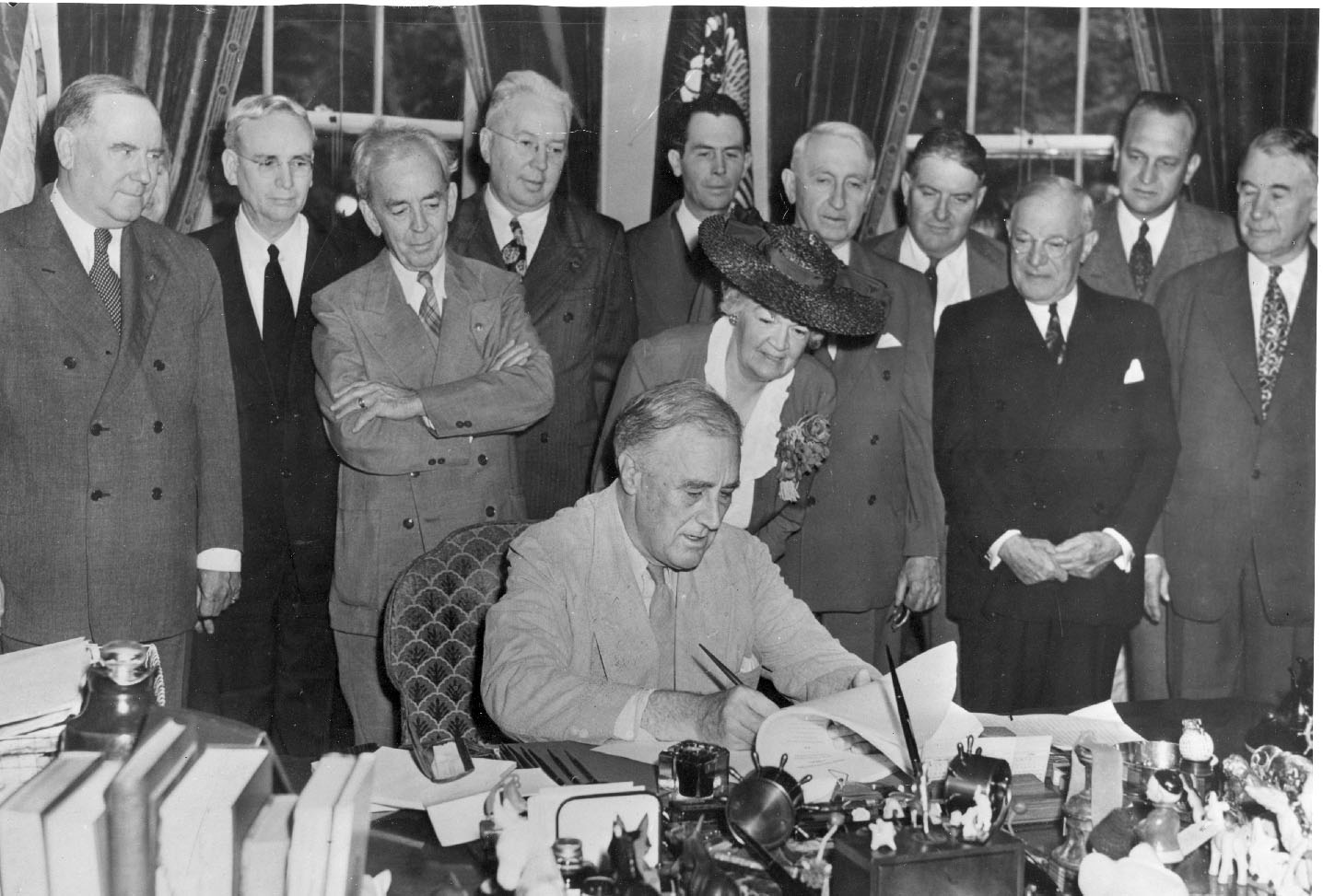
The GI Bill is often remembered as a generous postwar thank-you note. The historical record reads more precisely as a state-capacity mechanism: Washington wrote a large, rules-based entitlement in 1944, then routed delivery through local colleges, banks, and labor markets. That architecture produced enormous aggregate gains in schooling, homeownership, and income formation, while also transmitting local discrimination into outcomes.
The core analytical question is straightforward: what policy mechanism let one law scale opportunity so quickly, and why did distribution stay so uneven?
Timeline anchors: where the mechanism turned
- June 22, 1944: Roosevelt signed the Servicemen’s Readjustment Act (Public Law 78-346).[1][2]
- 1944–1947: demobilization pressure was immediate; Labor-era planning had warned of up to 15 million potential postwar unemployed service members, so fast civilian absorption became the policy target.[1]
- By the early 1950s: uptake had shifted from emergency cushioning to structural mobility, with millions moving through college, vocational training, and mortgage channels.[1][3]
- By 1955–1956: cumulative scale was visible in fiscal data—about 4.3 million home loans with face value near $33 billion, and education/training disbursements near $14.5 billion by expiry in 1956.[1]
Stage 1: Entitlement design converted demobilization risk into immediate private demand
The first mechanism was legal design. Congress did not build a new national university network or federal housing authority for veterans; it created portable benefits tied to individual eligibility. In practice, that meant tuition/living support for study, loan guarantees for homes and businesses, and temporary unemployment support.[1][2][3]
This mattered because it accelerated demand without waiting for a new federal delivery bureaucracy. Veterans became purchasing actors in existing systems: they could enroll where seats existed, borrow where lenders participated, and relocate where jobs and housing pipelines were opening.
In mechanism terms: federal rulemaking set the payment guarantee; local institutions handled throughput.
Stage 2: Scale came from coupling entitlement money with existing institutional capacity
The National Archives synthesis reports that within seven years around 8 million veterans used education benefits, including about 2.3 million in colleges/universities, 3.5 million in other school training, and 3.4 million in on-the-job training tracks.[1]
Those numbers were too large to interpret as marginal welfare support. They indicate a demand shock that colleges, trade programs, and employers had to absorb and standardize around. The GI Bill therefore functioned less like a narrow benefit and more like a federal demand guarantor for human-capital formation.
Housing worked through a similar channel. Loan backing reduced financing friction for lenders and down-payment barriers for households, pushing veterans into ownership pipelines at industrial scale. The result, again from National Archives summary figures, was 4.3 million GI-linked home loans by 1955.[1]
A useful causal shorthand is:
- entitlement certainty lowered household risk,
- guarantee structure lowered lender risk,
- synchronized demand pulled institutional supply into expansion.
Stage 3: Decentralized implementation transmitted local exclusion into national outcomes
The same architecture that enabled speed also created distributional asymmetry. Program rules were federal, but many gatekeeping decisions sat with local banks, colleges, and administrative offices. That is why the law could be formally race-neutral in text while materially unequal in practice.
Historical accounts from both archival and later scholarship-facing summaries describe the pattern: Black veterans were disproportionately blocked by segregated education capacity, discriminatory mortgage access, intimidation in housing markets, and unequal administration of benefits.[1][4][5]
Put differently, the GI Bill did not fail to scale; it scaled through institutions that already encoded unequal access. Aggregate prosperity and unequal distribution were produced by the same design choice—decentralized delivery through existing local systems.
Competing interpretations and what the evidence supports
Two interpretations dominate public memory.
- Universal-lift interpretation: the GI Bill broadly democratized opportunity and built the postwar middle class.
- Stratified-state interpretation: the GI Bill built opportunity for many but reproduced hierarchy through local implementation filters.
The evidence supports a combined reading with asymmetric emphasis. On aggregate outcomes, the universal-lift case is strong: multimillion-participant education uptake, multi-million-loan housing expansion, and large fiscal throughput are well documented.[1][3] On distribution, the stratified-state case is also strong: implementation channels allowed racial exclusion to remain decisive in many localities.[1][4][5]
The right historical conclusion is not that one interpretation cancels the other. It is that both were mechanically linked.
Invalidation boundary
A clear falsifier would weaken this mechanism claim: if archival loan approval records, school admissions, and local VA administration outcomes showed broadly race-parity access across regions during 1944–1956, then implementation-channel inequality would be overstated. Existing evidence points the other way, but this remains the decisive empirical test.
Why this history still matters
The GI Bill remains one of the clearest cases where policy architecture—not only policy generosity—determined long-run outcomes. Eligibility plus federal money created capacity at extraordinary speed. Delivery through local institutions determined who could actually convert entitlement into durable assets.
That combination explains why the GI Bill can be remembered, correctly, as both a mobility engine and an inequality amplifier.
Sources
- U.S. National Archives — Servicemen’s Readjustment Act (1944)
- Public Law text citation (Servicemen’s Readjustment Act of 1944, Pub. L. 78-346)
- Wikipedia — G.I. Bill (timeline and program structure overview)
- HISTORY — How the GI Bill’s Promise Was Denied to Black WWII Veterans
- U.S. VA Education and Training portal (program continuity context)
- Smithsonian Magazine — How the GI Bill’s Promise Was Denied to a Million Black WWII Veterans