Vasa's disaster is often told as a perfect engineering joke: Sweden built a great warship, filled it with guns and carvings, and watched it tip over almost immediately. That version is memorable because it is simple. The historical reconstruction is sharper because it is not simple. Vasa did not sink because nobody had noticed the problem. It sank because a warning was seen, understood as dangerous, and then allowed to pass into a launch ceremony that had no practical brake.
On 10 August 1628, the new royal warship sailed only about 1,300 meters in Stockholm harbor before a gust pushed it to port, water poured through open gunports, and the hull settled on the seabed roughly 32 meters below the surface.[1] Thousands of Stockholm residents and foreign ambassadors saw the failure from shore.[1] The publicness matters. This was not a remote loss at sea. It was a state project collapsing in view of the city that had built it.
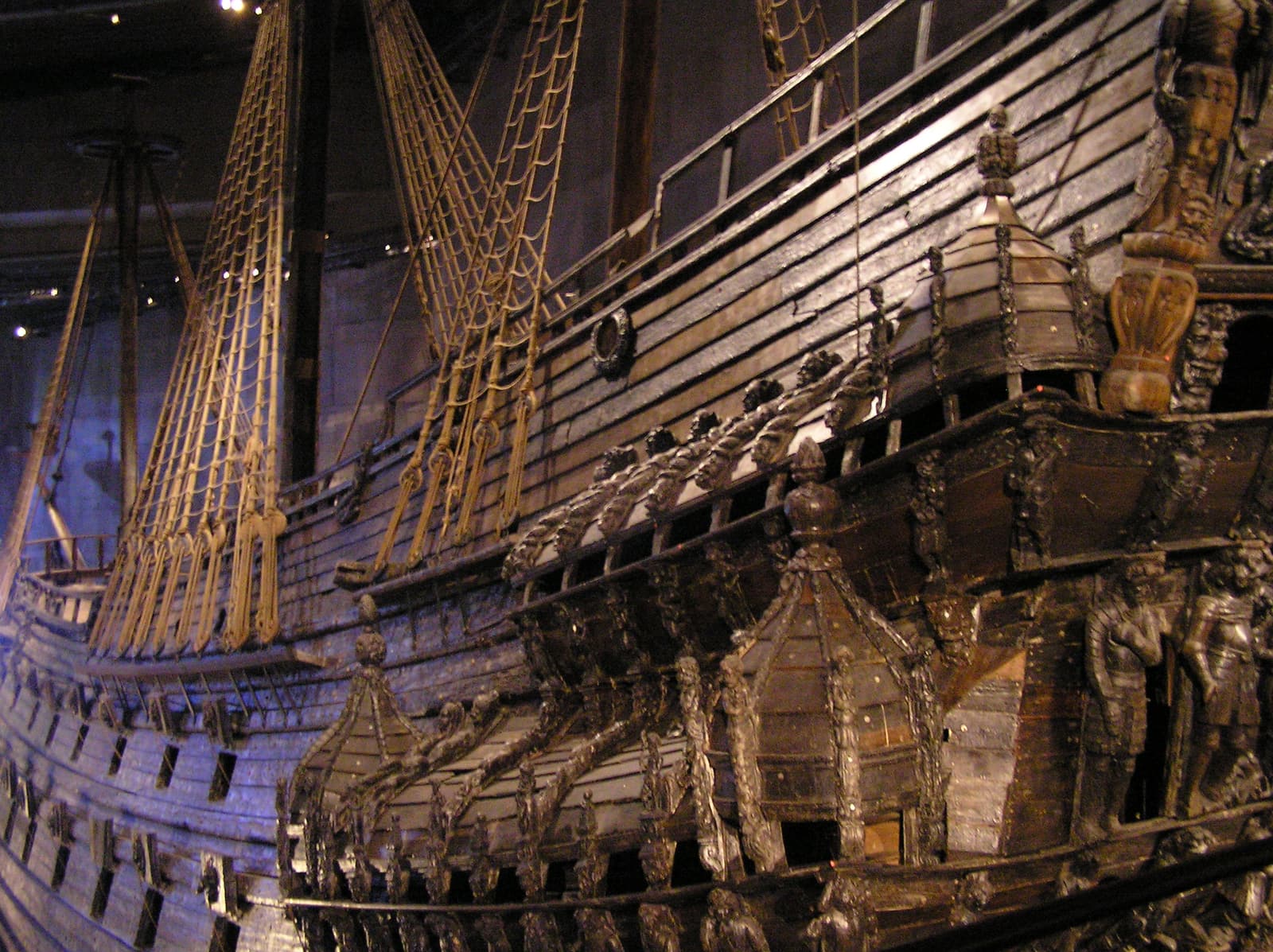
Image context: the cover uses a real photograph of the preserved Vasa inside the Vasa Museum, not a diagram, chart, or generated reconstruction. It fits this article because Vasa's unusual survival turns the story from legend back into material evidence: a high, ornamented, heavily armed hull still stands where readers can see the proportions that made one gust enough.[6]
Before the voyage: a policy argument in oak
The project began inside Swedish state ambition. In January 1625, Gustav II Adolf contracted with the Dutch master shipwright Henrik Hybertsson and Arendt de Groote for new ships, including Vasa, which the Vasa Museum's timeline describes as intended to become the most powerful warship in the Baltic, if not the world.[1] Vasa's keel was laid in 1626 at the Stockholm navy yard, and the ship was launched in 1627 while hundreds of craftsmen continued work on hull, rigging, sculpture, and weapons.[1]
The completed vessel made royal policy visible. The museum's timeline gives the scale: about 69 meters long, more than 50 meters high from keel to mainmast top, over 1,200 tonnes when outfitted, carrying ten sails, 64 cannons, 120 tonnes of ballast, and hundreds of sculptures.[1] Those numbers are not decoration around the event. They are the event's preconditions. Vasa was being asked to be a symbol, a troop platform, and a concentrated artillery machine at once.
The armament explains the pressure. The Vasa Museum's account of the ship as a machine of war says Vasa carried 64 cannons when it sailed, with the main force coming from 48 24-pounders; its broadside could throw about 250 kilograms of ammunition, several times the weight of a typical Swedish warship of the 1620s.[4] Gustav II Adolf, the same page notes, favored a future of artillery duels at sea and wanted more guns and bigger guns.[4] That made Vasa more than one ship. It was a test of what the Swedish navy might become.
But a warship is not only its desired effect. It is also a balance among weight, hull volume, wind, ballast, openings, crew, and handling. The Vasa Museum's disaster account is careful about the limits of seventeenth-century design: shipwrights did not have modern mathematics for predicting stability and speed, so they worked from experience.[2] Vasa stretched that experience. Its upperworks were too tall and too heavily built for the relatively small amount of hull below the waterline, pushing the center of gravity too high.[2] In modern terms, the ship had too little margin. In 1628 terms, it was frighteningly tender.
The warning that did not stop the launch
The decisive warning came before the public voyage. The museum's timeline says Captain Sofring Hansson worried enough in the summer of 1628 to call Vice Admiral Klas Fleming down to the ship while it lay by the royal palace. Thirty men ran back and forth across the deck, and the vessel rolled alarmingly.[1] The inquest account gives the same episode in more forensic form: after only a few crossings, the ship heeled so badly that the demonstration was interrupted because people feared it might capsize at the quay.[3]
This is the hinge of the reconstruction. The roll test did not reveal a hidden flaw after the disaster. It made the flaw visible before the disaster. Fleming reportedly said, "If only His Majesty were at home!"[3] The remark is short, but it names the chain of authority. A vice admiral saw enough to fear the ship, but the absent king's pressure to get Vasa to sea shaped what could be done. Fleming did not halt the program. His practical response was to appoint Sofring Hansson as captain.[3]
The inference should be bounded. The sources do not show a clean memo saying: this ship will sink, sail anyway. They show something more common and more dangerous: an organization recognized a risk without converting that recognition into authority. The test produced alarm, not redesign. Vasa then moved from shipyard uncertainty into ceremonial expectation.
10 August 1628: a ceremony becomes a test
When Vasa set out, the ship still had one possible path to survival: it could have lasted long enough to be corrected. The Vasa Museum's disaster account notes that unstable new ships were not unknown and that accepted remedies existed, including revising armament, adding planking at the waterline, or reducing height by removing a deck.[2] Vasa did not get that chance. It was so unstable that the first voyage became the final test.[2]
The gunports made the difference between a severe warning and a sinking. The museum's disaster account calls Captain Hansson's decision to leave the gunports open fateful: if they had been closed, water could not have poured in, and the ship might have survived long enough to be rebuilt into a more stable form.[2] That sentence matters because it keeps the explanation from becoming one-dimensional. Bad proportions made the ship heel. Open gunports made heeling lethal.
The short route also matters. Vasa had not yet entered the open sea, had not met battle damage, and had not faced storm weather. It was still within sight of the yard when a gust pushed it over, the lower openings took water, and the voyage ended.[1][2] The disaster therefore exposed not seamanship under extreme conditions, but the absence of reserve in ordinary ones. A ship designed to project fear from Reval to Copenhagen could not absorb a harbor gust in front of Stockholm.[4]
The inquest and the usable scapegoat
The autumn 1628 inquest had to answer a difficult question: who could be blamed without damaging the royal project too deeply? The Vasa Museum's timeline says officers claimed innocence, builders insisted they had built according to the approved design, and experts believed the ship had too little belly, meaning not enough hull to carry the heavy upperworks.[1] That phrase is blunt. The problem was not merely a negligent sailor or a loose cannon. It was proportion.
The inquest account tightens the point. Witness statements did not support ballast or loose cannon as the cause; instead, they pointed toward bad design.[3] The ballast figure itself is important: the ship had 120 tonnes of stone in the bottom, placed to lower the center of gravity.[3] More ballast was not a simple fix if the ship was already as deeply ballasted as it could safely be. The proportions left too little room below the waterline for what had been built above it.
The builders' defense was politically precise. Hein Jakobsson said the ship had been built according to Master Hybertsson's design, approved by the king; he also revealed that he had widened the ship by about 40 centimeters, suggesting uncertainty around the measurements.[3] Hybertsson had died before the disaster. The dead designer became the safest place for blame to land: technically plausible, politically useful, and no longer able to embarrass the living chain of command.[1][3]
That does not make the inquest meaningless. It preserved testimony about the roll test, ballast, design, command pressure, and royal approval. But its endpoint shows the limit of accountability when a failure belongs to a system. Vasa's sinking came from a sequence: ambitious artillery requirements, high upperworks, inadequate stability margin, ignored warning, open gunports, and authority structured around pleasing the king. A single guilty man could not carry that whole chain.
Why the preserved ship still matters
Vasa's afterlife changes how the event can be understood. Anders Franzen located evidence of the wreck in August 1956, the ship was moved underwater in 1959, and on 24 April 1961 it surfaced after 333 years below.[1] The museum's timeline says that by 1962 visitors could see the ship while conservators worked, and that preservation began with polyethylene glycol treatment to keep the waterlogged wood from shrinking and cracking.[1]
The survival is extraordinary but not static. The Vasa Museum now says the ship needs a new support structure because the support used since the 1960s is damaging the hull, the oak has weakened chemically, the hull is deforming, and the ship leans slightly to port.[5] From 2024 to 2028, the museum is replacing 17 pairs of external cradle elements with 27 steel cradles and adding an internal steel support structure.[5]
That contemporary conservation work is not an unrelated museum footnote. It is a reminder that Vasa remains a problem of loads, shape, wood, and support. In 1628, the ship's high structure and insufficient hull volume turned prestige into instability. In the present, conservation engineers must support the same high, fragile body without letting it move itself apart.[5] The disaster has not become less physical with time. If anything, the preserved ship makes the physicality harder to avoid.
The best reconstruction of Vasa is therefore not "too many decorations sank a ship." It is that a royal warship was asked to carry a new naval ambition before its hull could safely carry the consequences. The warning arrived before the voyage, but the organization did not let the warning rule. On 10 August 1628, Vasa did not merely sink. It demonstrated, in public, what happens when a visible risk has no authority stronger than ceremony.
Sources
- Vasa Museum, "Timeline" - official chronology of contract, construction, roll test, sinking, inquest, salvage, and preservation milestones.
- Vasa Museum, "The Disaster" - explanation of Vasa's high center of gravity, unstable upperworks, open gunports, and design limits.
- Vasa Museum, "The Inquest" - interrogation evidence on ballast, the thirty-man roll test, Klas Fleming, approved design, and blame.
- Vasa Museum, "Vasa - the machine of war" - armament, broadside weight, Gustav II Adolf's artillery preference, and tactical context.
- Vasa Museum, "Vasa's new support" - current preservation project, hull deformation, wood weakening, and 2024-2028 support replacement.
- Wikimedia Commons, "File:Inside-vasa-museum.jpg" - source page for the real photograph of Vasa used as the article image.