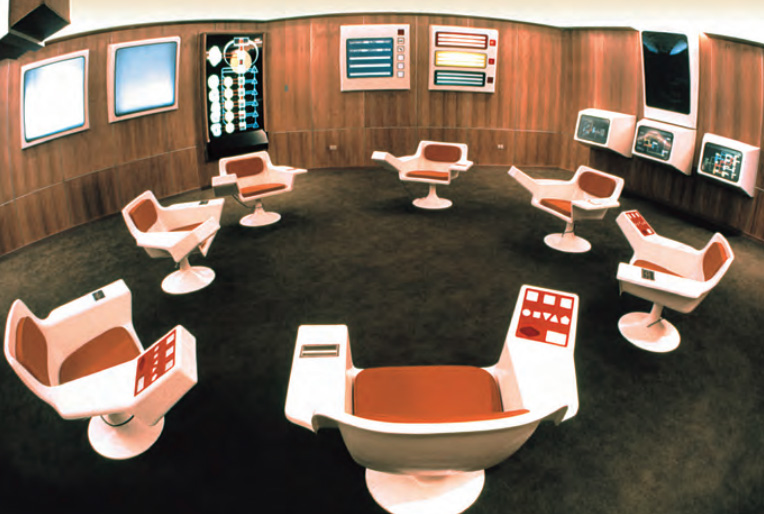
The weak version of Project Cybersyn's history calls it a "socialist internet" that Chile almost built before the world was ready. The phrase is memorable, but it makes the wrong thing look modern. Cybersyn was not a public network, not a web, and not a completed machine for running a country. It was a fast improvisation built between 1971 and 1973 inside Salvador Allende's democratic socialist government, using scarce computers, stored telex machines, cybernetic theory, Chilean engineers, British software help, and one room designed to make data feel discussable.[1][2][3]
That makes the story more interesting, not less. The myth treats Cybersyn as a lost gadget. The evidence points to a harder historical question: could a government use near-real-time industrial information without turning planning into either central command or empty theater? Cybersyn's answer was partial, fragile, and overtaken by political crisis, but it was not naive. It tried to make information move faster than bureaucracy while leaving room for human judgment, factory knowledge, and emergency coordination.[2][3]
Myth: Cybersyn was basically an internet before the internet
The internet myth begins with real elements. Allende's government had expanded the state-controlled sector and needed a way to coordinate factories, supplies, production bottlenecks, and shortages. Fernando Flores, working in the state development agency, brought in Stafford Beer, the British cybernetician whose management theory imagined organizations as adaptive systems. Beer arrived in Chile in 1971, and the project soon took the name Cybersyn, from cybernetics and synergy.[1][3]
But the hardware was not a hidden digital future. Chile had very few computers. The workaround was telex. The 99% Invisible account puts the practical problem plainly: Beer could get only one computer for the network, so the team used telex machines, essentially typewriters connected through phone lines, to send factory information for computer analysis.[1] The New Yorker describes the same constraint from another angle: a single central computer would analyze reports sent by telex machines installed in state-run factories.[4]
That architecture matters. An internet story suggests open-ended connectivity. Cybersyn was a decision-support system. It collected specific industrial indicators, sent them toward a central processing point, flagged deviations, and fed human deliberation. The Cambridge article's abstract describes the project as an early computer network built to regulate the growing social property area and manage Chile's transition from capitalism to socialism; it also emphasizes that Chilean teams modeled factories and built a rapid transmission network between government and factory floor.[2]
So the corrective is not "Cybersyn was low-tech." It was high-concept under low-resource conditions. Telex was not glamorous, but it was available, legible, repairable, and already connected to administrative routines. The historical point is that Cybersyn's modernity did not depend on resembling the later internet. It depended on converting ordinary industrial messages into a feedback loop fast enough to matter.
Evidence: the strike made the network real
Cybersyn's strongest proof did not come from the famous operations room. It came during the October 1972 truck owners' strike, when distribution and supply became an emergency. 99% Invisible describes the telex network as a way to send shortage, labor, and production information into a central process; the New Yorker notes that Fernando Flores used the machines during the strike to coordinate fuel and industries.[1][4]
The significance is not that Cybersyn solved Chile's crisis. It did not. The strike, inflation, credit pressure, opposition mobilization, and approaching violence were bigger than a communications system. But the episode shows what the system could do. It could help officials see blocked roads, available trucks, fuel needs, and resource shortages quickly enough to respond. The New Yorker likewise notes that Fernando Flores deployed the telex machines to help coordinate fuel and industries during the October strike.[4]
This is the part the internet shorthand hides. Cybersyn was most historically concrete when it was least futuristic: not a glowing control room, but noisy telex traffic in a crisis. It was useful because it shortened the distance between factory floor, transport problem, and state response. It was limited because moving information faster could not by itself create spare trucks, restore political legitimacy, or make hostile forces cooperate.
Myth: the room proves it was a command center
The photograph invites the command-center reading. Seven white swivel chairs, orange cushions, wall screens, wood paneling, armrest buttons, and a hexagonal layout make Cybersyn look like a science-fiction state. 99% Invisible identifies the images as coming from Gui Bonsiepe's documentation of industrial design in Chile; the episode also notes that the room was conceived by Beer and designers from Chile's industrial design group.[1] The room was real, and its design mattered.
But the room was not evidence that the system had become an all-seeing machine. It was an interface experiment. Its buttons controlled slide carousels and pre-made displays; some screens and graphics had to be manually prepared.[1][4] The New Yorker stresses the tension between futuristic appearance and practical scarcity: the displays could summarize production information, but they did not make the system magically automatic.[4]
The more revealing question is who the room was for. 99% Invisible says it was meant for workers and higher-level bureaucrats alike.[1] Medina's research frames Cybersyn as a system shaped by Allende's political attempt to combine state control with participation and by Beer's cybernetic interest in balancing autonomy and coordination.[2][3] That is a different design problem from pure surveillance. In theory, Cybersyn was supposed to help lower levels respond before problems escalated upward. In theory, data should support decentralization rather than smother it.
The evidence is mixed. Beer argued for worker participation, but the project also depended on experts modeling factories, deciding indicators, and translating factory life into data categories. Morozov's New Yorker essay records criticism from a participating engineer that some factory modeling became technocratic and top-down.[4] That does not make Cybersyn a dictatorship machine. It makes it a historical experiment caught between its participatory promise and the ordinary bureaucratic pressures of implementation.
Evidence: the system remained unfinished and politically exposed
The myth of the lost internet tends to imply that only the September 11, 1973 coup prevented a working cybernetic socialism from blooming. The coup did end the project, along with Allende's government, but Cybersyn was already struggling with time, trust, and organizational fit. The New Yorker recounts a case where a cement-factory manager solved a coal-shortage problem in person before the Cybersyn warning arrived several days later; with delays like that, factories had little incentive to keep reporting data.[4]
That failure is important because it keeps the history honest. A feedback system is only as good as its reporting cadence, data categories, and authority to trigger action. If factory models lag behind shop-floor reality, if warnings arrive late, or if workers and managers do not trust the process, then the most elegant cybernetic theory turns into paperwork by another name. Cybersyn's problem was not only technical capacity. It was organizational credibility.
The political environment narrowed the room for repair. By 1973, the project was trying to mature while Allende's government was losing political room, economic stability, and time. The New Yorker places Cybersyn's end with the military overthrow on September 11, 1973; 99% Invisible states that the operations room was finished but never put to use.[1][4]
What the myth gets right
The myth survives because it points to something real: Cybersyn saw that information architecture is political. It asked who gets to collect data, who gets to interpret it, who gets alerted first, and whether a system built for speed can still preserve autonomy. Those questions feel contemporary because governments and companies now routinely promise adaptive management through dashboards, sensors, and algorithmic regulation.[3][4]
But the useful lesson is not that Chile invented the internet and lost it. The lesson is that technical systems carry political assumptions before they succeed or fail. Cybersyn's telex network, statistical software, economic simulator, and operations room all tried to make scarcity governable without treating society as a passive machine.[2][3] At its best, it made crisis communication faster. At its weakest, it risked becoming technocratic display, late warnings, and expert abstraction.
Correcting the myth gives Cybersyn back its actual stakes. It was not a finished future. It was a contested attempt to build feedback into a revolution that promised democracy, planning, and worker participation at once. The photograph of the room is still powerful, but not because it shows a lost internet. It shows a society trying to decide whether information should flow upward as command, downward as instruction, or sideways as a shared tool before the political clock ran out.
Sources
- 99% Invisible, "Project Cybersyn" - episode article with Gui Bonsiepe image credits, operations-room photographs, and overview of the telex-based system.
- Eden Medina, "Designing Freedom, Regulating a Nation: Socialist Cybernetics in Allende's Chile," Journal of Latin American Studies 38, no. 3, 2006 - Cambridge Core abstract and DOI record.
- Eden Medina, "Publications" - MIT faculty bibliography listing Cybernetic Revolutionaries, "Designing Freedom, Regulating a Nation," and Cybersyn-related publications and exhibitions.
- Evgeny Morozov, "The Planning Machine," The New Yorker, October 6, 2014 - critical historical essay on Cybersyn, its operations room, delays, and afterlife.