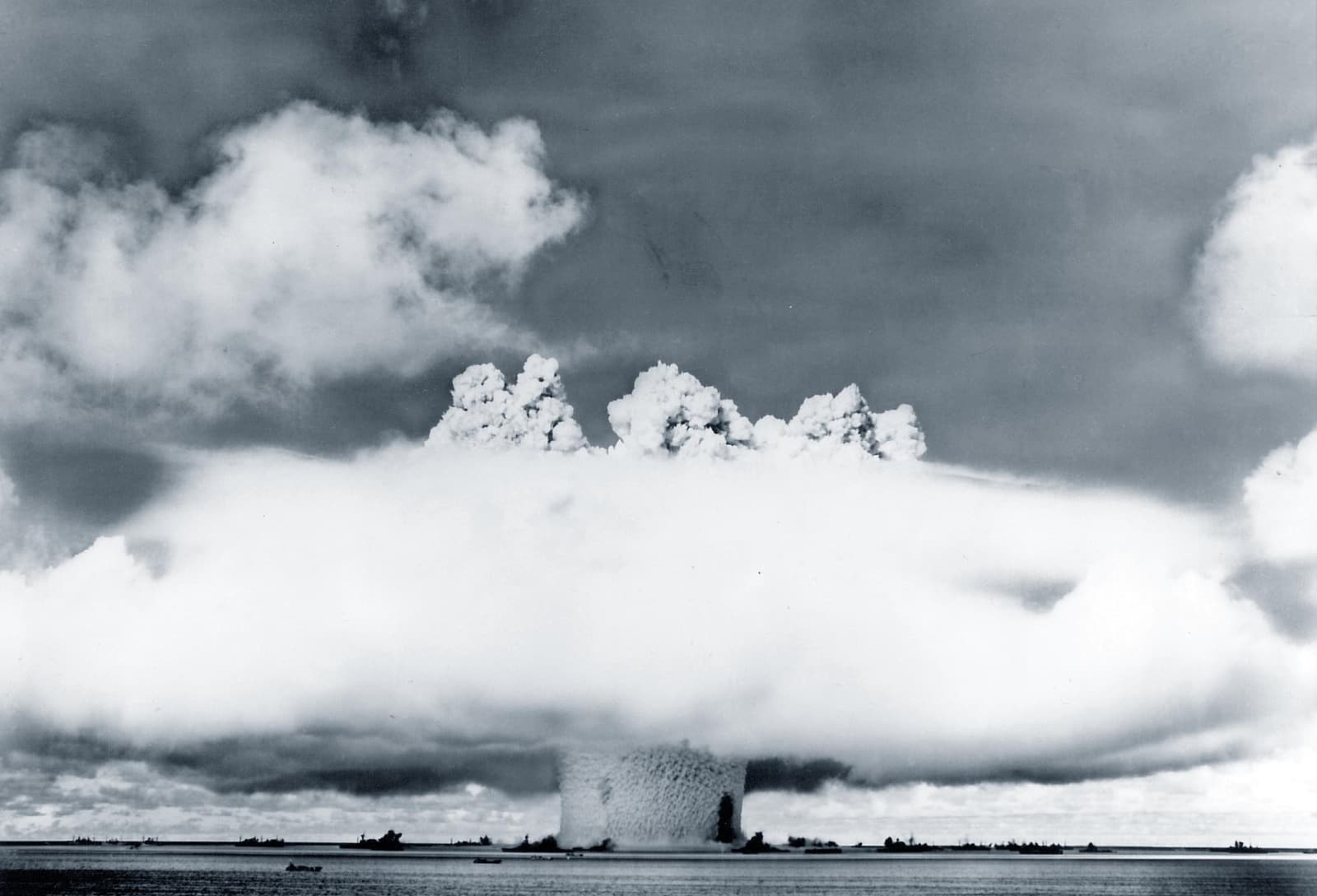

Operation Crossroads is easiest to misread if it is remembered only as a spectacular picture: a white column in Bikini Lagoon, ships reduced to silhouettes, a cloud so large it seems to make the surrounding ocean into a stage. The archival footage embedded below is useful because it pushes against that simplification. It shows a military test system trying to make the atomic bomb measurable, public, and administratively legible, while the second detonation, Baker, turned the target fleet into a radioactive problem that ordinary naval labor could not solve.[1][2][3]
The tests took place in July 1946, less than a year after Hiroshima and Nagasaki and before nuclear strategy had hardened into later Cold War doctrine. The United States wanted to know what atomic weapons would do to ships, equipment, animals, instruments, and naval organization. Bikini Atoll was chosen as a remote lagoon where target vessels could be arranged, filmed, and inspected; 167 Bikini islanders were moved from their home under promises that made the displacement seem temporary, even though later testing helped make return impossible for generations.[3][4]
Crossroads had two completed shots. Able, on July 1, 1946, was an air burst that missed its intended aim point and still sank ships. Baker, on July 25, was an underwater detonation about 90 feet below the surface. That difference changed everything. Baker did not only shock hulls from below. It lifted radioactive water, sand, coral, fission products, and unfissioned plutonium into a towering spray column and a rolling base surge. When that material came back down, the fleet was not just damaged. It was contaminated.[2][3][4]
That is why the event deserves an archival spotlight rather than a simple "atomic age" label. Crossroads was not secret like Trinity, and it was not a wartime bombing. It was a publicized experiment with reporters, cameras, foreign observers, congressional scrutiny, technical instruments, support ships, and thousands of service personnel. The National WWII Museum's account stresses the test's astonishing scale: tens of thousands of U.S. personnel, hundreds of ships and aircraft, hundreds of cameras, thousands of gauges, and a vast temporary infrastructure built to make the bomb into data.[4] Baker then showed that data collection itself could become hazardous when the archive, the fleet, and the cleanup crews all had to work inside a contaminated environment.
Image context: the lead image is a real U.S. Navy/National Archives photograph of the Baker underwater test preserved through Wikimedia Commons. It is not a diagram or generated illustration. Its value is documentary and slightly deceptive: the frame captures the famous column before the harder historical problem, the radioactive return of water onto ships and people, fully appears.[6]
The Archival Film
The embedded video is the U.S. National Archives YouTube upload "Operations Crossroads, Atom Bomb Test, Bikini Atoll." The National Security Archive identifies a related official Crossroads film as a Joint Task Force One documentary prepared under Admiral William Blandy's direction and preserved through the U.S. National Archives Motion Picture Branch.[1][3] That provenance matters. We are not watching a later television documentary explain Crossroads from a moralized distance. We are watching the test program as a state and military image-making system wanted it to be seen: ships in formation, instruments in place, observers at safe distance, water rising, then men returning to examine what the explosion had made.
What The Film Wants To Make Orderly
Crossroads was built around order. The target ships were positioned so damage could be compared at different distances from the detonation. Personnel were evacuated before each shot. Observers watched from outside the immediate danger zone. Radiological monitors accompanied boarding parties after Baker. Film badges were issued to a portion of personnel, with the Defense Nuclear Agency description later summarized by the National Academies' Bookshelf chapter as part of a system meant to keep exposure under a daily limit that was then considered tolerable.[2]
That orderly surface is historically important because it was not fake. Crossroads really was a carefully staged technical operation. Its support fleet housed laboratories, workshops, communications, and radiological monitoring. Its target fleet made the bomb's effects visible on known naval objects rather than on an abstract battlefield. Its documentary footage therefore performs a kind of institutional confidence: the bomb can be filmed, the ships can be counted, the damage can be inspected, and the Navy can convert apocalypse into after-action knowledge.[1][2][5]
But the same footage also reveals the weakness of that confidence. A ship that survives blast is not necessarily usable. A hull that stays afloat can become untouchable. An inspection routine can become an exposure pathway. Crossroads tried to answer whether navies could survive atomic weapons; Baker answered with a more difficult category. Survival had to include contamination, decontamination, salvage, crew exposure, instruments, bilge systems, and the invisible movement of radioactive material through water and ship surfaces.[2][3]
Baker Made The Ocean Part Of The Weapon
The key historical turn was the underwater burst. Able behaved more like the air-burst logic already associated with Hiroshima and Nagasaki. Baker made the lagoon itself participate. The National Security Archive summarizes the result sharply: Baker contaminated nearby test ships with radioactive mist and produced a radiological crisis when personnel were assigned to salvage and cleanup work.[3] The National Academies chapter explains the mechanism in operational terms: the underwater detonation sprayed radioactive water and debris over much of the target fleet, limiting inspections and instrument recovery.[2]
This is where the famous Baker image becomes almost misleading. The white column and cloud look like the event. They are only the event's first public face. The more consequential movement came afterward, as contaminated spray and base surge spread across decks, hulls, equipment, and lagoon water. The damage was no longer limited to things that could be photographed as broken metal. It entered surfaces and routines. It changed where men could stand, how long they could work, which ships could be boarded, and whether a vessel could be returned to ordinary naval service.[2][3]
The article's central claim follows from that shift: Baker made nuclear war harder to imagine as controllable because it broke the boundary between target and environment. A shell hole or shattered superstructure could be mapped. Radioactive seawater made the entire scene unstable. Even support ships began registering contamination from marine growth on hulls and radioactive water moving through ship systems.[2] The enemy in the footage is no longer only blast pressure. It is residue.
The Cleanup Became The Second Test
The post-Baker cleanup is the most revealing part of the story because it turned ordinary seamanship into radiological experiment. Early August decontamination work relied on intensive washing of ship surfaces, with boarding parties guided by radiological monitors.[2] The problem was that no proven ship-decontamination method existed for this kind of contamination. Hoses, brushes, soap, lye, and repeated washing could reduce some readings, but they did not convert the target fleet back into a normal fleet.[2][3]
Stafford Warren, the task force's radiation safety adviser, eventually warned that many ships were contaminated with dangerous levels of radioactivity and that rapid cleanup could not be achieved without serious personnel exposure.[3] The National Security Archive notes that those warnings helped push Blandy to halt decontamination activities, although many military and civilian participants had already been exposed to radioactive substances.[3] The National Academies chapter traces the operational consequence: target ships were moved to Kwajalein, some were eventually returned for radiological inspection, and many were ultimately sunk rather than recovered as ordinary vessels.[2]
That sequence changes how the film should be watched. The footage's value is not only in the detonation. It is in the return. Men, boats, gauges, and decks become evidence of a new military problem: a battlefield might still be physically present after an atomic burst, yet unusable on human terms. Crossroads therefore did not simply teach the Navy whether ships sank. It taught that floating wreckage, radioactive surfaces, and contaminated water could defeat salvage, repair, and reuse without needing to sink every hull.
Legacy: A Spectacle That Undercut Its Own Promise
The official report Bombs at Bikini presented Crossroads as a major technical achievement and public record of the tests.[5] That was true in one sense. The tests generated photographs, films, measurements, reports, and a shared visual grammar for the postwar atomic age. But the stronger legacy is less triumphant. Baker showed that the visible drama of a nuclear detonation could be less important than the invisible persistence of contamination.
The National WWII Museum frames Operation Crossroads as a moment when military planners were trying to learn whether nuclear war could be fought and managed.[4] Baker's answer was not reassuring. It suggested that the post-blast environment could become the decisive problem. Ships could remain in place but lose military meaning. Cleanup could expose the very crews assigned to restore order. A test designed to make nuclear effects measurable instead exposed the limits of measurement, because radiation moved through surfaces, water, bodies, paperwork, and later memory in ways that no single camera angle could contain.[2][3][4]
That is why this archival film still matters. It preserves Crossroads as the U.S. military wanted to organize it: an experiment, a spectacle, a fleet problem, a technical film. Reading it now requires keeping the second story in view. The image of Baker rising over Bikini is only the beginning. The historical meaning arrives when the column falls back, the mist spreads, the gauges click, and a navy discovers that some victories over blast leave behind a world too contaminated to use.[1][2][3]
Sources
- U.S. National Archives, "Operations Crossroads, Atom Bomb Test, Bikini Atoll," YouTube archival footage upload.
- National Academies / NCBI Bookshelf, "Description of Operation Crossroads," in Mortality of Veteran Participants in the Crossroads Nuclear Test (1996) - overview of Able, Baker, personnel, radiological supervision, decontamination, and ship disposition.
- National Security Archive, "Bikini A-Bomb Tests July 1946" - declassified-document briefing on Crossroads, Baker contamination, Bikini displacement, official film provenance, and cleanup warnings.
- The National WWII Museum, "Operation Crossroads: A Deadly Illusion" - historical account of the tests' scale, public staging, military logic, Baker contamination, and nuclear-war lessons.
- United States Joint Task Force One and W. A. Shurcliff, Bombs at Bikini; the official report of Operation Crossroads (1947), Internet Archive scan.
- Wikimedia Commons, "File:80-G-396229 (18052431144).jpg" - National Archives / National Museum of the U.S. Navy photograph of Operation Crossroads Baker Day used as the article image.