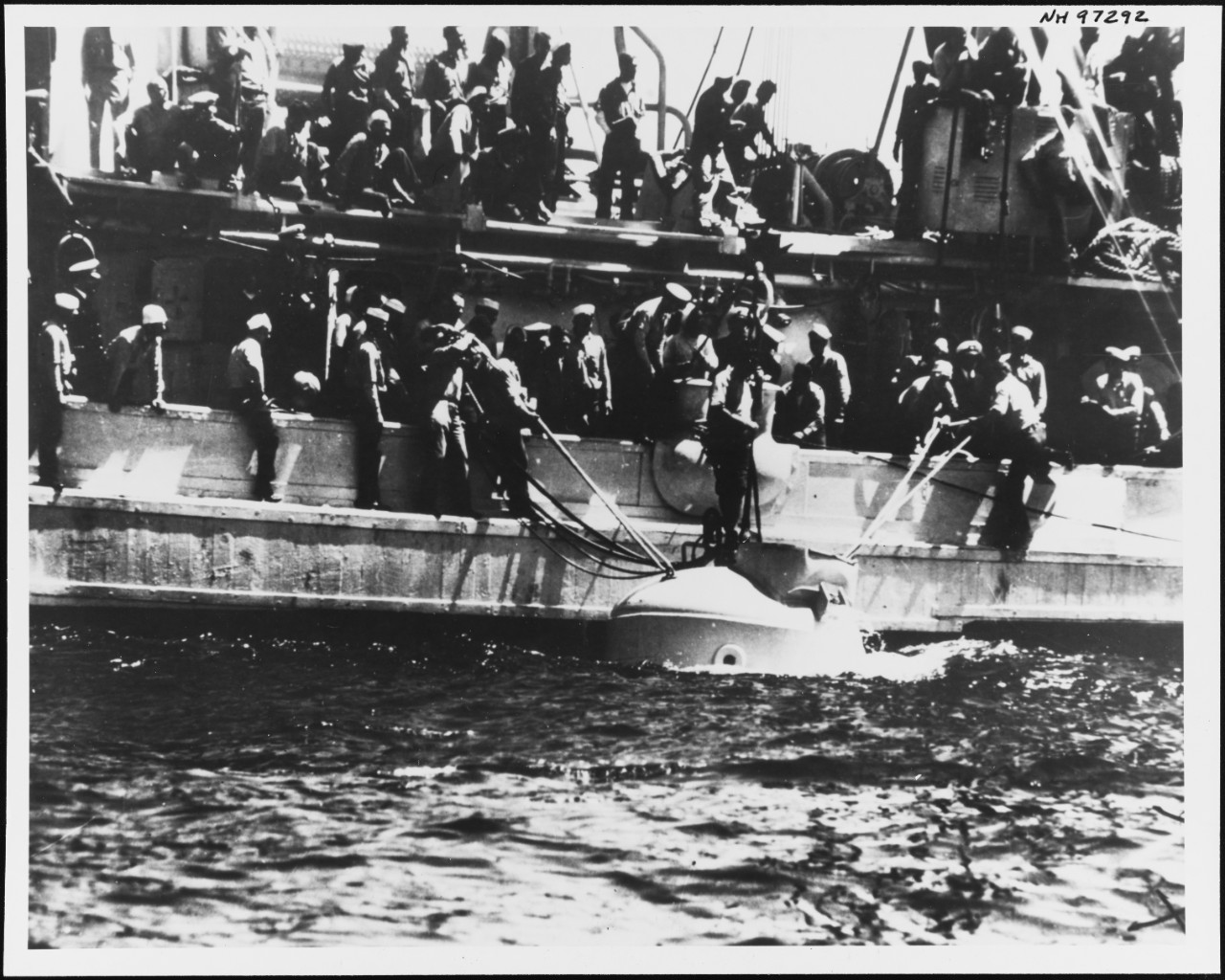
At 8:40 a.m. Eastern daylight time on 23 May 1939—7:40 by the standard-time clock used in some official summaries—the new submarine USS Squalus began a test dive off New Hampshire. At 12:25 a.m. on 25 May, a hatch opened aboard the rescue ship USS Falcon and the final eight survivors climbed out of a steel chamber. Between those two moments lay almost forty hours, four round trips to the seabed, and one rescue that nearly became a second disaster.[2][3]
The familiar version is an invention story: the McCann rescue chamber went down 243 feet and brought up 33 men. That is true, but it turns an operation into an object. The chamber could do nothing until searchers converted a smoke bomb into a position, a tug converted that position into a secured line, anchors held Falcon over the line, and a diver converted the submarine's deck into a clean docking surface. Even then, the device did not perform one rescue. It had to make the same pressure-tight transfer four times. On the fourth ascent, the machinery that made repetition possible failed.
This is therefore not a story of 59 people being saved. The main engine induction valve remained open as Squalus submerged, and seawater flooded the after compartments. Twenty-six people—24 Navy men and two civilian technicians—died there. A shut watertight door preserved the forward part of the boat, where 32 Navy personnel and one civilian remained alive. The later Court of Inquiry found the hydraulic control lever in its shut position but the engine-induction gear latched open; it attributed the sinking to mechanical failure rather than misconduct by the crew.[1] The rescue began only after the casualty had already divided the submarine into a flooded afterbody and a survivable forward refuge.
May 23: finding the submarine twice
When Squalus failed to send its expected surfacing report, Portsmouth Navy Yard sent her sister submarine USS Sculpin to search. The reported diving position was wrong by about 4¾ miles and lay nearly opposite the actual course. An alert lookout, not the plotted position, saved the search: Sculpin saw a smoke bomb fired from below and reached the marker buoy released by Squalus.[2]
The buoy contained a telephone. It produced roughly two minutes of direct conversation—enough to report the open induction line, flooded compartments, and survivors forward—before its cable parted. Sonar supplied another indication, but rescuers still needed a physical route to an invisible hull. The yard tug Penacook dragged the area with an anchor borrowed from Sculpin and at 7:30 p.m. caught what was believed to be the submarine. Hammer taps through the hull confirmed 33 people alive and cold. The same buoy line that marked the contact would guide the first diver the next morning.[2][5]
That distinction matters. Finding a point on the sea was not the same as finding the correct hatch on a 310-foot submarine. Nor was hovering nearby sufficient. Falcon, steaming from New London with the rescue chamber and trained divers, arrived at 4:25 a.m. on 24 May. Wind and sea complicated a four-point moor. Only after lines were shifted to bring the weather ahead could the ship settle above the contact. Divers briefly studied fittings on Sculpin so that the unseen deck below would at least be familiar by type.[2]
At 10:14 a.m., Boatswain's Mate Martin Sibitzky went over the side. Three minutes later he reported standing on Squalus, only six feet aft of the forward torpedo-room hatch. He attached the chamber's downhaul wire and cleared a loop of the broken marker-buoy cable from the hatch seat. The rescue report treats that second task as decisive: a cable across the circular seat could have fouled the chamber or prevented its rubber gasket from sealing. By 10:39, the vertical route was fastened to a usable door.[2][6]
A chamber is only useful when it can become a doorway
The McCann chamber was a nearly ten-ton pressure vessel designed after earlier submarine losses had exposed the limits of waiting for a wreck to be raised. Two operators occupied its upper compartment. Below them, an open-bottomed compartment held the downhaul reel and met the submarine's escape hatch. Ballast let the chamber descend; the wire pulled it onto the hatch seat; water could then be blown out of the lower space. Once pressure was reduced and the rubber gasket held a dry seal, operators secured the chamber to the submarine, moved the reel aside, and opened two hatches into the forward torpedo room.[4][6]
This arrangement avoided asking each survivor to flood an escape trunk, breathe from a personal apparatus, and make an individual ascent through cold water. It also created a demanding interface. The surface ship had to remain over the wreck. The guide wire had to stay clear. The gasket had to meet a clean seat. Ballast, pressure, bolts, hatches, and two cables then had to change state in the correct order—down, dock, dry, open, load, close, flood, release, rise.
The contemporary Falcon log records the four survivor loads as follows. Its times use Eastern daylight time, and its named lists establish the easily missed arithmetic: 7 + 9 + 9 + 8 = 33.[3]
| Trip | Chamber enters the water | Surface hatch opens | Survivors | What changed |
|---|---|---|---|---|
| 1 | 11:31 a.m. | 1:42 p.m. | 7 | First live docking; provisions delivered and the forward room ventilated |
| 2 | 1:52 p.m. | 4:11 p.m. | 9 | A clutch delay, then a complete transfer cycle |
| 3 | 4:25 p.m. | 6:27 p.m. | 9 | The fastest confirmation that the interface could be repeated |
| 4 | 6:41 p.m. | 12:25 a.m., May 25 | 8 | Drive and cable failures turned ascent into a second rescue |
Three repetitions made the extraordinary look procedural
On the first trip, the chamber reached the submarine at 12:12 p.m. It took another 35 minutes to establish contact with the men below. The operators tested the seal, fitted hold-down bolts, cleared the downhaul reel from the doorway, opened the hatches, passed down provisions and carbon-dioxide absorbent, and ventilated the torpedo room. Seven men entered. The chamber broke its seal at 1:13 and reached the surface twenty minutes later.[2][3]
The second and third trips carried nine men each. Their importance is easy to lose in a dramatic retelling because little went wrong. Yet uneventful repetition was the actual breakthrough. A device previously used only in training could locate the same hatch, make the same dry connection, transfer a heavier human load, and return without subjecting the survivors to sea pressure. By 6:27 p.m., 25 people were aboard Falcon. Eight remained below with commanding officer Oliver Naquin and diving officer William Doyle.[3][4]
Those first trips also moved more than passengers. Each opening refreshed some of the submarine's air. Each return gave the surface team direct evidence about conditions and confirmed the number still waiting. The chamber made the inaccessible compartment temporarily continuous with the rescue ship—not through one permanent tunnel, but through a doorway rebuilt three times.
The fourth ascent stopped at 155 feet
The last trip began its ascent at 8:14 p.m. with operators James McDonald and John Mihalowski plus the eight remaining survivors inside. At 8:22, the air motor driving the downhaul equipment stalled. The operators tried to continue on the brake, but around 155 feet the reel jammed. With the chamber unable to move safely up or down on its own system, controllers sent it back toward Squalus rather than force the wire.[3]
A diver reached the submarine at 9:15 and cut the downhaul cable seven minutes later. The chamber began rising on its separate retrieving wire. Then that wire stranded—most of its strength gone under an abnormal load—and the chamber was lowered to the bottom at about 232 feet. The system had shed the jammed guide but was now resting on the seabed with its final ten occupants attached to the surface by a damaged recovery line.[2][3]
The solution was deliberately poised between too heavy and too light. If the wire carried the chamber's full weight, its remaining strand could part. If the operators made the chamber strongly buoyant, it could accelerate upward without control and strike Falcon. The surface team instead ordered brief releases of ballast while sailors tested the retrieval wire by hand. At 12:04 a.m., three carefully timed blows—30 seconds, then 15, then 15—brought the chamber close enough to neutral buoyancy that the line no longer had to lift its full weight. The men above could guide rather than hoist it. At 12:23 the chamber surfaced; two minutes later its hatch opened.[2][3][6]
This improvisation did not replace the rescue chamber. It recovered the chamber's purpose after one part of its designed sequence had broken. Ballast became a load-control tool, the damaged cable became a guide, and human hands supplied feedback a powered reel could no longer provide. The final trip took more than five and a half hours. The first three had each taken a little over two.
May 25: one more descent, but no fifth rescue
All 33 known survivors were now above water, but the after torpedo room had never answered. Later on 25 May, Falcon was repositioned and the chamber made a fifth descent—not to collect another group, but to settle the remaining uncertainty. Because the after compartment might be flooded at full sea pressure, operators William Badders and Mihalowski had to pressurize the chamber before cracking the submarine hatch. Water entered from below, proving the compartment flooded. After a slow decompression ascent, the bell returned to Falcon at 9:07 p.m. Rescue operations were formally over.[2][3]
The distinction between four rescue trips and five chamber descents keeps both outcomes visible. The first four transferred every person who survived the initial flooding. The fifth confirmed that no hidden pocket of life had been left behind. Squalus was later raised, repaired, renamed USS Sailfish, and returned to service, but that salvage is a different operation with a different clock.[1][5]
The rescue's most useful historical shape is not a lone bell dropping heroically through black water. It is a chain of exact handoffs. A lookout corrected a bad position. A telephone established the condition below before its line failed. Dragging preserved contact. Anchors held a work platform over that contact. A diver turned a point on the hull into a clean hatch. The chamber turned the hatch into a repeatable passage. And when the fourth passage lost its machinery, the crew redistributed weight until a frayed wire could finish the job.
Technology mattered at every stage, but no device carried the entire causal burden. What saved 33 people was the ability to preserve just enough position, information, pressure, and control for the next action to begin.
Sources
- U.S. Navy Court of Inquiry, Findings on the Loss of USS Squalus (1939) — post-salvage examination, induction-valve operating gear, casualty finding, and determination of mechanical failure.
- Rear Admiral C. W. Cole, U.S. Navy, “USS Squalus (SS-192): Report of Rescue Operations” (28 May 1939), preserved from the Naval History and Heritage Command — search position, buoy contact, mooring, first diver, fourth-trip recovery, and fifth descent.
- USS Falcon, “Diving Log of Rescue Operations” (24–25 May 1939), preserved from the Naval History and Heritage Command — contemporaneous trip times, operators, depths, mechanical events, and named survivor loads.
- U.S. Naval Undersea Museum, “Saving Submariners: Submarine Rescue and Escape” — development and operating principle of the rescue chamber and its place between rescue and individual escape.
- U.S. Coast Guard Historian's Office, “The Long Blue Line: Coast Guard helps rescue U.S. submarine Squalus over 80 years ago!” (17 July 2023) — force mobilization, four-point mooring, Coast Guard support, survivor transfers, and aftermath.
- Lieutenant Commander Charles W. Shilling, “We Rescue the Men from the U.S.S. Squalus,” Duke Medical Center Archives — firsthand account of Falcon's mobilization, Sibitzky's dive, chamber operation, and the hand-controlled final ascent.
- U.S. Naval Historical Center, “USS Squalus (SS-192) — Rescue of Survivors, 23–25 May 1939,” photograph NH 97292 — catalog record for the official U.S. Navy image of the McCann rescue chamber beside USS Falcon used above.