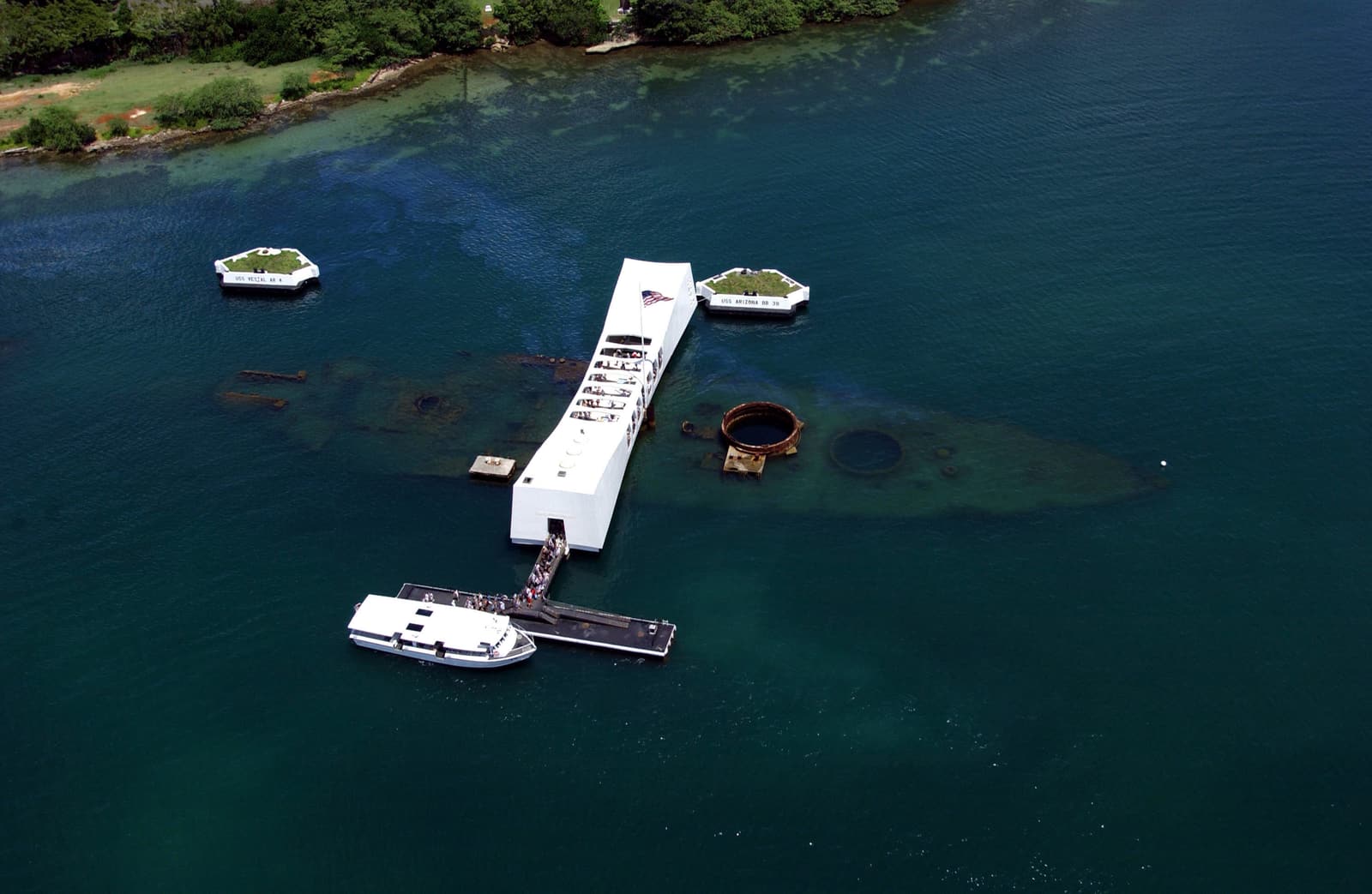
The USS Arizona Memorial is often described in one sentence: a monument over a sunken battleship. That is accurate, but historically incomplete.
What actually emerged at Pearl Harbor is a dual structure of memory: a military grave that remains physically present in the water, and a high-throughput civic ritual site that receives thousands of visitors per day. The tension between those two functions explains most of the memorial’s design and management choices.
Image context: The aerial hero photo makes the memorial’s dual geometry visible at a glance—the white span for public ritual crossing directly above the still-submerged hull that remains a war grave.
Timeline anchors: from wartime loss to memorial governance
- 1941-12-07 — USS Arizona is destroyed during the attack on Pearl Harbor; 1,177 crewmen are killed.[1]
- 1950 — Admiral Arthur Radford orders a flag to be flown above the wreck, creating the first durable ceremonial marker over the ship.[1]
- 1958-03-15 — Public Law 85-344 authorizes construction of a USS Arizona memorial and museum, gives the Navy authority to accept contributions, and sets a public-private funding pathway.[2]
- 1962 — The Alfred Preis-designed memorial is dedicated over the battleship hull.[1][3]
- 1980 — Operations transfer to the National Park Service (with Navy partnership), institutionalizing long-run visitor management and interpretation.[3][5]
- 2008-12-05 — Executive action creates the World War II Valor in the Pacific National Monument, widening the site’s interpretive frame.[3][8]
- 2019-03-12 / 2019-04 — Federal law establishes Pearl Harbor National Memorial as a National Park System unit and revises monument boundaries accordingly.[4][8]
This sequence matters because it shows commemoration as layered governance, not one-time construction.
Why the architecture still carries the argument
NPS descriptions preserve Alfred Preis’s intent: a form that “sags in the center” yet remains strong at the ends, staging loss and endurance in one line of structure.[1] The memorial’s three-room progression (entry, assembly, shrine) converts this architectural idea into a behavioral sequence: approach -> gather -> read names.
In other words, the building is not only symbolic. It scripts how collective memory is performed.
The operational reality: ritual at scale
Current NPS operations describe a site managed as a timed public ceremony: departures every 15 minutes, fixed vessel capacity, and daily visitor flow commonly in the 4,000–8,000 range.[5] These are logistics facts, but they are also memory facts.
A memorial that must handle this volume cannot rely on spontaneous mourning alone. It requires queue systems, reservation windows, and strict time blocks—administrative tools that make remembrance reproducible across generations.
The grave function never disappeared
NPS materials also maintain the opposite register: the wreck remains a resting place for more than 900 of the dead, and eligible survivors may be interred with former shipmates.[1][6] The interment protocol and named lists are not museum extras; they keep the site anchored to human remains, kinship, and military custom.[6]
That anchor is what prevents the memorial from collapsing into generic heritage tourism.
The core historical disagreement
Interpretation A: a successful national mourning institution
Under this reading, the memorial solved a difficult civic problem. It made a specific wartime loss legible to mass publics without erasing the dead as individuals. Evidence includes the name-wall shrine, persistent interment practice, and the legal continuity from 1958 through 2019 that kept commemorative purpose explicit.[1][2][4][6][8]
Interpretation B: ritual management that can smooth historical violence
A rival reading emphasizes throughput and choreography. Timed tickets, high-volume processing, and partner-site circulation can make the visit feel efficient enough to dilute the event’s brutality.[5] On this view, state-managed memory risks becoming a consumable itinerary.
Working assessment
The strongest evidence supports a mixed conclusion: the site’s legitimacy comes from maintaining both registers at once. Remove the grave register, and it becomes a tourist platform. Remove the operational register, and it cannot sustain intergenerational public memory at real-world scale.
What would materially change this assessment
- Archival evidence showing early planners treated the memorial primarily as a tourism engine, with casualty remembrance as secondary branding, would weaken the mixed-model interpretation.
- Long-run visitation evidence demonstrating substantial decline in commemorative understanding despite stable attendance would suggest operational scaling no longer preserves memory quality.
- Process records showing survivor-family and casualty-descendant input was structurally excluded from major redesign decisions would shift weight toward the “managed spectacle” critique.
Until such evidence dominates, Pearl Harbor is best read as a durable memory institution built from law, architecture, and operations—not as a static monument alone.
Sources
- U.S. National Park Service, “USS Arizona” (history, design, casualty counts, timeline)
- GovTrack / U.S. Statutes at Large text, Public Law 85-344 (H.R. 5809, approved March 15, 1958)
- U.S. National Park Service, “Description of the Memorial” (NPS timeline: 1958, 1962, 1980, 2008, 2019)
- GovTrack text, S.47 (116th Congress), Sec. 2206 “Pearl Harbor National Memorial, Hawai‘i” (establishment, purposes, boundary revision)
- U.S. National Park Service, “USS Arizona Memorial Programs” (daily operations, capacities, visitor flow)
- U.S. National Park Service, “USS Arizona Interments” (eligibility, process, interment list context)
- U.S. National Park Service, “Purpose of the Memorial” (mission framing and redesignation context)
- GovInfo, Proclamation 8327 (Dec. 5, 2008), Establishment of the World War II Valor in the Pacific National Monument (Stat. 122, p.5398)
- Wikimedia Commons image source — “USS Arizona Memorial (aerial view)” (U.S. Navy photo, 2002)