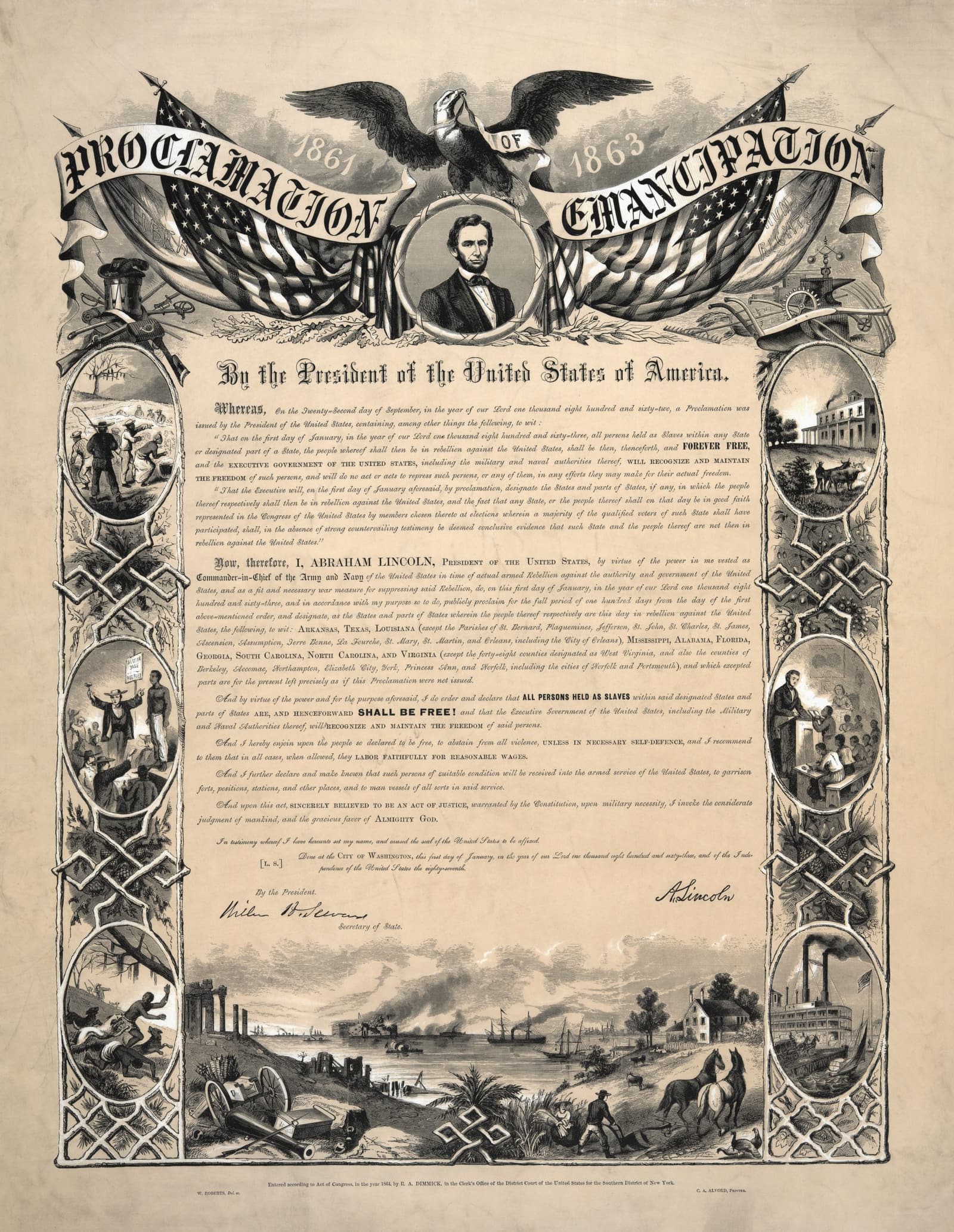
The Emancipation Proclamation is often remembered as a single moral sentence. As a historical document, it is sharper and more constrained than that memory suggests.
Read closely, Abraham Lincoln’s January 1, 1863 proclamation is a wartime legal instrument built on commander-in-chief authority, drafted to survive constitutional challenge during active rebellion. Its power came from the way it tied emancipation to military geography and Union enforcement, not from a universal peacetime abolition formula.[1][2][3]
Image context: The hero image is a Library of Congress restoration of the proclamation broadside, used here because this article centers on textual structure and legal wording in the original document itself.
Timeline anchors: how the text reached legal force
- 1862-09-22: Lincoln issues the preliminary proclamation after Antietam, signaling that enslaved people in still-rebellious areas would be declared free on January 1, 1863 unless those states returned to the Union.[1][8]
- 1863-01-01: The final Emancipation Proclamation is signed and issued as an executive war measure.[1][2][3]
- 1863 (through the year): The order begins changing Union military policy, including formal authorization to accept Black men into armed service.[2][5]
- 1865-12-18: The 13th Amendment is certified, ending legal slavery nationwide and converting wartime emancipation logic into constitutional abolition.[7]
This sequence matters: the proclamation was not the end of the legal story, but it changed the war’s operating rules and made nationwide abolition politically and legally harder to reverse.
Clause-by-clause: what the text says
The best-known sentence appears early in the operative section. Lincoln, in the official proclamation dated January 1, 1863, declares that “all persons held as slaves within said designated States, and parts of States, are, and henceforward shall be free.”[2][3]
Three details in the same sentence block are easy to miss but historically decisive:
- “designated States, and parts of States”: freedom is attached to rebellion geography, not to every U.S. jurisdiction at once.[2][3]
- Executive authority framing: Lincoln grounds the order in his authority as “Commander-in-Chief … in time of actual armed rebellion,” explicitly presenting emancipation as a military necessity measure.[2][3]
- Enforcement linkage: the text directs that the Executive government, including military and naval authorities, “will recognize and maintain the freedom” of those persons.[2][3]
That third element is crucial. The proclamation does not only announce; it assigns enforcement behavior to institutions that could move with armies.
What the proclamation did not do (inside the same document)
The proclamation itself lists jurisdictions excluded from its immediate emancipation operation, including specific Union-held or exempted areas and loyal slave states not in active rebellion designation.[2][3]
So the document is neither symbolic-only nor universal-at-once. It is a calibrated war order that frees where Union war authority claims operational reach over rebellion-defined territory.
This is why many historians treat the text as structurally dual: morally expansive in declared purpose, but legally narrow in immediate scope.[1][5][8]
Why Black enlistment language is not a side note
Later in the same proclamation, Lincoln states that persons of suitable condition “will be received into the armed service of the United States.”[2][3]
This clause does two things at once:
- It links emancipation to state capacity by turning formerly enslaved people into recognized participants in Union force structure.
- It alters the war’s political horizon by making Black military service part of national policy, not ad hoc local practice.[1][5]
In primary-source terms, this is not decorative wording. It is part of the document’s mechanism: emancipation + recognition + recruitment.
Two interpretations, and where the evidence points
Interpretation A: the proclamation was mostly symbolic until the 13th Amendment
Evidence for this view emphasizes limited immediate jurisdiction and uneven wartime enforceability. Because the order did not instantly free enslaved people in every legal jurisdiction, critics argue the truly decisive legal break came only with constitutional amendment in 1865.[2][7]
Interpretation B: the proclamation was a real legal-military pivot before 1865
Evidence for this view comes from the text’s own enforcement language, military-service authorization, and the way Union advance converted declaration into practical freedom across designated areas.[1][2][5][8]
Working assessment
The primary text supports a synthesis closer to Interpretation B with an important caveat: the proclamation was immediately operative as wartime law in designated rebellion geographies, but incomplete as a nationwide abolition regime. That incompleteness is exactly why the 13th Amendment followed as constitutional closure rather than legal redundancy.[2][7]
What would change this assessment
- Documentary evidence that top Union legal advisers treated the proclamation as non-enforceable rhetoric would weaken the legal-pivot reading.
- Operational records showing military authorities systematically refused “recognize and maintain” directives where federal control existed would shift weight toward symbolic-only interpretation.
- Constitutional evidence that a durable nationwide abolition path was fully secure without amendment would reduce the proclamation’s strategic distinctiveness.
Current primary and institutional records support the opposite conclusion: the proclamation reorganized wartime law and policy in 1863, then the amendment consolidated that shift into permanent constitutional order.[1][2][7]
Sources
- U.S. National Archives, Emancipation Proclamation (1863) (milestone context and document history)
- U.S. National Archives, Transcript of the Emancipation Proclamation (official text)
- Yale Law School, Avalon Project, The Emancipation Proclamation, January 1, 1863 (text facsimile/transcription)
- Library of Congress, printed broadside record, By the President of the United States. A Proclamation (item 98500145)
- Library of Congress Exhibition, African American Odyssey — The Emancipation Proclamation (wartime policy context)
- Miller Center, January 1, 1863: Emancipation Proclamation (presidential document context)
- U.S. National Archives, 13th Amendment to the U.S. Constitution: Abolition of Slavery (1865)
- History.com Editors, Emancipation Proclamation (publication sequence and reception overview)
- Wikimedia Commons image source, Emancipation Proclamation - LOC 04067 - restoration1.jpg