Rachel Carson is often remembered through a simplified civic myth: one book appears, a nation wakes up, policy flips. The documentary trail is slower and more instructive.
If we keep the lens tight—1962 to 1972, from Silent Spring serialization to the federal DDT cancellation order—Carson’s role becomes clearer: not solitary hero, not symbolic mascot, but a high-leverage translator who changed what counted as admissible public evidence in pesticide governance.
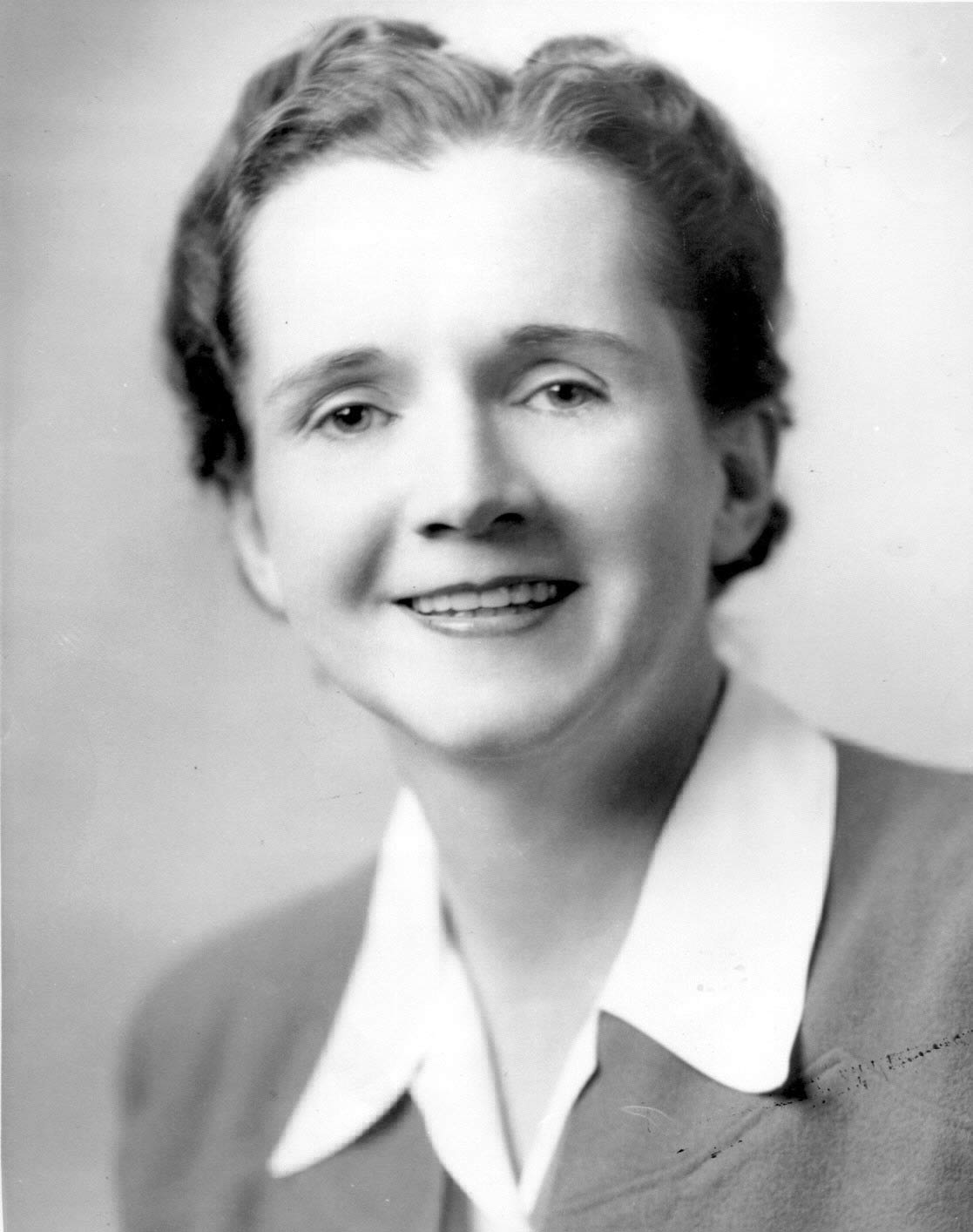
Image context: The hero portrait is a U.S. Fish and Wildlife Service photograph from Carson’s federal service period; it places this essay in her working-scientist identity, not only her later canonized author image.
Five timeline anchors (1962–1972)
- June 16, 1962 — The New Yorker begins publishing Silent Spring as a three-part series, moving pesticide risk out of specialist circles and into mass readership.[1][2][3]
- May 15, 1963 — President Kennedy releases the President’s Science Advisory Committee (PSAC) report Use of Pesticides, which validates major risk concerns and calls for stronger federal coordination.[4][5]
- June 4, 1963 — Carson testifies before a U.S. Senate subcommittee, framing contamination as a system-level governance problem rather than an isolated farm-chemical problem.[6]
- October 21, 1972 — President Nixon signs the Federal Environmental Pesticide Control Act amendments, tightening federal authority under the Federal Insecticide, Fungicide, and Rodenticide Act (FIFRA).[7]
- December 31, 1972 — EPA’s cancellation order takes effect for most U.S. DDT uses, while preserving specific public-health exceptions.[8][9]
These dates show a chain, not a moment: publication, scientific review, congressional framing, statutory redesign, and administrative enforcement.
The decision chain was not linear: three clocks running at once
A close read of 1962-1972 shows three institutional clocks that rarely moved together.
Clock 1: Public attention (weeks to months). The New Yorker serialization and the book release moved pesticide risk into household conversation and general media speed. This clock changed salience quickly, but salience alone cannot issue or enforce a rule.
Clock 2: Scientific arbitration (months to years). PSAC and related advisory work moved claims from rhetorical controversy to documented federal review. The central shift was not that every sentence in Carson’s text became official doctrine; it was that cumulative ecological risk became a legitimate object of national technical evaluation.
Clock 3: Legal-administrative conversion (years). Hearings, statutory amendments, and EPA cancellation process required procedural durability: records, standards, scope definitions, exceptions, and implementation dates. This was the slowest clock and the place where historical causal claims must be tested against documents, not memory culture.
Reading the decade through these clocks also explains why simplistic hero or anti-hero narratives keep returning. The public sees Clock 1 first because it is visible and dramatic. Regulators, historians, and affected communities live with Clock 3, where outcomes are delayed, contested, and expensive. The microhistory payoff is in connecting the clocks: Carson accelerated agenda formation, and institutional capacity determined whether that agenda survived long enough to become enforceable governance.
What Carson changed in the policy pipeline
1) She reframed pesticide harm as cumulative and cross-media
In her June 4, 1963 testimony, Carson told the Senate subcommittee that “the contamination of the environment with harmful substances is one of the major problems of modern life,” and argued pesticides must be evaluated within interacting exposures across water, soil, air, and bodies.[6]
That framing was operationally important. It pushed debate away from single-product efficacy and toward population-level risk, persistence, and long-tail uncertainty.
2) She forced scientific adjudication in the executive branch
The PSAC report did not copy Carson line by line, but it moved federal discussion onto the terrain she had opened: precaution, ecological effects, and governance coordination across agencies.[4][5]
This is where biography matters. Carson’s influence was strongest when her public argument entered institutions that could issue standards, budgets, and enforcement rules.
3) She changed political tempo, not just public sentiment
By the early 1970s, pesticide law and enforcement architecture were being rewritten: the 1972 amendments strengthened federal registration/cancellation power, and EPA formalized the DDT cancellation pathway with explicit carve-outs for disease-vector control.[7][8][9]
That sequence indicates a structural point: public attention alone rarely produces durable policy; administrative authority and legal language do.
The main historical disagreement
Interpretation A: Carson as principal causal driver
Under this reading, Silent Spring is the decisive break. Without Carson’s public intervention, the argument goes, DDT-era policy would have remained fragmented far longer.
Evidence for this view includes the immediate national controversy after serialization, Senate attention in 1963, and the way later official histories place Carson near the front of the environmental-policy narrative.[1][2][3][8][10]
Interpretation B: Carson as catalyst inside a broader institutional shift
This reading accepts Carson’s importance but treats her as one force among many: postwar toxicology growth, federal administrative expansion, litigation pressure, and changing statutory design.
Evidence here is the decade-long lag between publication and enforceable cancellation, plus the fact that legal outcomes depended on hearings, agency process, and statutory amendments rather than literary reception alone.[5][7][8][9]
Working synthesis
The strongest evidence currently supports a middle position: Carson accelerated and reorganized the policy agenda, but institutions converted that agenda into enforceable rule.
In other words, she moved the boundary of legitimate public risk claims; agencies and Congress moved the boundary of lawful pesticide practice.
What would materially change this assessment
- Archival executive records showing the 1963–1972 federal pathway was already locked before Silent Spring would weaken Carson-as-catalyst claims.
- Comparative cross-country evidence showing similar pesticide regulatory tightening in peer states without an equivalent public-intellectual shock would reduce estimated Carson-specific causal weight.
- New hearing/process evidence proving Carson’s framing had minimal uptake in committee drafting, PSAC language, or EPA reasoning would shift weight toward pure institutional drift.
Until that evidence dominates, the most defensible historical reading is sequential causality: narrative intervention -> scientific arbitration -> legal redesign -> administrative enforcement.
Why this microhistory still matters
Current technology-policy fights (AI safety, biosecurity, endocrine disruption, PFAS) often replay the same argument about timing: should regulation wait for complete certainty, or act under accumulating but incomplete evidence?
Carson’s decade suggests a practical answer from history: uncertainty does not remove governance responsibility; it changes the burden from prediction to reversible, monitorable rule design.
Sources
- Rachel Carson, “Silent Spring—Part 1,” The New Yorker (June 16, 1962)
- Rachel Carson, “Silent Spring—Part 2,” The New Yorker (June 23, 1962)
- Rachel Carson, “Silent Spring—Part 3,” The New Yorker (June 30, 1962)
- President’s Science Advisory Committee, Use of Pesticides (released May 15, 1963), scan copy (Cal Poly Pomona host)
- USGS publication catalog entry for PSAC report metadata/citation
- Rachel Carson, “Statement before Congress” (Senate subcommittee testimony, June 4, 1963), Archives of Women’s Political Communication
- Richard Nixon, “Statement on Signing the Federal Environmental Pesticide Control Act of 1972” (Oct 21, 1972), The American Presidency Project
- U.S. EPA history page, “DDT Ban Takes Effect” (archived EPA history)
- U.S. EPA, “DDT—A Brief History and Status”
- American Chemical Society, “Legacy of Rachel Carson’s Silent Spring” (National Historic Chemical Landmark)
- Wikimedia Commons image source — Rachel Carson portrait (USFWS)